
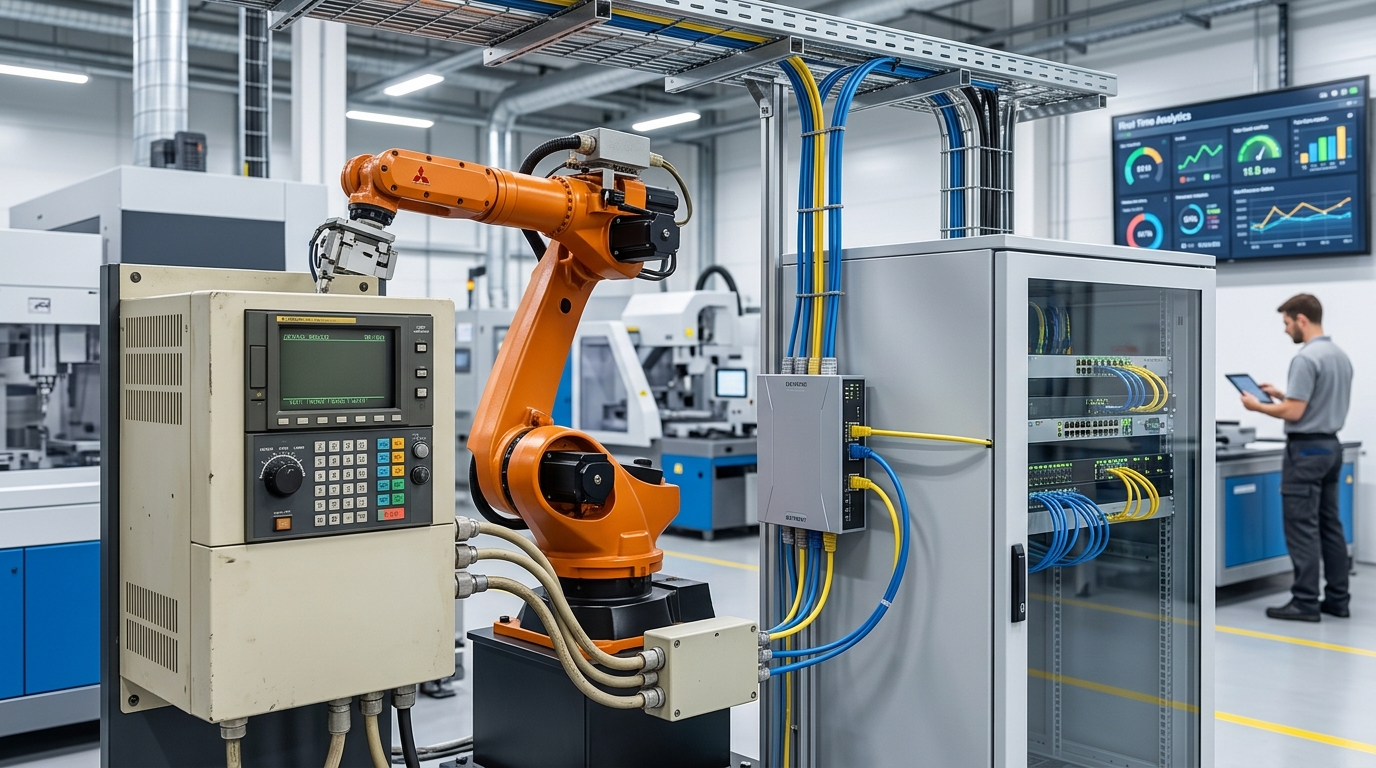
A robot that has run reliably for years does not necessarily need to be replaced because the plant wants better production data. In many cases, legacy robot connectivity can extend an existing robotic asset into a more connected production environment. The difficult question is not simply whether data can be extracted, but whether the connection can be implemented without creating an unsupported dependency that affects uptime.
An older robot controller was often selected for motion control and cell coordination, not for the data requirements of a modern manufacturing system. Plants may now want production status, alarms, cycle information, maintenance indicators, or data that can be combined with information from other equipment. The controller generation, available interfaces, software environment, cell architecture, and purpose of the data all influence whether that objective is practical.
The correct decision is therefore not based on the age of the robot alone. A mechanically useful robot may remain valuable while its controller requires a carefully designed interface between the cell and the plant’s newer data infrastructure.
What Actually Changes When a Legacy Robot Joins a Modern Data Architecture
A legacy robotic cell may have spent most of its operating life in a relatively contained environment. The robot communicated with equipment required to run production, such as a PLC, tooling, positioner, process equipment, or local operator interface. Plant-level visibility may have been limited or unnecessary.
Modern factory data projects change the boundary of that system. Information that once remained inside the cell may now need to reach supervisory, maintenance, production-management, or analytics systems. The robot becomes one data source within a larger manufacturing architecture.
This distinction matters because connecting a robot is not the same as modernizing its mechanical system. The arm can remain completely capable of its production task while the controller becomes the main constraint on connectivity.
The controller matters more than the age of the robot arm
Two robots of similar mechanical age can present very different integration situations because they use different controller generations, communication hardware, software options, or existing cell architectures. The model of the robot arm alone does not establish what information can be exchanged or how it should be exchanged.
Before planning the connection, identify the exact controller, installed software, existing communication interfaces, current PLC relationship, and any dependencies already supporting production. This is the same compatibility principle that matters when assessing refurbished robot compatibility with existing systems.
That assessment should happen before a plant selects dashboards, analytics software, or higher-level data platforms. Otherwise, the desired software architecture may be designed around information the existing cell cannot reliably provide.
Data access and machine control are different requirements.
A plant that wants visibility into whether a robot is running, stopped, or generating an alarm has a different integration requirement from a plant that wants another system to send commands or modify production behavior. Those objectives should not be treated as equivalent.
The first question should be what information the business actually needs. The second is where that information already exists. In some cells, the required production state may already be available through another part of the automation architecture rather than requiring extensive changes to the robot controller itself.
Choosing the least disruptive source that supplies useful information can reduce integration complexity. It can also avoid turning a stable production asset into a dependency for a data project that does not directly improve the robot’s core task.
Modern Factory Data Does Not Have to Come Directly From the Robot
One of the most important assumptions to challenge is that every piece of production information must be extracted directly from the robot controller. A robotic cell is a system, and useful information can exist at several points in that system.
The PLC, process equipment, sensors, operator interface, or an intermediate data layer may already know whether the cell is producing, waiting, faulted, or blocked. The appropriate architecture depends on what the plant wants to measure and which system owns the relevant state.
An intermediate layer can separate old and new systems
Where direct communication between a legacy controller and a modern factory platform is impractical, an intermediate integration layer may be considered. Its purpose is not to make the old controller behave like a current platform. Its purpose is to translate or expose the required information while keeping the production architecture controlled.
The exact implementation depends on the controller and the existing automation system. No single gateway, protocol, or software approach should be assumed to work across legacy robots from different manufacturers and controller generations.
This is why connectivity needs to be treated as an integration project rather than a software installation. URT’s discussion of important factors when integrating a robot provides useful context: controller communication is only one dependency inside the wider cell.
Start with the required information, not the available technology
Plants can easily collect data simply because an interface makes the data accessible. That reverses the correct engineering sequence.
Define the operational question first. Maintenance may need to understand recurring stoppages. Production may need reliable cell-state information. Management may want to compare utilization patterns across equipment.
Once the decision that the data must support is clear, determine which variables are necessary and where they can be obtained reliably. A smaller set of dependable production signals can be more useful than a large volume of poorly contextualized controller data.
Where Connecting an Older Robot Can Create Real Production Value
Connectivity is justified when it helps people make better production or maintenance decisions. Simply showing robot information on another screen is not, by itself, a strong modernization case.
Downtime visibility
A connected cell can be more useful when production teams need clearer information about when the system stops and what was happening around the event. The important distinction is between detecting a stop and diagnosing its cause.
A robot alarm does not necessarily mean the robot itself caused the production loss. The cell may have stopped because of tooling, material presentation, process equipment, upstream flow, downstream equipment, or another interlock. Data architecture should preserve enough context to make those distinctions useful.
Plants evaluating this objective should connect the data project to their existing approach for minimising downtime in robotic automation rather than treating connectivity as a separate IT initiative.
Maintenance information
Data can also support maintenance decisions when the available signals have a defined relationship with equipment condition or recurring production events. However, collecting controller data does not automatically create predictive maintenance.
Useful condition-based decisions require suitable data, context, consistent collection, and people or systems capable of interpreting what the information means. The plant also needs a response process. An alert that nobody owns has little operational value.
The distinction between collecting data and acting on it is explored further in URT’s guide to predictive maintenance using robot sensors and data.
Production coordination
Connectivity can also support coordination when the robotic cell is one part of a larger automated line. Understanding whether the robot is producing, waiting, blocked, or unavailable can help operations teams interpret losses across interconnected equipment.
The value comes from context. A robot waiting for parts should not necessarily be evaluated in the same way as a robot unavailable because of a cell fault. Factory-level systems need sufficiently clear states to avoid turning raw data into misleading performance conclusions.
Where the Connected Factory Argument Becomes Overhyped
More connectivity does not automatically mean a more capable factory. A legacy robot should not be connected merely because the technology exists to connect it.
A useful modernization project has a defined operational outcome. If the plant cannot explain what decision will change because the data becomes available, the project may add architecture, software, support requirements, and failure modes without producing equivalent manufacturing value.
Connectivity does not fix an unstable process
A data platform can make process instability more visible, but it does not remove the instability. Poor part presentation, unreliable tooling, inconsistent fixtures, recurring process faults, or weak maintenance practices remain production problems after the robot is connected.
The additional information may help identify those problems, which can be valuable. It should not be confused with solving them.
A dashboard is not an improvement unless someone acts on it
Factories sometimes approach data projects by asking what can be displayed rather than what must be controlled. This can produce dashboards containing dozens of values without clear ownership or response rules.
For each important metric or event, define who uses it, what decision it supports, and what happens when the value moves outside the expected condition. If those questions cannot be answered, collecting the data may not yet be justified.
Age alone is not a reason to replace a robot
An older robot should not automatically be rejected because a newer platform offers easier connectivity. Replacement should be considered in the context of mechanical condition, controller support, spare parts, integration requirements, production needs, maintenance capability, and total project risk.
Equally, retaining an old controller indefinitely is not automatically economical. If extracting basic information requires extensive custom engineering, unsupported software, or fragile communication dependencies, a controller or equipment modernization decision may become more defensible.
The Main Integration Risks Are Compatibility, Support and Failure Recovery
The technical challenge is not finished when two systems successfully exchange information during a test. Production teams need to understand what happens after the connection is commissioned and what happens when part of it fails.
Compatibility must be verified at controller level
Do not assume a communication method is available because another robot from the same manufacturer supports it. Controller generations, installed options, software versions, and cell configurations can differ.
The exact system should be documented before the architecture is finalized. Where manufacturer documentation or specialist support is required, verification should happen before the plant commits to the higher-level data design.
Support ownership can cross departmental boundaries
A conventional robotic fault may be owned by maintenance or automation engineering. A connected cell can introduce switches, servers, gateways, databases, industrial networking, software services, or other infrastructure involving additional teams.
This creates an ownership question. If robot production data disappears, who determines whether the problem is the controller, PLC, network, intermediate interface, or factory data platform?
Responsibility should be defined before commissioning. A capable industrial automation systems integrator can also help establish these boundaries when the project crosses several automation layers.
Communication failure needs a defined production response
A data connection should be evaluated partly by what happens when it becomes unavailable. If the data platform stops communicating, does production continue normally, does visibility disappear while the cell keeps running, or does the failure interfere with the production sequence?
Those are materially different risk profiles. Where possible, monitoring requirements and production-control dependencies should be distinguished clearly during architecture design.
The plant should also know how the system is backed up, how communication is restored, who has access to configuration, and how the cell is returned to its normal operating state after an infrastructure problem.
Connectivity Also Changes the Cybersecurity Boundary
An older controller operating inside a contained cell exists in a different environment once it communicates with a wider production network. The mechanical robot may be unchanged, but the systems capable of exchanging information with the cell have changed.
This does not mean a legacy robot should never be networked. It means network architecture, access, software support, and communication paths become part of the production-risk assessment.
Internal connectivity still matters
A robot does not have to communicate directly with the public internet for connectivity to change the risk profile. Internal factory connections can link the cell indirectly to engineering workstations, other automation equipment, monitoring platforms, and systems maintained by different teams.
The practical requirement is to understand the communication path rather than assume that an internal connection is inherently isolated. Plants should document which systems exchange information with the cell and which users or services require access.
Do not add communication paths without an operational reason
Every additional dependency should have a purpose. If a connection is not required for production, maintenance, diagnostics, or another defined operational objective, its value should be questioned.
Legacy equipment makes this discipline particularly important because older controller and software environments may have support constraints that were acceptable when the system was isolated but become more significant when connectivity expands.
What to Verify Before Connecting a Legacy Robot
Use this checklist to determine whether the project has been defined well enough to move from a connectivity idea into detailed engineering. The objective is not to select a particular technology, but to expose missing information before production becomes dependent on the new architecture.
- Identify the exact controller and software environment. Do not plan from the robot arm model alone.
- Define the business reason for the connection. State what production, maintenance, or operational decision the data must support.
- List the required data. Separate essential information from values that are merely available.
- Determine where the data already exists. Check the robot, PLC, process equipment, sensors, and existing cell systems.
- Map the communication path. Document the systems between the robotic cell and the final data consumer.
- Verify compatibility. Confirm that the required interfaces, software, and support exist for the actual controller configuration.
- Define access and ownership. Establish which teams maintain each part of the connected architecture.
- Plan for communication failure. Determine whether production can continue safely and predictably if the data connection is unavailable.
- Define backup and recovery responsibility. Know which configurations must be protected and who restores them.
- Test the complete architecture before relying on the data. Verify behavior during normal operation, stoppages, restarts, and relevant communication failures.
When a Legacy Robot Should Not Be Connected Yet
Connection should be delayed when the plant does not know the exact controller configuration, cannot identify who will support the interface, or has not defined what information is actually required. Adding technology before resolving those questions tends to move uncertainty into the production system.
The project should also be reconsidered when the desired data depends on extensive unsupported modifications to a controller that is otherwise operating reliably. In that situation, another source in the cell, an intermediate architecture, partial modernization, or eventual replacement may present a better risk balance.
Finally, do not make a data project responsible for correcting broader operational weaknesses. If the real problem is unreliable tooling, process variation, inadequate maintenance, poor recovery procedures, or unstable upstream flow, address those conditions directly. Connectivity can expose a production problem, but it cannot substitute for fixing it.
FAQ
Can old industrial robots connect to modern factory data systems?
Potentially, yes. Feasibility depends heavily on the robot controller, installed software, communication interfaces, existing PLC architecture, and the data the plant wants to obtain. The robot’s mechanical age alone does not answer the question. The exact controller environment should be assessed before selecting the integration approach.
Does a legacy robot need to communicate directly with the factory data platform?
No. The required information may already exist in a PLC, process system, sensor, or another part of the robotic cell. In other cases, an intermediate integration layer may be appropriate. The architecture should be selected according to the required information and production risk rather than assuming direct controller connectivity is necessary.
What data is worth collecting from an older robot?
Collect data that supports a defined production or maintenance decision. Cell state, stoppage information, alarms, or selected maintenance-related information can be useful when the plant knows how the information will be interpreted and acted upon. Collecting every accessible value without a clear operational purpose can increase complexity without improving production decisions.
Can connecting a legacy robot improve predictive maintenance?
Connectivity can provide data that contributes to a maintenance strategy, but connectivity alone does not create predictive maintenance. The plant needs relevant signals, reliable collection, sufficient context, an interpretation method, and a defined response when the information indicates a developing issue.
Should a robot be replaced if its controller cannot easily provide modern data?
Not automatically. Replacement should be evaluated against mechanical condition, production suitability, controller support, spare parts, modernization cost, integration complexity, downtime risk, and the actual value of the required data. In some cases, an alternative data source or intermediate architecture can preserve a useful robotic asset. In others, modernization or replacement may provide a cleaner long-term solution.
What is the biggest mistake when connecting older robots?
A common mistake is starting with the technology instead of the operational requirement. Plants should first define what information they need, why they need it, where that information exists, and what should happen if the connection fails. Only then should the communication architecture be selected.
Talk to URT About Legacy Robot Connectivity
If you are evaluating legacy robot connectivity, contact URT. We will give you a direct, technical answer based on your actual production requirements.