
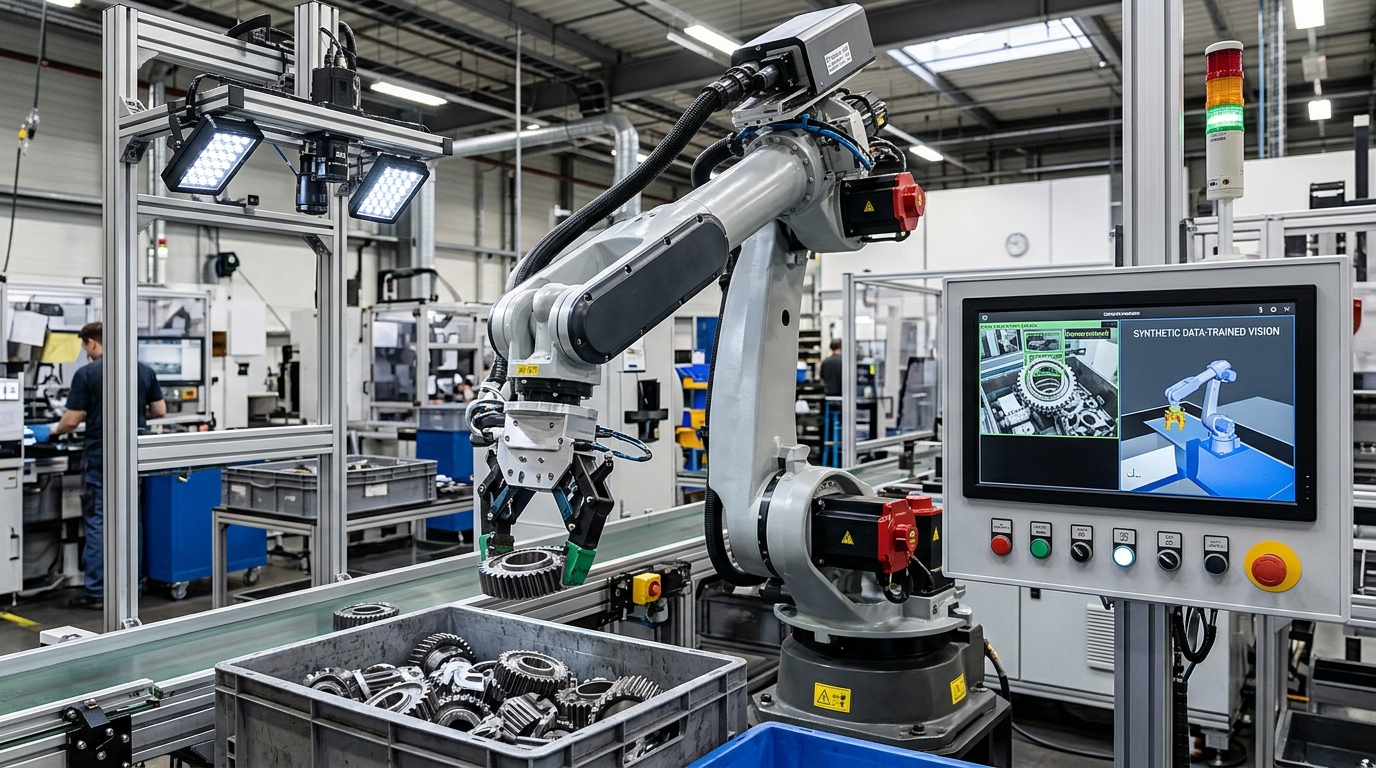
A robot vision project can fail even when the camera, lighting, and robot hardware meet their technical requirements. The problem often appears in the training data: the vision model recognizes parts under controlled conditions but struggles with reflections, changing orientations, damaged surfaces, or unfamiliar backgrounds. Synthetic data for robot vision offers manufacturers another way to prepare vision systems for these variations without collecting every training image from a physical production line.
The attraction is practical. Engineers can generate simulated images, adjust production conditions digitally, and create labeled training examples before the complete robotic cell becomes available. However, synthetic images do not automatically represent the visual complexity of a real factory, and a model that performs well in simulation may still fail during production.
Manufacturers therefore need to evaluate synthetic data as part of a broader vision integration strategy. The important question is whether simulated training improves recognition under actual operating conditions enough to justify the additional engineering, validation, and maintenance work.
Why manufacturers are considering synthetic data for robot vision
Traditional machine vision development often requires engineers to collect images from physical cameras, label relevant objects, and train recognition models using examples captured under real operating conditions. This approach provides direct evidence of the production environment, but image collection becomes difficult when equipment is unavailable, product variants are numerous, or certain defects rarely occur.
Consider a robotic picking application that handles components arriving in different orientations. Engineers may collect many images of correctly presented parts while obtaining relatively few examples of overlapping components, unusual reflections, or partially hidden surfaces. The resulting training dataset may represent normal operation without adequately covering the conditions that cause recognition failures.
Synthetic data addresses part of this problem by generating images from digital models and simulated environments. Engineers can vary object positions, camera perspectives, lighting conditions, surface appearances, and backgrounds while maintaining control over the information associated with each image.
Generating training examples without physical production
A simulation environment can render a digital component from different viewpoints and place it in a virtual work area. Engineers can change the orientation, position, and surrounding objects to produce examples that would otherwise require repeated physical setup changes.
This capability becomes useful when manufacturers develop a new production cell and cannot yet collect images from the final installation. A digital representation of the intended process can support early model development while mechanical design and equipment integration continue.
However, simulation does not eliminate the need for physical testing. Engineers must eventually confirm that the trained model handles the actual camera images, optical conditions, and production variations.
Reducing manual annotation work
Real-image datasets often require manual annotation. Depending on the application, engineers may need to identify objects, draw bounding boxes, classify defects, or mark segmentation boundaries.
Simulation can generate annotations automatically because the software already knows the positions, identities, and geometries of the virtual objects. This can reduce repetitive labeling work, especially when the application requires large numbers of precisely annotated examples.
The benefit depends on annotation quality and simulation accuracy. Automatically generated labels are useful only when the rendered images and labels correctly represent the intended recognition task.
How synthetic images support industrial robot vision applications
Synthetic images are most useful when engineers can describe the relevant visual conditions and reproduce them digitally. Their value changes according to the task, the production environment, and the consequences of recognition errors.
Robotic picking and material handling
In robotic picking applications, the vision system may need to identify a component, estimate its position, and determine its orientation before the robot approaches it. Synthetic datasets can expose the recognition model to different object arrangements, rotations, and partial occlusions.
This approach can support bin picking, machine loading, and component sorting when engineers have suitable digital models of the objects. It becomes less predictable when the parts deform, overlap in complex ways, or interact with materials that are difficult to simulate accurately.
The vision model also represents only one part of the application. Gripper design, collision avoidance, robot reach, part presentation, and cycle-time requirements determine whether the complete system performs reliably.
Manufacturers considering these applications should also evaluate whether processes with variable parts are suitable for robotic automation before investing in more complex perception systems.
Automated visual inspection
Quality inspection presents another potential application. Manufacturers may have enough images of acceptable components but limited examples of scratches, missing features, surface damage, or unusual assembly defects.
Engineers can use simulation to generate examples of selected defect types and investigate whether additional training data improves detection. This approach may be useful when collecting real defective components would require long production periods or deliberate creation of scrap.
However, defect appearance can depend on material texture, illumination, camera resolution, and surface geometry. A simulated scratch that looks convincing on a computer screen may not reproduce the optical characteristics of a real defect.
For this reason, synthetic defect images should supplement rather than replace real inspection samples. Manufacturers must validate detection performance using actual components, including difficult acceptable parts that could trigger false rejection.
The broader integration requirements are covered in URT’s guide to automated quality control with machine vision and robots.
Assembly verification and component recognition
Assembly applications may require the vision system to identify component types, confirm orientation, or detect missing elements before the next production step.
Synthetic images can help engineers generate examples of different component arrangements and assembly states. They may also support early development when physical prototypes remain limited.
The approach becomes more difficult when the recognition task depends on subtle differences between similar components or small features near the camera’s resolution limit. In those cases, engineers must verify whether the simulation reproduces enough visual detail for reliable classification.
Why the simulation-to-reality gap remains the main technical risk
The central limitation of synthetic data is the difference between simulated images and real camera images. Engineers commonly describe this as the simulation-to-reality gap, or sim-to-real gap.
A simulated image may reproduce the geometry of a component while failing to represent its actual surface response, environmental lighting, sensor noise, or optical distortion. A vision model can learn patterns that work consistently in the simulation but do not transfer to the physical cell.
Lighting and reflective surfaces
Industrial environments rarely provide perfectly uniform illumination. Metallic components can create reflections, shadows, and highlights that change with their orientation and the surrounding equipment.
Simulation tools can reproduce lighting variations, but accurate rendering requires suitable material properties, lighting models, and camera configuration. If engineers simplify these elements too aggressively, the synthetic dataset may fail to represent the most difficult production conditions.
This risk becomes particularly relevant in metalworking, automotive manufacturing, and inspection of polished components.
Camera characteristics and image quality
The physical camera introduces additional variables. Lens distortion, focus, exposure, sensor noise, motion blur, and image processing can affect what the recognition model receives.
A simulation that generates visually clean images may create unrealistic expectations. Engineers should reproduce relevant camera characteristics where possible and compare synthetic outputs with real images from the intended hardware.
Camera calibration also matters when the application requires positional information. Even accurate object recognition cannot compensate for incorrect transformations between camera coordinates, robot coordinates, and the physical workpiece.
Material variation and unexpected conditions
Real production components may contain oil, dust, scratches, manufacturing marks, or surface variations that do not appear in the original digital model.
Engineers can introduce some of these conditions into simulation, but they must identify which variations matter. Randomly adding visual complexity does not guarantee that the model will handle the actual sources of variation.
The goal is not to produce the largest possible synthetic dataset. It is to generate examples that improve recognition of the conditions the system will encounter in production.
How engineers can make synthetic training data more representative
Manufacturers can reduce some simulation limitations through structured dataset design. Two approaches are particularly relevant: domain randomization and domain adaptation.
Domain randomization
Domain randomization changes selected properties of the simulated environment across training images. Engineers may vary lighting, backgrounds, object positions, surface appearance, and camera parameters within defined ranges.
The objective is to prevent the model from depending too heavily on a narrow visual presentation. Instead, the model encounters multiple representations of the same underlying object or task.
However, engineers must select variations carefully. Unrealistic combinations can consume training resources without improving performance, while excessively broad variation may make it harder for the model to learn relevant distinctions.
A useful starting point is to identify the real operating conditions that cause recognition errors and prioritize those variations in the synthetic dataset.
Domain adaptation and real-image refinement
Domain adaptation uses techniques intended to reduce differences between synthetic and real data. Depending on the method, engineers may adjust image representations, model features, or training procedures to improve performance on physical camera images.
Manufacturers can also combine synthetic training examples with a smaller collection of real production images. This hybrid approach allows simulation to provide broad variation while real images help the model account for the specific equipment and environment.
The amount of real data required depends on the application and cannot be determined from simulation quality alone. Engineers must establish this requirement through testing.
Validation with production-representative images
Every synthetic-data project needs an independent real-image validation dataset. Engineers should capture examples that represent normal operation, difficult conditions, product changes, and relevant failure scenarios.
They should keep these validation images separate from the training data. Otherwise, performance measurements may overstate the model’s ability to recognize unfamiliar production examples.
Validation must also reflect the consequences of different errors. A false rejection in quality inspection creates different operational costs from a missed defect or an incorrect pick position.
Where synthetic data for robot vision can improve project economics
The business case for synthetic data depends on whether it reduces development effort or improves production performance enough to offset simulation costs. Generating images digitally does not make the overall project inexpensive by default.
Manufacturers must account for digital asset preparation, simulation software, engineering time, model training, real-image validation, integration, and ongoing dataset maintenance.
Development before equipment availability
One potential advantage is the ability to begin vision development before the complete physical cell exists. Engineers may use available CAD models and a planned camera arrangement to generate initial training examples.
This can reduce schedule dependencies when the vision model would otherwise wait for mechanical installation. The value becomes measurable if early development shortens commissioning work or identifies recognition limitations before the production line is ready.
However, the benefit disappears if the virtual environment differs substantially from the final cell and engineers must repeat most of the development work.
Training across multiple product variants
Manufacturers with frequent product changes may need to update recognition models as new component geometries enter production.
When accurate digital models already exist, simulation can support dataset generation for additional variants without requiring extensive physical image collection for every configuration.
This advantage depends on the degree of similarity between variants and the accuracy of their digital representations. New materials, different optical properties, or changes in the handling process may still require significant physical validation.
Comparing development cost with production value
Managers should compare the total cost of synthetic-data development against a conventional real-image approach. The comparison should include engineering effort, labeling time, commissioning duration, model maintenance, and the operational consequences of recognition errors.
Useful performance indicators include recognition accuracy under defined conditions, false acceptance and rejection rates, successful pick rate, cycle time, manual intervention frequency, and downtime attributable to vision failures.
The project should not claim ROI simply because engineers generate more training images. Value appears when the resulting system reduces measurable production costs, improves acceptable output, or lowers implementation effort.
These measures should fit the wider framework for evaluating robotic automation KPIs after implementation.
When manufacturers should not invest in synthetic data yet
Synthetic data is not appropriate for every robot vision application. In some cases, conventional machine vision methods or real-image training provide a simpler and more defensible solution.
Stable applications with limited visual variation
A production process that presents the same component in a controlled position under fixed lighting may not need a complex synthetic-data pipeline.
Traditional image processing, geometric measurement, or a relatively small real-image dataset may provide adequate performance. Adding simulation would increase engineering complexity without necessarily improving production results.
Applications without accurate digital representations
Simulation becomes more difficult when manufacturers lack suitable CAD models or reliable information about material appearance.
Creating digital assets may require substantial engineering work, especially for irregular, deformable, or highly reflective objects. If engineers cannot reproduce the visual characteristics relevant to recognition, the synthetic dataset may have limited value.
Processes that lack stable physical conditions
Synthetic training cannot correct unstable part feeding, inconsistent fixturing, poor camera mounting, or uncontrolled lighting.
A vision model may recognize a component correctly while the robot still fails to handle it because the gripper cannot reach the required position or the component moves unexpectedly.
Manufacturers should address these physical constraints before assuming that additional training data will solve the problem.
Applications with demanding validation requirements
Some inspection and handling tasks require particularly strong evidence that the system will recognize critical conditions consistently.
In these applications, synthetic data may support development, but it cannot replace representative physical testing and appropriate validation procedures. Engineers must establish acceptance criteria that reflect the actual consequences of recognition failure.
What manufacturers should verify before implementing synthetic vision training.
Before approving a synthetic-data project, engineering and operations teams should use a structured evaluation. The following checks help distinguish a practical training strategy from a simulation exercise that lacks a clear production benefit.
- Define the recognition task: Specify whether the system must classify components, detect defects, estimate position, or support robot guidance.
- Identify current data limitations: Determine which production conditions are missing from the available image dataset.
- Assess digital asset quality: Confirm that the available geometry and material information represent the intended objects adequately.
- Document camera conditions: Record relevant lighting, optics, exposure, mounting, and calibration requirements.
- Select meaningful simulation variations: Prioritize conditions that affect actual recognition performance.
- Plan real-image validation: Establish a separate dataset captured from representative production hardware.
- Define acceptance criteria: Set measurable limits for recognition errors, intervention frequency, and application performance.
- Evaluate integration requirements: Confirm that the vision output supports the robot controller, coordinate transformations, cycle time, and recovery logic.
- Assign ongoing responsibility: Identify who will maintain datasets and retrain or validate models when products or production conditions change.
- Calculate total project cost: Include simulation development, training infrastructure, integration, validation, and long-term support.
Integration deserves particular attention because a successful recognition model does not automatically produce a successful robotic cell. The system must communicate usable results to the robot, handle uncertain predictions, and recover safely when recognition fails.
Manufacturers should consider these dependencies alongside the main technical factors involved in integrating a new industrial robot.
For a plant introducing AI-based vision for the first time, a limited pilot application may offer a more manageable evaluation than immediate deployment across several production lines. The pilot should compare synthetic-data training against an appropriate real-data baseline and measure performance on the same physical test conditions.
The decision to expand should follow verified production results, not simulated accuracy alone.
FAQ
What is synthetic data for robot vision?
Synthetic data consists of artificially generated training examples that represent objects or environments relevant to a robot vision task. Engineers commonly create these images through simulation or rendering software and use them to train or evaluate recognition models.
Can synthetic images replace real production images completely?
Some applications may achieve useful performance with predominantly synthetic training data, but manufacturers should not assume that simulation eliminates the need for real images. Physical validation remains necessary to confirm that the vision model performs under actual camera and production conditions.
Which robotic applications benefit most from synthetic data?
Potential applications include robotic picking, component recognition, assembly verification, and visual inspection. The strongest candidates often involve limited access to real training images, many controlled variations, or a need to begin development before physical equipment becomes available.
Does synthetic data improve robot accuracy?
Synthetic data may improve visual recognition or pose estimation when it adds relevant training examples. It does not directly improve the robot’s mechanical accuracy, calibration, gripping capability, or positioning performance. Engineers must evaluate the complete robotic system separately.
Is synthetic data cheaper than collecting real images?
It can reduce physical image collection and annotation work, but simulation introduces other costs. Manufacturers need to compare digital modeling, rendering, training, validation, and maintenance expenses against the conventional development process before determining which approach costs less.
What causes the simulation-to-reality gap?
The gap arises when simulated images differ from real images in ways that affect model performance. Lighting, material appearance, sensor characteristics, optical distortion, object variation, and environmental conditions can all contribute to these differences.
Can manufacturers use synthetic data with existing industrial robots?
Yes, provided the vision system and robot controller can exchange the information required by the application. Compatibility depends on the camera system, processing architecture, controller interfaces, coordinate calibration, and integration software rather than the synthetic dataset alone.
How should manufacturers measure the success of synthetic-data training?
They should compare performance against a suitable baseline using independent real production images and, where appropriate, physical cell trials. Relevant measures include recognition errors, successful picks, inspection decisions, cycle time, intervention frequency, and the engineering effort required to achieve acceptable performance.
Talk to URT about synthetic data for robot vision
If you are evaluating synthetic data for robot vision, contact URT. We will give you a direct, technical answer based on your actual production requirements.