
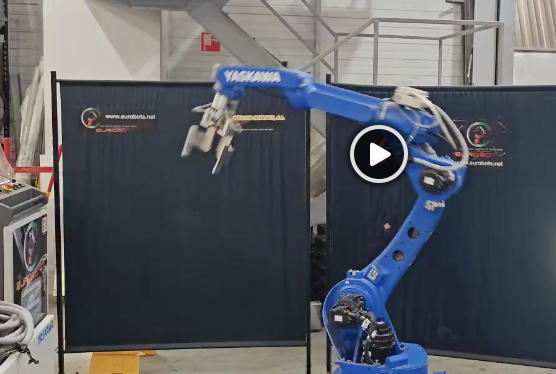
Motoman MH24-10 welding applications are possible — but the robot needs to be understood correctly before it is specified for a welding cell. That is the first thing any engineer evaluating it for a welding application needs to understand — and it is the starting point for an honest assessment of where this robot delivers value and where its limitations begin.
Yaskawa builds purpose-built arc welding robots — the MA series and the AR series — specifically optimized for welding: hollow wrist cable management, torch-compatible motion profiles, and welding-specific software integration. The MH24-10 is a high-speed general-purpose material handling robot. It can be integrated into a welding cell, and it has been. But the configuration, the cell design, and the application selection need to reflect what the robot actually is rather than what a dedicated welding platform would be.
This article covers the MH24-10’s verified technical specifications, where it works for welding applications, where it does not, and how to design a cell around it for companies taking their first steps into welding automation.
Motoman MH24-10 Technical Specifications
The MH24-10 is the lighter, longer-reach variant in Yaskawa’s MH24 family. It is important to distinguish it clearly from the standard MH24, because the two variants have different specifications on reach, payload, and repeatability.
| Specification | MH24 (standard) | MH24-10 |
|---|---|---|
| Payload | 24 kg | 10 kg |
| Reach | 1,730 mm | 2,010 mm |
| Repeatability | ±0.06 mm | ±0.08 mm |
| Controller | DX200 | DX200 |
| Axes | 6 | 6 |
| Weight | 268 kg | 280 kg |
The MH24-10’s 2,010 mm reach is notably longer than the standard MH24’s 1,730 mm. This extended reach is the MH24-10’s primary advantage in welding applications — it allows the robot to access a larger working envelope without repositioning, which matters when welding medium-sized structural parts with joints distributed across multiple faces.
The 10 kg payload covers most robotic welding torch configurations. A standard MIG/MAG torch with wire conduit and associated hardware typically weighs 3 to 5 kg. The MH24-10’s 10 kg payload provides comfortable headroom above the torch weight, leaving capacity for a sensor or camera if seam tracking is required.
The ±0.08 mm repeatability is adequate for most arc welding applications on structural steel and medium-precision fabrication. It is not matched to high-precision TIG welding on thin materials, where the Yaskawa AR series or a dedicated welding platform with tighter repeatability would be more appropriate.
The Hollow Arm Design and Its Relevance for Welding
The MH24-10 features a hollow upper arm structure with a 50 mm internal diameter. This design allows welding cables — the power cable, the wire conduit, and the gas hose — to be routed internally through the upper arm rather than externally along the robot body.
This matters for welding in two ways. First, it reduces cable interference during complex weld paths. External cables attached to the robot body create constraints on motion, particularly in confined cell layouts or when the robot needs to reach into tight spaces around fixtures. Internal cable routing eliminates that constraint. Second, it extends cable service life. External cables flex and abrade with every robot movement. Internal routing protects the cables from that wear.
This feature is shared with Yaskawa’s dedicated arc welding platforms. Its presence on the MH24-10 is one of the reasons the robot is a more credible choice for welding than other general-purpose handling robots of similar payload.
Motoman MH24-10 Welding: Where It Fits
The MH24-10 is most appropriately used for welding in the following scenarios.
According to the International Federation of Robotics, arc welding is consistently one of the top three industrial robot applications globally by installation volume. The growth is driven by SMEs automating welding for the first time — which is exactly where the MH24-10 can play a role.
First-step welding automation for SMEs. For a small or medium-sized manufacturer automating welding for the first time, the MH24-10 offers a lower entry cost than a dedicated Yaskawa MA or AR series robot while still providing adequate performance for moderate-volume, medium-complexity arc welding. The DX200 controller integrates with standard welding power sources from Fronius, Lincoln Electric, Miller, and EWM through fieldbus protocols. The programming environment is the same as Yaskawa’s dedicated welding robots, so operator training transfers directly if the company later expands to AR series equipment.
Compact welding cells for light to medium structural parts. The MH24-10’s extended reach makes it effective for welding medium-sized weldments where the robot needs to access joints on multiple faces without repositioning. With a rotary positioner — such as the Yaskawa MT1-3000 S2D positioner — the robot can access all weld positions while the positioner rotates the part to the optimal orientation. This combination is well-suited to structural brackets, frames, and light fabrications where weld quality requirements are moderate.
Mixed-task cells. Because the MH24-10 is a general-purpose robot rather than a dedicated welding platform, it can be reprogrammed for handling, machine tending, or assembly if the welding application changes. For companies whose production mix is variable, this flexibility has real value. A dedicated welding robot optimized for welding is harder to redeploy.
For a broader view of which welding processes benefit most from robotic automation and how to evaluate readiness, see our article on the 5 signs your MIG/MAG welding is ready for automation.
Where the MH24-10 Is Not the Right Choice for Welding
Transparency matters here. The MH24-10 has genuine limitations for welding applications, and overstating its capability leads to poor project outcomes.
High-precision welding on thin materials. The ±0.08 mm repeatability is adequate for structural welding on materials above 2 mm thickness. For precision TIG welding on thin stainless steel or aluminum — where the weld pool is narrow and torch position accuracy directly determines bead consistency — a dedicated welding platform with tighter repeatability is more appropriate.
High-duty-cycle production environments. The MH24-10 is not designed for the thermal and mechanical demands of continuous high-duty-cycle welding. In automotive body-in-white or high-volume structural fabrication running three shifts, a purpose-built welding robot with a 100% duty cycle torch specification is the correct choice. The MH24-10 is better suited to moderate production volumes.
Applications requiring full welding software integration out of the box. Yaskawa’s AR series comes with welding-specific software packages pre-configured — arc start conditions, crater fill routines, weave patterns, and power source synchronization optimized for welding. On the MH24-10, this integration requires more configuration effort because the robot is not pre-optimized for welding. The result is achievable, but it requires more integration work at commissioning.
Cell Design Principles for MH24-10 Welding Applications
A well-designed compact welding cell around the MH24-10 typically includes the following elements.
Rotary positioner. A single-axis or two-axis positioner allows the part to be oriented so all weld joints can be accessed in a flat or horizontal position. This improves weld quality by avoiding out-of-position welding and allows the robot to follow a more direct path. The positioner is coordinated with the robot controller through the DX200, enabling synchronized motion between the robot and the rotating part.
Pulsed MIG welding power source. Pulsed MIG reduces heat input compared to conventional MIG, which benefits thin-material applications and reduces spatter. A power source with a robot-compatible digital interface — Fronius, Lincoln Electric, Miller, EWM, or Kemppi all offer compatible options — allows the DX200 to control welding parameters directly from the robot program.
Offline programming with MotoSim. Yaskawa’s MotoSim offline simulation tool allows welding paths to be developed and tested virtually before the cell is installed. For cells handling multiple part numbers, offline programming reduces commissioning time significantly and allows engineers to identify reach problems and collision risks before they become physical problems on the production floor.
Divided station layout. In a two-station cell, one part is being welded while the operator loads and fixturizes the next part in the adjacent station. This eliminates idle robot time during part changeover and significantly improves effective arc-on time. The layout requires careful safety zoning — the robot operates in one station while the operator accesses the other.
For context on the total cost structure of a robotic welding cell — robot, integration, power source, programming, training, and maintenance — see our article on the total cost of investing in a robotic welding solution.
MH24-10 vs Dedicated Yaskawa Welding Robots
The most direct comparison is with Yaskawa’s own dedicated arc welding platforms. The MA1440 — Yaskawa’s most widely deployed arc welding robot — handles 6 kg at 1,440 mm reach with ±0.08 mm repeatability. The AR1440 is the current-generation equivalent with improved path accuracy and native welding software integration.
The MH24-10’s advantages over these platforms are its extended reach (2,010 mm versus 1,440 mm) and its higher payload (10 kg versus 6 kg). These matter in applications where the robot needs to reach across large weldments or carry a heavier torch or sensor combination.
The dedicated welding robots’ advantage is pre-optimized welding software, a purpose-designed hollow wrist for torch integration, and a motion profile tuned for weld path following rather than high-speed pick-and-place. For pure welding applications where reach and payload are within the AR/MA series envelope, a dedicated welding robot will typically produce better results with less integration effort.
The MH24-10 occupies a specific niche: applications that need more reach and payload than the standard welding robot provides, where the user is willing to invest additional integration effort to configure the welding software correctly.
For a comparison of Yaskawa and FANUC welding platforms and how to choose between them, see our article on FANUC vs Yaskawa Motoman: how to choose the right robot.
FAQ
Is the Motoman MH24-10 a dedicated welding robot?
No. The MH24-10 is a general-purpose high-speed material handling robot. It can be configured for arc welding applications, and its hollow arm design and DX200 controller support welding integration. However, it is not purpose-built for welding in the way that Yaskawa’s MA and AR series robots are. For applications where dedicated welding robot performance is required, those platforms are the more direct choice.
What is the correct reach of the MH24-10?
The MH24-10 has a reach of 2,010 mm — significantly longer than the standard MH24’s 1,730 mm. This extended reach is the MH24-10’s primary technical advantage for welding applications on medium-sized weldments. The two variants also differ in payload (10 kg vs 24 kg) and repeatability (±0.08 mm vs ±0.06 mm).
What welding processes is the MH24-10 suited for?
The MH24-10 is best suited for MIG/MAG arc welding on structural steel and general fabrication. Its ±0.08 mm repeatability is adequate for materials above approximately 2 mm thickness. It is less well-suited for precision TIG welding on thin materials or high-duty-cycle production environments where a dedicated welding platform’s optimized motion profile and duty cycle rating are required.
What controller does the MH24-10 use?
The MH24-10 uses the Yaskawa DX200 controller. The DX200 supports integration with standard welding power sources through fieldbus protocols (EtherNet/IP, PROFIBUS, DeviceNet) and can coordinate up to eight robots simultaneously. It also supports MotoSim offline programming for cell design and path validation before installation.
Is the MH24-10 suitable for a first welding automation project?
It can be, with appropriate expectations. For a small or medium-sized manufacturer automating welding for the first time with moderate production volume and medium-complexity parts, the MH24-10 provides adequate performance at a lower cost than a dedicated welding robot. The cell design needs to account for the additional integration effort required to configure welding parameters that a dedicated welding robot would handle more directly. Working with an experienced integrator is recommended.
Talk to URT About Motoman MH24-10 and Welding Cell Projects
At URT, we supply Motoman MH24-10 and other Yaskawa robots — new and refurbished — and advise on welding cell design, positioner selection, and integration with welding power sources.
If you are evaluating the MH24-10 for a welding application or comparing it against dedicated welding robot options, contact URT. We will give you a direct, technical answer based on your actual production requirements.