
Industrial Robot Applications Depend on More Than the Robot Arm
Using the same robot for different industrial robot applications can increase the value of an existing automation asset. However, a robot that can physically perform another motion may still require significant engineering before it can support a new process.
An industrial robot is only one part of a robotic cell. A move from material handling to machine tending, welding, packaging, or another process can change the tooling and payload condition. It can also change the working envelope, programming, peripheral equipment, communications, safety requirements, cycle expectations, and maintenance needs.
The practical question goes beyond whether engineers can program the robot for another task. They must determine whether the robot, controller, tooling, process equipment, and surrounding cell can meet the second application’s requirements. They also need to consider whether the conversion creates excessive integration cost or production risk.
What Determines Whether a Robot Can Be Reused?
Industrial robots use programmable motion, which gives them genuine flexibility. However, that flexibility has technical boundaries. A robot selected for one application may also suit another process. Engineers still need to evaluate its characteristics against the new production requirements.
The main checks include the robot’s mechanical capability, controller, software environment, and new end-of-arm tooling. The engineering team should also review process equipment, cell layout, safety systems, and required production rate.
Payload Changes Between Industrial Robot Applications
The workpiece alone does not determine payload suitability. Engineers must consider the end-of-arm tooling and everything the robot carries during the cycle. Tool geometry and mass distribution also affect the suitability of the complete configuration.
A robot may handle one component successfully but struggle with a second process that requires a heavier or substantially different gripper. Welding creates another tooling condition. Other processes may require specialized equipment at the robot wrist.
Before repurposing a robot, the engineering team should check the exact robot variant against official manufacturer documentation. The team should also evaluate the complete tooling configuration for the proposed application.
Reach Is More Than the Maximum Distance to the Part
A simple measurement from the robot base to the workstation does not confirm adequate reach. Engineers need to verify every required point and tool orientation. They must also account for fixtures, machines, guarding, cables, and other cell equipment.
These constraints become more important when the application changes. A material-handling task may allow several approach angles. Welding may require controlled torch access around a joint. Machine tending can create another constraint because the robot may need to reach inside a machine while maintaining a workable wrist orientation.
For that reason, engineers should validate reach against the actual motion path and cell layout. A nominal distance alone does not show whether the robot can execute the complete process.
Cycle Requirements Can Change the Decision
A robot can perform a required movement without becoming a good production choice. Long travel distances or difficult orientations can extend the cycle. Frequent tool changes and additional process steps can also prevent the cell from meeting the required production rate.
The robot may not create the bottleneck. In machine tending, machine cycle time and door operation also affect output. Part presentation, clamping, inspection, and finished-part removal add more variables. URT’s guide to robotizing CNC loading and unloading without creating bottlenecks explains why the complete production sequence matters.
Changing Industrial Robot Applications Means More Than Reprogramming
Companies can underestimate a conversion when they treat reprogramming as the main requirement. In practice, a new application can require a broader integration project.
The robot arm may remain unchanged while engineers replace or modify much of the surrounding equipment. This distinction matters when a plant calculates whether repurposing an existing robot makes economic sense.
End-of-Arm Tooling Changes the System
Material handling may use a mechanical, pneumatic, magnetic, or vacuum-based gripper. The correct choice depends on the part and process. Machine tending may need tooling that loads raw parts, removes completed parts, controls orientation, or performs additional handling operations.
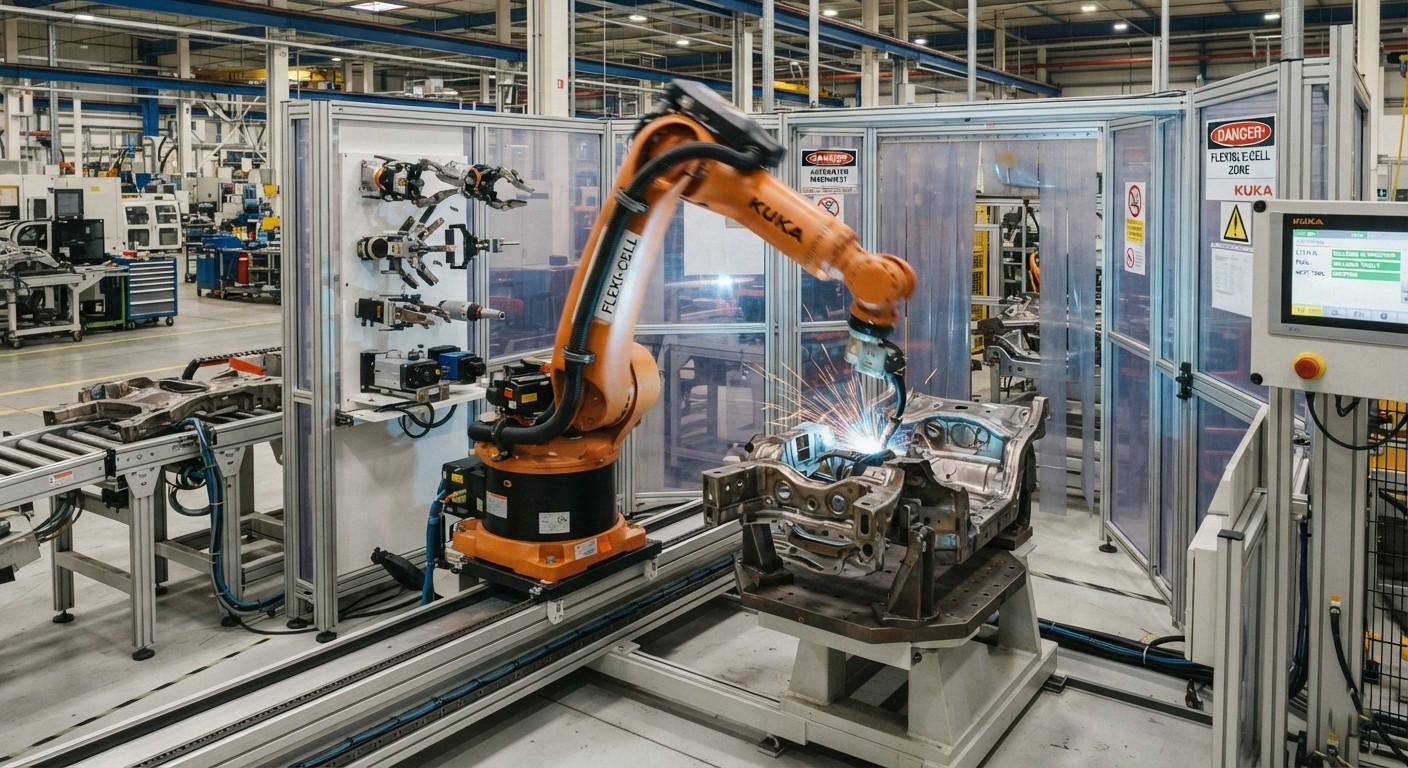
Welding introduces different process requirements. Engineers must integrate the robot with the welding equipment, torch package, fixture, and workpiece presentation. They also need to consider process parameters and any additional axes or positioners.
Robot motion alone does not determine weld consistency. Part fit-up, fixture repeatability, torch access, programming, wire feed, shielding gas, and process stability all influence the result. The tooling decision can therefore determine whether robot reuse remains practical.
Controller and Software Compatibility Matter
The controller manages more than robot motion. The new cell may require communication with PLCs, machines, sensors, safety equipment, process equipment, and operator interfaces.
Software options also matter. A controller configured for the original task may lack functions that the new process requires. This issue deserves particular attention with older robots. Engineers should check software availability, communication hardware, backups, licensing, and support before approving the conversion.
Programming effort also belongs in the project calculation. Program development and changeover time can affect commissioning and future production changes. URT’s guide to reducing robot programming time in industrial automation explains why programming deserves attention during project planning.
Fixtures and Part Presentation May Need a Redesign
A robot repeats programmed motion, but it does not automatically correct an unstable process. Parts may arrive in inconsistent positions. Fixtures may locate them differently between cycles. Part dimensions may also vary beyond the range that the automated process can tolerate.
In those conditions, moving an existing robot into the process will not remove the underlying variation. The new application may require different fixtures, sensors, part presentation equipment, or vision. In some cases, the plant should stabilize the process before selecting or installing the robot.
How Industrial Robot Applications Change Engineering Requirements
Some application changes require relatively similar integration work. Others need such different tooling and process infrastructure that keeping the same robot provides less value than expected.
Plants should examine what actually changes between the two processes. Grouping every task under the broad label of robotic automation can hide important engineering differences.
Material Handling to Machine Tending
This transition can make sense when the robot’s mechanical characteristics suit both processes. However, machine tending adds direct interaction with the machine. Engineers may need to manage door signals, clamping confirmation, machine-ready states, part presence, fault handling, and safe access.
Part presentation also affects the conversion. The robot needs a reliable method for locating raw parts and placing completed parts. A previous handling application may have presented every component in a controlled fixture. A machine-tending process with greater variation may require additional equipment.
Material Handling to Palletizing
A robot that handles products will not necessarily perform well in a palletizing cell. Engineers need to consider the product, gripper, pallet pattern, working envelope, infeed timing, pallet presentation, and downstream handling.
Production mix adds another consideration. Plants that process several formats need to check whether one end effector can handle the required range. They should also determine how operators will manage recipes and changeovers. URT’s comparison of industrial robots and traditional palletizing systems examines these trade-offs in more detail.
Material Handling to Welding
This transition requires closer scrutiny because welding changes the process requirements significantly. Moving the robot arm through a welding path represents only one part of the application. The cell also needs suitable welding equipment, torch integration, fixturing, workpiece access, process control, cable management, programming, and process stability.
The business case should therefore include the complete conversion. An available robot arm may represent only part of the investment. URT’s guide to the total cost of a robotic welding solution covers the wider cost elements that companies should consider.
Safety Must Be Reassessed for Different Industrial Robot Applications
A plant should not automatically carry a previous cell design into a new process. New tooling, workpiece dimensions, robot paths, or process equipment can change the hazards. Changes in operator interaction and cell layout can also affect how people enter, operate, maintain, and recover the system.
For broader industrial safety context, OSHA’s robotics guidance considers the complete robotic system rather than the robot arm alone. Its safety context includes associated equipment, controls, sensors, end effectors, and other system elements.
This system-level approach becomes particularly relevant when a plant repurposes equipment. Employees may already know the robot, but the new application can create different access points and operating sequences. Maintenance interventions, energy conditions, and failure scenarios may also change.
The engineering team should therefore include safety planning from the beginning of the conversion. Waiting until the team finishes programming and tooling can expose design issues late in the project.
When Reusing the Same Robot Makes Operational Sense
Robot reuse makes the strongest case when the second application falls comfortably within the robot’s verified mechanical capabilities. The surrounding system should also require a manageable level of modification.
The business case becomes stronger when maintenance personnel already understand the robot platform and can support its controller. Available spare parts and technical support also reduce uncertainty. The integration work should not create an excessive or unpredictable commissioning period.
Existing familiarity can create operational value. Standardizing around a controller family may reduce training requirements and simplify troubleshooting. It can also simplify backups, spare-parts planning, and internal support.
Plants still need to weigh those advantages against the robot’s suitability for the new task. Familiar equipment does not compensate for insufficient reach, payload margin, controller capability, or process fit.
Reuse can also make sense when production requirements change. A plant may release a robot from one line and find a productive use for it elsewhere. Engineers should treat the new installation as a new cell rather than as a simple relocation.
When a Different Robot Makes More Engineering Sense
An available robot should not become the default choice simply because the company already owns it. Previous investment does not determine whether that robot suits the next application.
The plant should evaluate another robot when the existing unit lacks adequate payload margin or creates difficult reach conditions. Poor tool orientation, unsuitable cycle performance, controller limitations, and support constraints can also weaken the case for reuse.
Conversion costs can change the decision as well. Specialized tooling, additional equipment, layout modifications, and engineering hours may consume the expected savings. In that situation, a robot selected specifically for the new process may offer a more practical project path.
The same logic applies when the two processes have fundamentally different requirements. Forcing an available robot into a poorly matched application can create compromises that remain throughout the cell’s production life.
Automation decisions should therefore start with the process rather than the equipment sitting in inventory. URT’s framework for choosing which process to robotize first focuses on process stability, measurable results, and implementation conditions before equipment selection.
What to Check Before Repurposing an Industrial Robot
Complete the reuse assessment before ordering tooling or dismantling the existing cell. The assessment should establish whether the robot genuinely fits the new process. It should also identify the engineering work required to make the complete cell operate reliably.
Use the following checklist as a pre-engineering filter. A positive answer does not replace detailed cell design. However, unresolved items can show where reuse may create additional cost or risk.
- Exact robot model and configuration: Check the model plate and official manufacturer documentation. Do not assume capabilities from a similar model or robot family.
- Payload condition: Calculate the effect of the new end-of-arm tooling, workpiece, and complete load condition.
- Working envelope: Confirm that the robot can reach every process point with the required tool orientation and clearance.
- Cycle requirement: Review the complete cell cycle. Include waiting, machine interaction, part presentation, tool changes, and downstream handling.
- Controller: Check communication requirements, software options, backups, interfaces, and compatibility with the new equipment.
- Tooling and fixtures: Identify the required changes. Confirm that the process presents parts consistently enough for automation.
- Peripheral equipment: Account for sensors, machines, process equipment, conveyors, positioners, vision systems, and other required devices.
- Safety system: Review the complete cell around the new process, layout, tooling, operating sequence, and human interaction.
- Maintenance and support: Confirm that the plant or its technical partner can support the robot and controller in the new configuration.
- Total conversion cost: Compare engineering, tooling, peripheral equipment, commissioning, training, and potential downtime with the cost of selecting a better-matched robot.
The final decision should reflect total conversion cost and production risk. The fact that the plant already owns the robot should remain only one factor in that decision.
FAQ
Can the same industrial robot perform different industrial robot applications?
Yes, in some cases. Industrial robots use programmable motion, so one robot may support more than one task. Engineers must still evaluate payload conditions, working envelope, tooling, controller capabilities, cycle requirements, peripheral equipment, safety, and integration for each application.
Can a material handling robot be converted to machine tending?
Potentially. The robot must meet the mechanical requirements of the machine-tending process. The cell also needs suitable tooling, part presentation, machine communication, process logic, and safety integration. Engineers should evaluate the complete system before approving the conversion.
Can a handling robot be converted into a welding robot?
Possibly, but the conversion can require substantial engineering. Robotic welding needs suitable process equipment, torch integration, fixturing, workpiece access, programming, and stable process conditions. Engineers must also check the exact robot and controller configuration before assuming compatibility.
Does changing a robot’s application require new programming?
Normally, yes. A different process requires motion and logic that match the new task. The robot may also need new communication with machines, sensors, process equipment, safety devices, or operator controls. Project planning should therefore include programming and commissioning effort.
Does the robot need a different gripper for every application?
Not necessarily. One tool may cover several products or related tasks when its design supports the required range. Different workpieces, forces, process functions, or handling methods may require another end effector. Some cells may instead use an automatic tool-changing strategy.
Is reusing an existing robot always cheaper than buying another one?
No. Existing equipment can reduce part of the initial investment, but the comparison must include tooling, engineering, peripheral equipment, controller requirements, software, safety modifications, commissioning, training, maintenance, and production downtime. Extensive adaptation can remove the expected cost advantage of reuse.
Talk to URT About Reusing an Industrial Robot
If you are evaluating reusing an industrial robot for different applications, contact URT. We will give you a direct, technical answer based on your actual production requirements.