
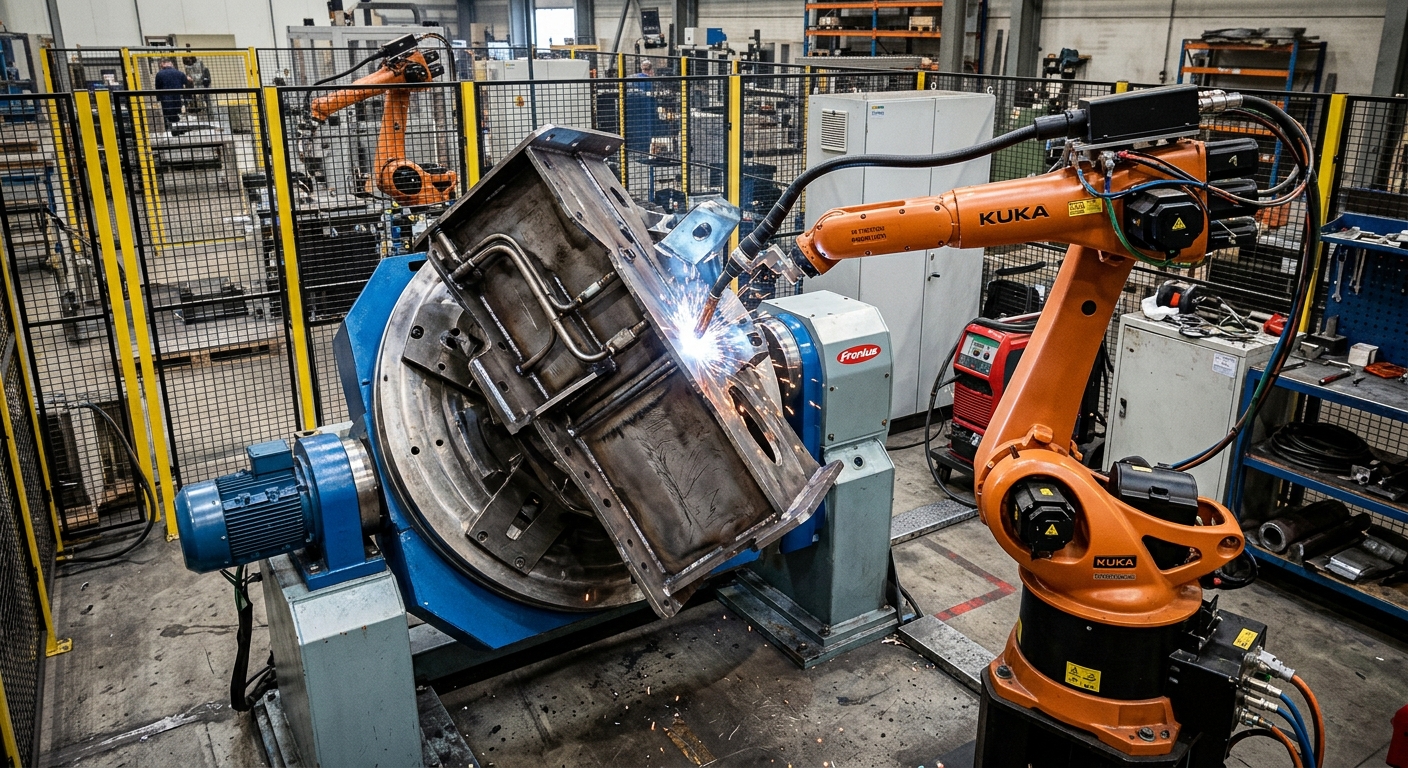
Adding more robot reach is not always the right way to solve an access problem. In many manufacturing cells, the more useful question is whether robot positioners can bring the workpiece into a better orientation instead of forcing the robot to approach it from increasingly difficult angles. This distinction affects robot selection, tooling, cycle time, fixture design, and the total cost of the automation project.
A robot may technically reach every required point on a component and still struggle to maintain a practical tool orientation throughout the operation. Welding torches can encounter clearance problems, machining tools may approach surfaces at unfavorable angles, and handling operations can require unnecessary robot movement. Moving the part can sometimes simplify these conditions, but it also introduces mechanical complexity, additional controls, and new safety requirements.
The decision is not simply whether a positioner improves access. It is whether the improvement justifies the additional equipment, integration work, and operational responsibilities. That evaluation should begin with the process requirements rather than the positioner itself.
Why robot reach does not always solve an accessibility problem
Engineers often consider robot reach among the first criteria during equipment selection. They compare the robot’s working envelope with the component dimensions and determine whether the tool can reach the necessary processing locations.
However, reaching a point and performing a process correctly at that point are different requirements.
Consider a robotic welding cell handling a fabricated steel component with joints on several faces. The robot may reach each joint individually, but some welds may require difficult wrist orientations or movement around structural features. A larger robot does not necessarily eliminate these restrictions.
The same problem appears in other applications. A deburring robot may reach an edge but struggle to maintain the required tool angle. A material handling robot may grasp a component successfully but require a complicated trajectory to change its orientation before placement.
Tool orientation matters as much as tool position.
Most robotic processes require more than positioning the tool at a specific coordinate. They also require maintaining a suitable orientation relative to the workpiece.
In welding, torch orientation affects access to the joint and the ability to maintain appropriate process conditions. In machining and finishing, tool orientation influences contact geometry and the direction of applied forces. In inspection, sensor orientation can affect whether the sensor can accurately observe and measure the required surface.
When the workpiece remains stationary, the robot must accommodate these requirements through its own joints and movements. This can create difficult configurations, particularly when the tool must pass around obstacles or operate near the limits of the robot’s usable workspace.
A positioner changes the relationship between the robot and the component. Instead of requiring the robot to adapt to every surface orientation, the positioner rotates or tilts the workpiece to present the required area in a more accessible position.
Robot configuration can become the real constraint.
Even when a target lies inside the robot’s nominal working envelope, the required configuration may create practical difficulties. Wrist orientation, nearby obstacles, cable routing, tooling dimensions, and joint limits can restrict the available motion.
Some trajectories may also approach robot singularities or require significant joint movement between operations. Engineers should evaluate these conditions using the actual robot model, tool geometry, and programmed paths rather than relying only on reach diagrams.
Before selecting a larger robot, engineers should determine whether repositioning the workpiece would resolve the underlying access limitation.
When moving the workpiece improves the robotic process
Moving the part offers particular advantages when the manufacturing operation benefits from controlled changes in orientation. The advantage is not necessarily greater speed. It may involve better process access, simpler robot movement, more consistent operating conditions, or reduced dependence on difficult robot configurations.
Robotic welding with multiple joint orientations
Welding is one of the clearest applications for coordinated robot and positioner movement.
A fabricated component may contain joints that would otherwise require different welding positions or complicated torch movements. By rotating or tilting the workpiece, a positioner can present selected joints in orientations that better suit the welding procedure.
This can provide particular value when weld accessibility and process consistency matter more than minimizing the number of mechanical axes.
However, a positioner does not automatically improve weld quality. Joint preparation, fit-up, fixture repeatability, welding parameters, torch access, shielding gas, and process stability remain essential.
Plants considering this approach should first determine whether their welding operation is ready for automation. URT’s guide to evaluating MIG/MAG welding readiness explains the production conditions that manufacturers should control before introducing robotic equipment.
Machining, deburring, and surface finishing
Some robotic machining and finishing operations require the tool to approach several faces of a component. Maintaining a suitable tool orientation with a fixed workpiece can produce unnecessarily complex trajectories.
A positioner can expose different surfaces while allowing the robot to operate within a more favorable portion of its workspace.
However, the mechanical requirements of these processes differ from welding. Machining and finishing can introduce cutting forces, vibration, and contact loads that engineers must consider when selecting the positioner and fixture.
The positioner must provide sufficient stiffness and holding capability for the actual process. Engineers cannot establish its suitability through rotational capacity or nominal workpiece weight alone.
For applications involving material removal, the comparison should also include the limitations of the robot structure itself. URT discusses related considerations in its article on industrial robots for milling and cutting.
Assembly and component handling
Positioners can also support assembly operations where a component must occupy different orientations.
For example, a robot may need to access several attachment points on a housing. Rotating the housing can reduce the need for the robot to move around the entire component or adopt difficult tool orientations.
In material handling, a controlled rotation device can sometimes simplify orientation changes between process stages.
Nevertheless, adding a positioner is not always justified. If the robot can already handle the necessary orientations with a simple gripper and reliable trajectories, another mechanical axis may add cost without producing a meaningful operational benefit.
Choosing between a fixed fixture, a positioner, and a larger robot
No universal configuration provides the best result for every application. The correct solution depends on component geometry, process requirements, available space, production volume, and the mechanical demands placed on the system.
Before selecting equipment, engineers should compare three configurations. The following table highlights the main operational differences and helps identify which alternative deserves further technical evaluation.
| Evaluation criterion | Fixed fixture | Robot positioner | Larger robot |
|---|---|---|---|
| Workpiece orientation | Remains fixed | Changes during the process | Remains fixed unless another device provides movement |
| Tool accessibility | Depends on robot movement and fixture geometry | Can improve by presenting different surfaces | May improve through additional reach, but not necessarily orientation |
| Mechanical complexity | Generally lower | Additional drive, structure, and controls | May require a larger robot and supporting infrastructure |
| Programming requirements | Robot paths and process logic | Robot paths plus positioner coordination | Robot paths and configuration management |
| Maintenance considerations | Fixture inspection and maintenance | Fixture, drive, bearings, controls, and cables | Robot and associated equipment maintenance |
| Best application conditions | Good access with stable part orientation | Multiple process orientations or difficult access | Genuine requirements for additional reach or capacity |
When a fixed fixture is sufficient
A fixed fixture is often the simplest option when the robot can access all processing locations without problematic joint configurations or tool interference.
It avoids the need for positioner drives, additional motion coordination, and rotating service connections. It can also simplify maintenance and troubleshooting.
If the process is stable, the component geometry allows adequate access, and cycle time already meets production requirements, introducing a positioner may offer little practical value.
When a positioner is the stronger option
A positioner becomes more attractive when the main constraint involves the orientation of the workpiece rather than the robot’s absolute reach.
This is particularly relevant when rotating the component can reduce difficult tool approaches, provide more consistent processing orientations, or eliminate repeated robot repositioning.
Engineers must confirm the benefit at cell level. A positioner that simplifies robot motion but requires long indexing movements may not improve the total production cycle.
When a larger robot is still necessary
A larger robot may offer advantages when the process requires additional reach, payload capacity, or access to widely separated locations that workpiece rotation cannot adequately address.
It may also provide a better option when the workpiece is too large, heavy, or difficult to support on a practical positioner.
Robot size and positioner selection therefore require a combined evaluation rather than separate purchasing decisions.
Positioner design must match the workpiece and process
Once a positioner appears technically useful, the next question concerns which configuration can support the component and process safely and repeatably.
Manufacturers offer different mechanical arrangements, including single-axis rotary units, multi-axis systems, and configurations that support components between opposing structures. Each arrangement creates different opportunities and constraints.
Single-axis rotation
A single-axis positioner rotates the workpiece around a defined axis. This can be sufficient when the process mainly requires access to different sides of a component.
Its relative mechanical simplicity can make it attractive, but the rotation axis must align with the actual access requirements.
If the workpiece also needs substantial tilting, a single rotary axis may not solve the problem.
Multi-axis positioning
Multi-axis positioners provide additional orientation control. They can support complex welding assemblies or components that require access from several directions.
The additional flexibility creates greater integration demands. Engineers must consider axis coordination, collision clearance, mechanical loading, cable routing, and the available controller functionality.
More axes are not automatically better. Engineers should select the minimum number of axes that can achieve reliable process access and production performance.
Workpiece mass, center of gravity, and fixture design
Engineers must evaluate positioner capacity using the complete rotating assembly, not only the nominal weight of the component.
The fixture, clamps, adapters, and other attached equipment contribute to the mechanical load. The location of the combined center of gravity also affects the torque and structural requirements of the positioner.
An off-center workpiece can create significant loading demands even when its total weight appears acceptable. Acceleration, deceleration, orientation, and process forces also influence the mechanical requirements.
Fixture design plays an equally important role. If the component moves relative to its fixture during rotation, the robot’s programmed positions may no longer correspond to the actual processing locations.
Consequently, engineers should assess the complete workpiece and fixture assembly before selecting the positioner.
Robot and positioner coordination determines actual cell performance
A positioner can operate as an indexing device or as a coordinated external axis, depending on the application and control architecture.
These arrangements create different requirements for programming, cycle time, and integration.
Indexed positioning versus coordinated motion
In an indexed system, the positioner moves the workpiece to a defined orientation and stops. The robot then performs the required operation while the part remains stationary.
This approach can work well when each processing step benefits from a different fixed orientation.
In coordinated motion, the robot and positioner move together according to the programmed process. This approach can support operations where the tool must maintain a defined relationship with a workpiece that rotates during the operation.
Coordinated movement requires compatible control functionality, correct kinematic configuration, and suitable programming. Not every robot controller supports every external-axis arrangement, and engineers must verify compatibility for the exact equipment involved.
Cycle time must include positioner movement
It is easy to assume that simpler robot trajectories will automatically shorten the cycle.
However, the complete cycle includes positioner rotation, acceleration, deceleration, settling, clamping confirmation, robot movement, and the processing operation itself.
A cell may gain better access but lose time if the workpiece must repeatedly rotate through large angles between short operations.
Simulation and cycle-time analysis should compare the complete sequences, not isolated robot movements. Programming efficiency also matters, particularly when a cell includes multiple axes and frequent product changes.
URT’s article on reducing robot programming time provides additional context for evaluating programming complexity as part of an automation project.
Safety and maintenance access
Adding a positioner changes the cell’s moving machinery and associated hazards.
Engineers must consider the swept volume of the rotating workpiece, fixture protrusions, pinch and crush points, unexpected movement, and access requirements for loading, unloading, inspection, and maintenance.
The safety design must account for both robot and positioner motion, including their interaction during automatic operation and recovery.
For broader industrial robotic safety considerations, OSHA’s robotics guidance provides a useful reference for evaluating robotic systems and their associated equipment.
Maintenance planning must also cover the positioner’s mechanical and electrical components. Bearings, drive systems, feedback devices, cables, and fixtures introduce additional inspection and support requirements that engineers should consider before commissioning.
When moving the part is not the right solution
Although positioners can improve accessibility, they do not suit every workpiece or production environment.
One limitation involves the size and mass of the component. Large or heavy assemblies may require substantial support structures, foundations, and drive systems. The cost and complexity of rotating the workpiece can outweigh the benefit of simpler robot movement.
Another limitation involves part stability. Thin, flexible, or poorly supported components may deform or shift when their orientation changes. If the fixture cannot maintain the required geometry, rotation can introduce process variation rather than eliminate it.
Process connections can also restrict movement. Some applications require electrical, pneumatic, hydraulic, or other services to remain connected to the workpiece or fixture. Rotating those connections may require specialized routing or rotary interfaces.
Production volume and product variety also affect the decision. A positioner designed around one component may become inefficient when operators must frequently change fixtures. Conversely, a flexible positioning arrangement may justify its additional complexity when several products share compatible fixturing and orientation requirements.
Finally, a positioner cannot compensate for an unstable manufacturing process. In welding, inconsistent fit-up remains a problem regardless of workpiece orientation. In machining, inadequate structural stiffness remains a limitation even when tool access improves.
The positioner should resolve a defined accessibility or process-orientation requirement. It should not replace the work necessary to correct poor fixture design, inconsistent part presentation, or unsuitable process parameters.
What to verify before investing in a robot positioner
Before selecting equipment, the engineering team should compare fixed-workpiece and moving-workpiece alternatives using the same production requirements. The following checklist helps structure concept development, supplier discussions, and preliminary cell design.
- Process accessibility: Identify difficult tool paths or operations with the workpiece in a fixed position, and determine whether rotation or tilting resolves them.
- Workpiece and fixture loading: Evaluate the complete rotating mass, center of gravity, inertia, process forces, and required mechanical support.
- Robot compatibility: Confirm that the exact robot and controller configuration support the intended positioner control method.
- Required motion: Determine whether indexed positioning meets the process requirements or whether the application needs coordinated robot-positioner movement.
- Fixture repeatability: Verify that the fixture securely holds the workpiece throughout every required orientation.
- Cycle time: Include all positioning, clamping, processing, and transfer movements in the comparison.
- Safety and layout: Evaluate the complete moving envelope, guarding, access points, loading operations, and maintenance requirements.
- Production flexibility: Assess whether the positioner can support future components or whether product changes will require substantial retooling.
- Total project cost: Include the positioner, fixtures, controls, installation, programming, safety integration, commissioning, and maintenance.
- Acceptance criteria: Define the required positioning performance, process quality, cycle time, and operational reliability before approving the equipment.
These checks become particularly important when engineers integrate a positioner with an existing or refurbished robot. Controller generation, external-axis interfaces, software options, and available technical support can affect whether the intended configuration is practical.
For projects involving existing equipment, URT’s guide to refurbished robot compatibility with existing systems explains why buyers should verify integration requirements before purchasing hardware.
The final selection should focus on the complete robotic cell, not the positioner as an isolated component. A technically capable positioner provides little value if its controls, fixture, layout, or operating sequence do not match the production requirements.
FAQ
What is the main purpose of a robot positioner?
A robot positioner changes the orientation of a workpiece so the robot can access the necessary processing locations more effectively. Manufacturers commonly consider positioners when fixed components create difficult tool angles, restricted access, or unnecessarily complex robot trajectories.
Can a robot positioner reduce the need for a larger robot?
Yes, in some applications. Reorienting the workpiece can allow a smaller robot to access locations that would otherwise require more reach or difficult joint configurations. However, engineers must verify the decision through actual tool paths, component geometry, loading requirements, and cell layout.
Are robot positioners only used for welding?
No. Positioners can support welding, machining, finishing, assembly, inspection, and certain material handling operations. Their usefulness depends on whether changing the workpiece orientation improves process access or simplifies the necessary robot movements.
Does a positioner always improve robotic cycle time?
No. A positioner may simplify robot trajectories while introducing additional rotation and indexing time. Engineers must evaluate the complete production sequence to determine whether total cycle time improves.
What is the difference between an indexing positioner and a coordinated external axis?
An indexing positioner moves the workpiece to a selected orientation before the robot performs an operation. A coordinated external axis moves together with the robot during the programmed process. Coordinated movement requires suitable controller functionality, configuration, and programming.
Can a positioner work with a used industrial robot?
Yes, provided the robot controller, software, interfaces, and external-axis capabilities support the intended configuration. Engineers must verify compatibility for the exact robot and controller rather than assuming it from the manufacturer or robot family.
How do you determine the correct positioner capacity?
Engineers must consider the workpiece, fixture, center of gravity, inertia, orientation, and process loads. Nominal workpiece weight alone does not provide enough information to establish whether a positioner can safely support the application.
When should a manufacturer avoid adding a robot positioner?
A positioner may not justify the investment when a fixed fixture already provides reliable access, when workpiece rotation creates excessive mechanical complexity, or when the additional equipment does not improve measurable production performance. Manufacturers should also avoid this approach when the fixture cannot securely support the component throughout the necessary movements.
Talk to URT about robot positioners and cell integration
If you are evaluating robot positioners and workpiece orientation strategies for an industrial robotic cell, contact URT. We will give you a direct, technical answer based on your actual production requirements.