
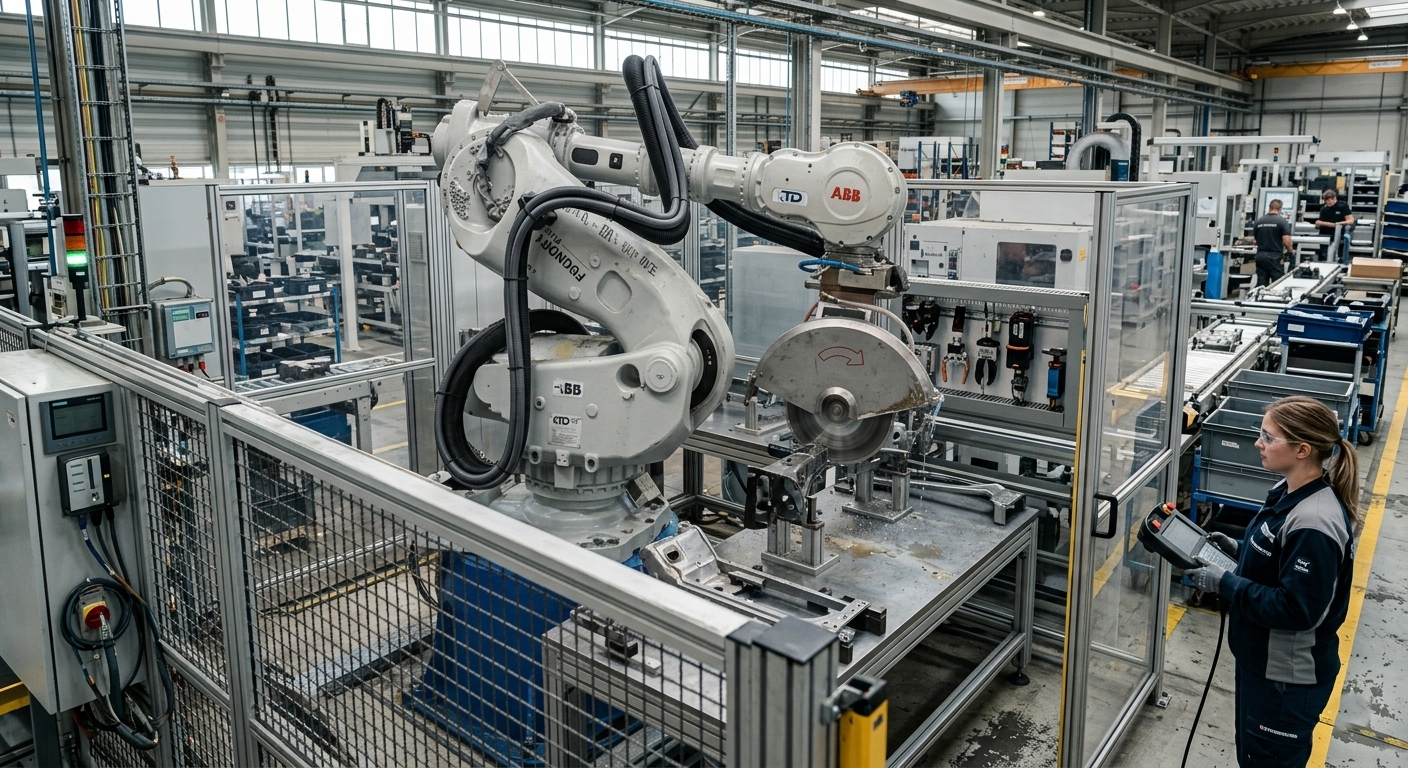
The question is not whether refurbished industrial robots can reduce investment costs. The more important decision is whether the production process, integration requirements, and long-term support strategy allow a refurbished system to perform reliably in day-to-day manufacturing. In many factories, the greatest value comes not from buying the newest equipment, but from matching the right robot to the right application.
The refurbished industrial robots market has matured considerably. Companies evaluating automation are increasingly comparing refurbished equipment with new systems, particularly where production requirements are well understood, and capital efficiency is a priority. The decision, however, should always be based on operational suitability rather than purchase price alone.
Why Value Depends on the Manufacturing Process Rather Than the Robot
A refurbished robot does not automatically create value because it costs less. Its value depends on how predictable the manufacturing process is, how stable production volumes remain, and whether the existing cell can accommodate the equipment without extensive redesign.
Processes with consistent part presentation, repeatable cycle requirements, and mature production methods often benefit most from refurbished automation. In these situations, companies can redirect capital toward tooling, fixturing, integration, or quality improvements while still achieving reliable robotic performance.
Where production conditions change frequently or future expansion requires significant flexibility, a new robot may offer advantages through newer controller generations, expanded software capabilities, or manufacturer support options.
Material Handling Often Offers the Strongest Business Case
Material handling applications are among the most practical environments for refurbished industrial robots. Loading, unloading, transferring components between workstations, and repetitive pick-and-place operations typically rely on consistent motion rather than highly specialized robot features.
Success still depends on the complete production cell. End-of-arm tooling, part presentation, conveyors, sensors, and safety systems influence productivity as much as the robot itself. A mechanically sound refurbished robot can perform reliably when these surrounding systems are designed appropriately.
Manufacturers should evaluate whether the existing workflow already supports repeatable handling before selecting any robot platform.
Machine Tending Can Deliver Measurable Returns
CNC machine tending, injection molding support, and similar applications often involve predictable loading and unloading cycles that suit refurbished robots well. The operational gains frequently come from improved machine utilization, reduced idle time, and more consistent production scheduling rather than dramatically faster robot motion.
Automation is most effective when machine cycle times remain stable and operators are no longer required to perform repetitive loading tasks throughout each shift.
If machine programs, fixtures, or part presentation vary significantly between production batches, those issues should be resolved before automation is introduced.
End-of-Line Automation Frequently Benefits from Refurbished Equipment
Palletizing, packaging support, and end-of-line material transfer often require dependable repeatability rather than cutting-edge robot functionality. For facilities with established packaging formats and relatively stable product mixes, refurbished robots may provide an efficient path toward automation.
The overall performance of an end-of-line system depends on conveyor timing, pallet presentation, gripper selection, safety integration, and downstream logistics. Replacing only the robot without addressing surrounding constraints rarely improves throughput by itself.
Plants experiencing frequent product changes should carefully evaluate whether additional flexibility is required before choosing refurbished equipment.
Processes Where Refurbished Robots Require More Careful Evaluation
Applications involving complex welding, precision assembly, advanced vision guidance, or rapidly changing production requirements deserve a more detailed technical assessment. The robot may still be suitable, but controller compatibility, available software, peripheral integration, and future expansion become increasingly important.
For example, robotic welding quality depends on fixture repeatability, part fit-up, torch access, welding parameters, and process stability. Purchasing a refurbished robot alone does not guarantee improved weld quality if those production variables remain uncontrolled.
Similarly, highly flexible assembly operations may benefit from newer controller capabilities if production complexity is expected to increase over time.
Integration Often Determines the True Cost
The purchase price represents only one part of the investment. Mechanical inspection, electrical integration, safety validation, end-of-arm tooling, programming, commissioning, operator training, and future maintenance all contribute to the total project cost.
A lower acquisition cost can quickly be offset if compatibility problems require unexpected engineering work or extended production downtime during installation.
Evaluating communication interfaces, controller generation, spare parts availability, and long-term service support before purchase helps reduce these risks.
When a New Robot May Be the Better Investment
Refurbished robots are not the right answer for every manufacturing environment. Companies introducing entirely new production technologies, operating under evolving product requirements, or requiring the latest software capabilities may find greater long-term value in new equipment.
Likewise, facilities with strict customer specifications, standardized global automation platforms, or long-term manufacturer support requirements should evaluate whether those operational priorities outweigh the potential capital savings of refurbished equipment.
The objective should always be selecting the solution that best supports production over its expected service life rather than minimizing the initial purchase cost.
Practical Checklist Before Choosing a Refurbished Robot
The following considerations help determine whether refurbished equipment is an appropriate investment for a particular manufacturing process.
- Is the production process stable and repeatable?
- Can the existing layout accommodate the robotic cell efficiently?
- Has controller compatibility been verified?
- Are spare parts and technical support available?
- Can existing tooling be integrated without major redesign?
- Have maintenance responsibilities been defined internally?
- Will future production changes require additional flexibility?
- Has the total project cost been evaluated beyond the purchase price?
FAQ
Which manufacturing applications benefit most from refurbished industrial robots?
Material handling, machine tending, palletizing, packaging support, and other repetitive production tasks often provide the strongest operational value because they typically rely on stable, repeatable processes.
Can refurbished industrial robots deliver the same production quality as new robots?
Production quality depends on the complete robotic cell, including tooling, fixtures, programming, process stability, and maintenance. A properly refurbished robot can perform reliably when these factors are well managed.
Are refurbished robots suitable for high-volume manufacturing?
They can be, provided the equipment has been properly evaluated, integrated, and maintained, and the application matches the robot’s capabilities.
What should buyers verify before purchasing a refurbished robot?
Mechanical condition, controller version, compatibility with existing equipment, spare parts availability, service history where available, and overall integration requirements should all be assessed before making a purchasing decision.
When is buying a new robot usually the better option?
New robots may be preferable when production requires the latest controller capabilities, future scalability, advanced software functions, or long-term manufacturer standardization across multiple facilities.
Talk to URT About Refurbished Industrial Robots
If you are evaluating refurbished industrial robots for your manufacturing operation, contact URT. We will give you a direct, technical answer based on your actual production requirements.