
Simulation always looks calm.
Everything flows. Nothing vibrates. Nothing shifts. No surprises.
On screen, the robot never hesitates.
That’s why, when the system moves from the digital environment to the real plant, the contrast is often brutal.
The first contact with the real material — the one with history, moisture, internal stresses, inherited tolerances — introduces something simulation rarely anticipates fully: behavior.
Not errors.
Behavior.
Doubt appears quickly, almost instinctively. The robot executes exactly what was programmed, yet the result is not what was expected. The trajectories are right, the timing is within range, the logic works… and still, the part reacts differently. It bends where it shouldn’t, marks where it never did before, vibrates when no one saw it coming.
And then the uncomfortable question emerges:
When did we start trusting simulation that much?
In the plant, this gap generates frustration. Because everything “looked fine.” Because the project passed reviews. Because the digital twin seemed solid.
The immediate temptation is to assume something failed: the software, the robot, the programming.
But in many cases, nothing actually failed.
Reality simply appeared.
Materials don’t read manuals.
They don’t follow assumptions.
They don’t behave like averages.
A simulation works with ideal values or, at best, nominal ones. Real material arrives with accumulated variations: different batches, inconsistent pre‑processes, thermal history, fiber orientation, residual stresses. All of that exists even if it’s not modeled.
And when the robot makes direct contact with the material — especially in machining, sanding, polishing, deposition, or printing — those variations stop being theoretical and become physical.
This is where many projects hit a conceptual wall.
Because the simulation wasn’t “wrong.”
It was incomplete.
The problem wasn’t trusting the digital model — it was expecting it to do something it cannot do: predict the unpredictable.
Simulation is meant to validate geometry, reach, collisions, sequence, macro‑timing.
Not to guarantee how a living material will react under real load, real tools, and real conditions.
When this distinction isn’t acknowledged from the start, frustration turns into distrust.
Teams begin doubting the model, the integrator, the entire project.
And worst of all: they start trying to force reality to match the simulation, instead of adapting the system to embrace variability.
From a technical standpoint, the real mistake is assuming the material is a constant when in fact it is a critical variable.
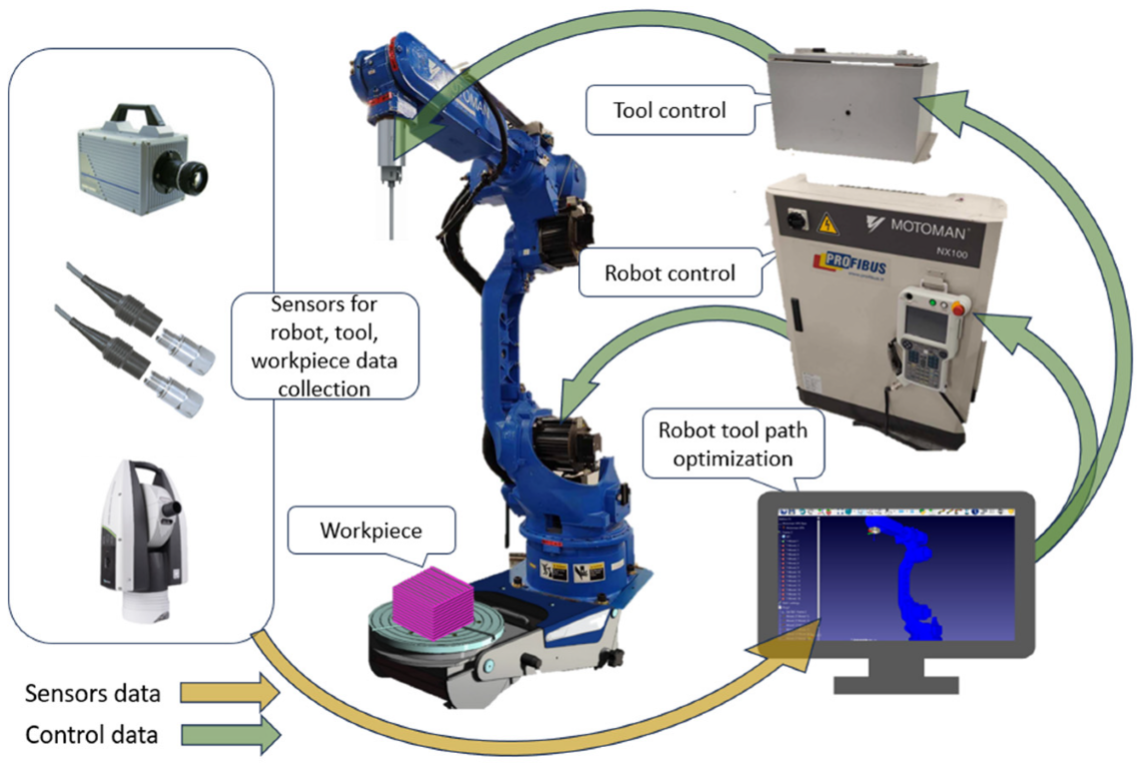
Simulation describes ideal trajectories; the real process demands compensation strategies.
This may involve force control, real‑time adaptation, sensors, process margins, or simply accepting that certain tolerances cannot be absolutely fixed.
The true leap in quality happens when the system is designed to absorb variations, not deny them.
But once again, technique alone doesn’t resolve the conflict.
The real shift is mental: accepting that simulation is not a promise — it’s a hypothesis.
A very good one, a necessary one, but an incomplete one.
Mature automation does not aim to eliminate uncertainty, but to reduce it to a manageable level.
When we expect simulation to remove every surprise, the collision with reality is inevitable.
Projects that succeed tend to have one thing in common:
They use simulation as a starting point, not as a final argument.
They leave room for adjustment.
They allocate time to learn from the real material.
They understand that knowledge does not end when the robot starts moving — it begins when the system starts interacting with what it is truly producing.
And in that interaction, the material always has the last word.
So perhaps the real question is not what happens when simulation doesn’t match reality…
but whether the system was designed to listen to that difference — or to ignore it.
If you need more information, don’t hesitate to call us.