
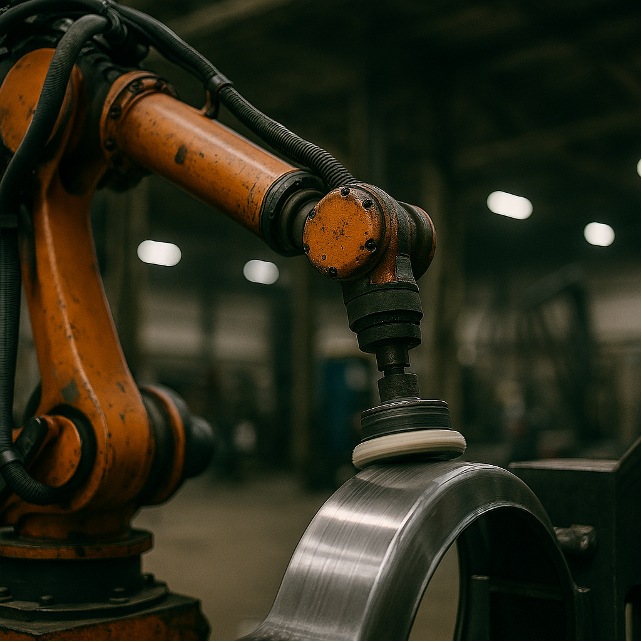
In the industrial sector, sanding, polishing, and surface finishing might seem like straightforward tasks, but they actually involve a significant level of technical complexity. Each piece requires consistent pressure, precise motions, a uniform rhythm, and an attentive approach to detail—qualities that are difficult to maintain manually over many hours of work.
This is where an industrial robot transcends its role as a mere machine and becomes a repeatable artisan, capable of performing delicate, uniform, and consistent movements without fatigue or deviation from cycle to cycle. However, before introducing a robot into these processes, it is crucial to consider several key technical aspects.
The core of sanding and polishing lies in the combination of pressure and movement. Abrasive processes rely not just on speed or the trajectory of movement, but on a delicate balance. Excessive pressure can cause marks, irregular wear, and even deformation of the material; too little pressure results in incomplete or inconsistent finishes. Poorly calibrated movement may lead to visible patterns or scorched areas on the surface. Unlike a human operator who adapts to the situation, a robot executes exactly what it is programmed to do.
Success in robotic sanding and polishing depends on the precise definition of process parameters, which is a tremendous advantage in repetitive applications, allowing for consistent quality and efficiency.
At URT, we recognise the value this robot brings to highly demanding sectors such as electronics, and we offer solutions that enable our customers to integrate used or new robots technology into their production lines to achieve new levels of efficiency and competitiveness.