
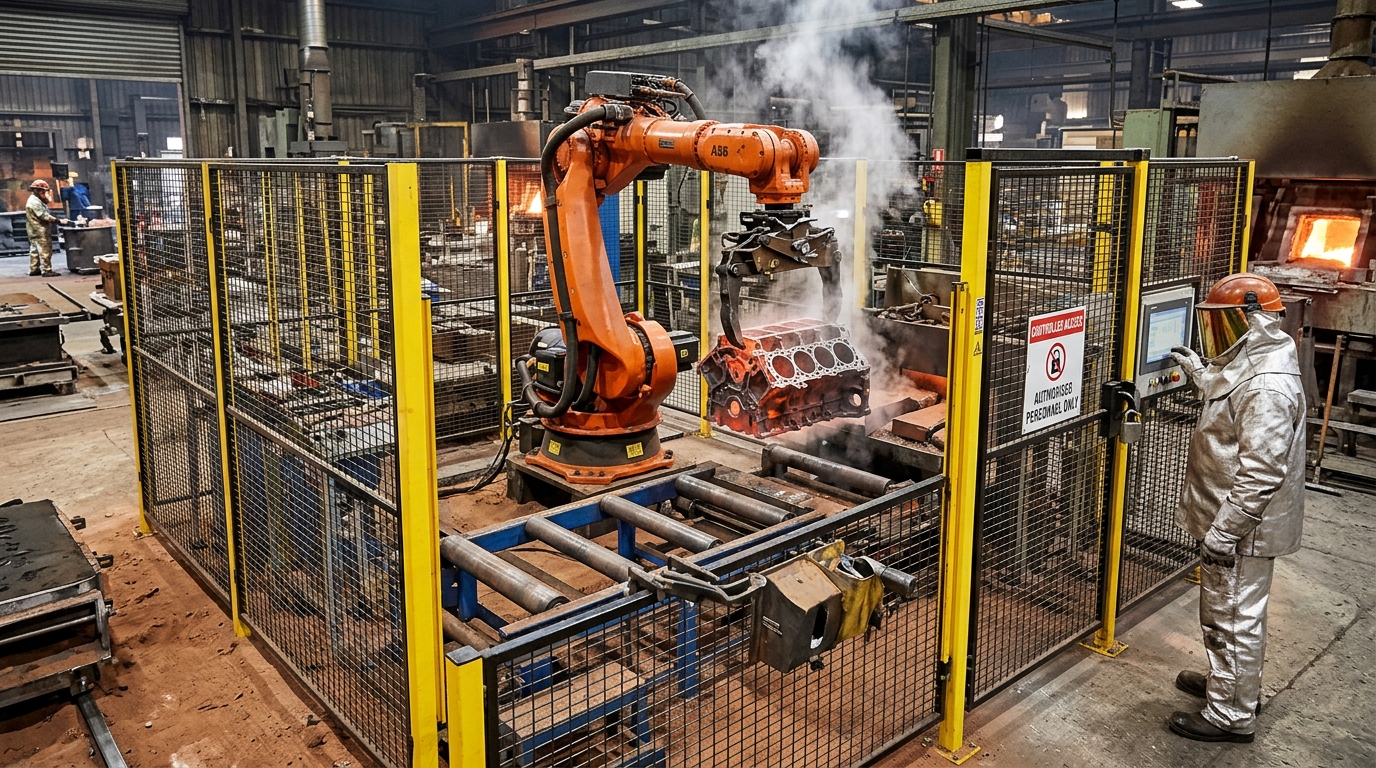
Why foundry conditions change the robot selection process
A robot that performs reliably in a conventional manufacturing cell may become a maintenance problem when it operates beside a furnace, casting machine, or abrasive finishing process. Foundry material handling robots must withstand environmental exposure while meeting payload, reach, and cycle requirements. A robot that can lift the casting will not necessarily survive the conditions around it.
Foundry environments combine several sources of risk. Radiant heat, airborne dust, metallic particles, scale, vibration, and contamination can affect the robot arm, tooling, sensors, cables, and surrounding equipment. These conditions may also change during production, especially when furnace doors open, castings leave molds, or cleaning operations generate concentrated dust.
For production managers and automation engineers, the decision goes beyond whether robotic handling is technically possible. They must determine whether the complete cell can maintain reliable operation without creating excessive maintenance costs, unplanned downtime, or new safety risks.
Thermal exposure matters more than the temperature of the casting alone.
Heat creates one of the most significant differences between conventional material handling and foundry automation. However, the temperature of the workpiece does not fully describe the thermal load that the robot experiences.
A casting may be extremely hot while the robot remains relatively protected because only the gripper approaches the part. In another installation, a robot handling cooler material may experience significant radiant heat because its arm repeatedly operates close to an open furnace.
Separate workpiece temperature from robot exposure
The thermal assessment should distinguish between part temperature, ambient temperature, radiant exposure, contact duration, and heat transfer through the tooling. These variables affect different components and require different protective measures.
Heat conducted through a gripper can reach mounting adapters and the robot wrist. Radiant heat can damage external cables, hoses, seals, and protective covers even without direct contact with the casting. Elevated ambient temperatures can also affect components located away from the immediate handling point.
A useful assessment measures conditions at the actual robot positions during normal production. The integrator should examine temperatures near the wrist, sensors, gripper actuators, cable routing, and other vulnerable components.
Repeated exposure can be more important than a single hot cycle.
A short handling movement may create less thermal stress than repeated cycles running continuously across a production shift. Components can accumulate heat when they have insufficient time to cool between operations.
Production interruptions also matter. A stopped conveyor, delayed furnace release, or blocked unloading station may force the robot to hold a hot casting longer than planned.
Engineers should therefore evaluate the robot and tooling under representative continuous operating conditions, not only during a successful demonstration cycle. They should also consider the worst credible operating conditions that the process assessment identifies.
Dust, scale and abrasive particles create a different reliability problem.
Heat does not dominate every harsh foundry environment. Sand handling, casting cleaning, shakeout, grinding, and finishing can expose robotic equipment to abrasive particles and persistent contamination.
These materials can accumulate around joints, protective covers, connectors, cable assemblies, and tooling mechanisms. Even when contamination does not immediately stop the robot, it can increase inspection requirements and accelerate component deterioration.
Environmental protection must match the actual contamination.
Manufacturers offer certain industrial robot configurations for demanding production environments. Depending on the exact model, these configurations may include enhanced sealing, protective coatings, guarded connections, or other application-specific features.
However, a foundry designation does not guarantee that a robot can handle every casting operation. The integrator must verify whether the specific model and protection package can withstand the expected dust, heat, liquids, and contamination.
Engineers should consult official KUKA robotics documentation or equivalent manufacturer information when evaluating environmental configurations. General product descriptions cannot replace the operating limits of the exact robot variant.
Protective covers do not eliminate contamination risk.
External covers and shielding may protect exposed equipment, but their design introduces additional maintenance considerations. Covers can retain contamination, obstruct inspection, or restrict access to components that require regular attention.
Protection can also influence thermal behavior. A cover that reduces direct exposure to particles may trap heat if its ventilation and installation do not suit the environment.
The selection process should therefore consider how maintenance personnel will inspect, clean, replace, and maintain protective equipment. Environmental protection belongs in the initial cell design rather than as an accessory added after installation.
Gripper design becomes a critical part of the handling decision.
In foundry applications, the end effector frequently determines whether the robot can handle the casting consistently. Irregular geometry, thermal expansion, surface scale, dimensional variation, and changing surface conditions can make gripping more difficult than in conventional handling.
A robot may have sufficient nominal payload and reach but still be unsuitable if the gripper cannot retain the part throughout the required movement.
Grip stability must account for real casting conditions.
Integrators often consider mechanical gripping for hot or irregular castings, but the gripping principle must match the geometry and production process. Contact surfaces, clamping force, finger geometry, mechanical stops, and part orientation all influence retention.
A gripping arrangement that works with a clean, cold sample may behave differently when the casting is hot, covered with scale, or subject to dimensional variation. Engineers should reproduce these conditions during testing rather than relying exclusively on nominal part drawings.
Vacuum handling may be inappropriate when surfaces are porous, irregular, heavily scaled, or incompatible with the temperature limits of the vacuum components. Engineers must also check how other gripping methods behave during a loss of power or pressure.
Heat protection changes payload and wrist loading.
Foundry grippers may require extended fingers, insulating sections, heat shields, reinforced mounting structures, or additional actuators. Each component contributes to the load that the robot carries.
The payload calculation must include the casting and all tooling mounted on the wrist. Centre of gravity and inertia are equally important, particularly when long gripper fingers position the casting away from the mounting flange.
Extending the gripper can reduce thermal exposure at the wrist, but it may increase bending, deflection, and rotational inertia. This creates a trade-off between environmental protection and mechanical suitability.
Engineers must check the final arrangement against the manufacturer’s approved load diagrams and configuration limits. Payload capacity alone cannot validate the application.
Cell layout can reduce exposure before additional protection is needed.
One of the most useful design decisions involves determining how much of the robot actually needs to enter the harsh production area. A cell that keeps the main robot structure away from heat and contamination may reduce environmental demands without changing the handling task.
For example, the robot may collect a casting at a defined transfer position rather than reaching deeply into a furnace or machine opening. A dedicated fixture, transfer mechanism, or modified presentation position can sometimes reduce exposure.
Reach and orientation must be evaluated together.
Moving the robot farther from the heat source changes the required reach and movement geometry. The robot must still approach the part, maintain the correct orientation, clear nearby equipment, and reach the unloading position without exceeding its permitted operating limits.
The analysis should include joint positions, wrist orientation, tooling clearance, machine doors, surrounding structures, and the complete transfer path. Engineers must also consider safe stopping and recovery positions.
A longer-reach configuration is not automatically preferable. Additional reach may change the robot’s mechanical loading, installation footprint, and integration requirements.
Upstream and downstream equipment determine real productivity.
A foundry robot cannot improve production flow if the casting process, conveyor, cooling station, or finishing equipment remains the actual bottleneck. The handling sequence must coordinate with the surrounding machines.
Part presentation is particularly important. If castings arrive with uncontrolled orientation, inconsistent positioning, or variable release timing, the robot may require additional fixtures, sensing, or process changes.
These principles reflect the broader issues discussed in common mistakes when automating manual processes. A process that depends on operators correcting variation may need greater stability before robotic handling becomes reliable.
Safety and maintenance requirements increase with environmental severity.
Robotic handling can reduce the need for operators to approach hot castings or perform repetitive movements in demanding areas. However, removing an operator from the immediate handling position does not eliminate the hazards associated with the process.
The automated cell still contains moving machinery, hot materials, stored energy, possible dropped loads, and equipment that requires maintenance intervention.
Evaluate the complete cell rather than the robot alone
The risk assessment should cover the robot, gripper, casting, furnace or machine interface, conveyors, guarding, sensors, control system, and access points. Engineers must pay particular attention to situations where personnel may enter the cell to clear a fault or recover a part.
A dropped hot casting creates a different consequence from dropping a conventional manufactured component. The cell design should account for foreseeable gripping system failures and the locations where material could fall.
For general industrial safety context, OSHA’s robotics guidance provides a useful reference for evaluating hazards associated with integrated robotic systems. The project team must determine the applicable safety requirements for the actual installation and jurisdiction.
Maintenance access should influence the initial layout
Maintenance personnel may need to inspect gripper fingers, replace damaged shields, examine cables, clean protective equipment, or troubleshoot sensors. These activities become more difficult when hot machinery or accumulated contamination surrounds the equipment.
The cell should provide suitable access for inspection and servicing after personnel control hazardous energy and address thermal hazards. Maintenance procedures must account for components that remain hot after production stops.
Maintenance teams should establish inspection requirements based on actual exposure, component condition, and manufacturer recommendations rather than assuming that conventional maintenance routines will be sufficient.
Plants evaluating support requirements can also apply the principles of spare parts planning and emergency support for robotic cells. Although the referenced application involves welding, foundry automation faces similar operational risks when replacement components are unavailable.
When foundry automation makes financial sense and when it should wait
The business case for robotic foundry handling should extend beyond replacing manual movements. The investment may also deliver value by reducing direct operator exposure, improving handling consistency, reducing damage, or stabilizing transfers between production stages.
However, these benefits depend on the reliability of the complete cell. A robot that requires frequent maintenance because of heat or contamination may fail to deliver the expected production value.
Measure the real sources of operational value
Before selecting equipment, the plant should establish a baseline for handling cycle time, production interruptions, part damage, operator involvement, maintenance effort, and machine waiting time.
After commissioning, the production team can use the same indicators to determine whether the cell has improved the process. This approach provides stronger evidence than calculating ROI exclusively from the purchase price and expected robot speed.
The framework described in robotic automation KPIs can help define measurable acceptance criteria before investment approval.
Conditions where automation should be delayed
Not every foundry handling operation is ready for robotics. Plants should reconsider or redesign automation when they cannot control part presentation, manage thermal exposure, establish reliable gripping, or implement a safe recovery procedure.
Robotic handling may also be inappropriate when production volume cannot justify the complete integration and maintenance cost. The same applies when an existing mechanical transfer system already meets operational requirements.
A semi-automated handling arrangement or a redesigned transfer point may offer a more suitable solution. The objective is to solve the production problem, not to introduce a robot where another method is technically simpler.
What to verify before investing in a foundry handling robot
Engineering teams should use the following checklist during the initial assessment and revisit it before approving equipment. Process measurements, drawings, manufacturer documentation, and representative testing should support each decision.
- Thermal conditions: Record part temperature, ambient conditions, radiant exposure, contact duration, and temperatures near sensitive components.
- Contamination: Identify sand, dust, scale, metallic particles, liquids, and other materials that may affect the equipment.
- Part characteristics: Confirm casting mass, geometry, centre of gravity, dimensional variation, surface condition, and required orientations.
- Gripper performance: Test retention, release, thermal expansion effects, and behavior during foreseeable interruptions.
- Mechanical loading: Verify the complete wrist load, including tooling, shielding, adapters, sensors, and accessories.
- Robot configuration: Confirm the exact model, permitted environmental conditions, protective options, mounting arrangement, and manufacturer load limits.
- Cell integration: Review reach, machine interfaces, part presentation, conveyor timing, guarding, and recovery paths.
- Maintenance readiness: Define inspection responsibilities, replacement components, access requirements, and technical support arrangements.
- Production acceptance: Establish measurable criteria for handling reliability, cycle time, part damage, downtime, and environmental performance.
When considering a used or refurbished robot, buyers must perform additional checks. Mechanical condition, controller version, application history, software compatibility, spare parts availability, and the condition of protective equipment can influence the investment’s suitability.
Buyers should not assume that a refurbished robot has foundry protection simply because the manufacturer offers foundry configurations within the same robot family. They must verify the exact configuration, including any modifications or protection packages that the new installation requires.
For projects involving existing equipment, refurbished robot compatibility with existing systems is another important part of the buying assessment.
FAQ
Can a standard industrial robot operate in a foundry?
Yes, in some applications. A standard robot may be suitable when the cell layout, tooling, and protective measures keep the equipment within its approved environmental limits. Severe heat or contamination may require a different configuration.
Is a foundry-rated robot always necessary for handling hot castings?
No. The requirement depends on the actual thermal exposure, contamination, handling path, and robot location. Severe environments may require a protected or foundry-specific configuration, but engineers must base the decision on verified operating conditions.
What is the biggest risk when selecting a robot for foundry material handling?
One of the main risks involves selecting the robot based only on payload and reach. The application must also account for thermal exposure, environmental protection, gripper performance, mechanical loading, maintenance access, and the reliability of the surrounding production process.
Can robotic handling reduce operator exposure to foundry hazards?
Robotic handling can reduce the need for operators to work directly beside hot materials or perform repetitive handling tasks in demanding areas. However, the complete cell still requires guarding, risk assessment, controlled access, and safe maintenance procedures.
How does foundry dust affect industrial robot maintenance?
Dust and abrasive particles can accumulate around exposed components and protective equipment. Depending on the environment and robot configuration, this may increase inspection, cleaning, and component replacement requirements. Maintenance teams should adapt their plans to actual contamination levels.
Are refurbished robots suitable for foundry applications?
They can be, provided their mechanical condition, controller compatibility, environmental protection, and available support match the application. Buyers must verify the exact robot configuration and evaluate the total cost of integration, protective equipment, maintenance, and potential downtime.
How should a foundry handling robot be tested before production?
Commissioning teams should use representative castings, realistic temperatures, actual surface conditions, and expected production cycles. They should verify gripping reliability, component temperatures, movement clearances, machine coordination, safe stopping behavior, and recovery procedures.
Talk to URT about foundry material handling automation
If you are evaluating foundry material handling automation, contact URT. We will give you a direct, technical answer based on your actual production requirements.