
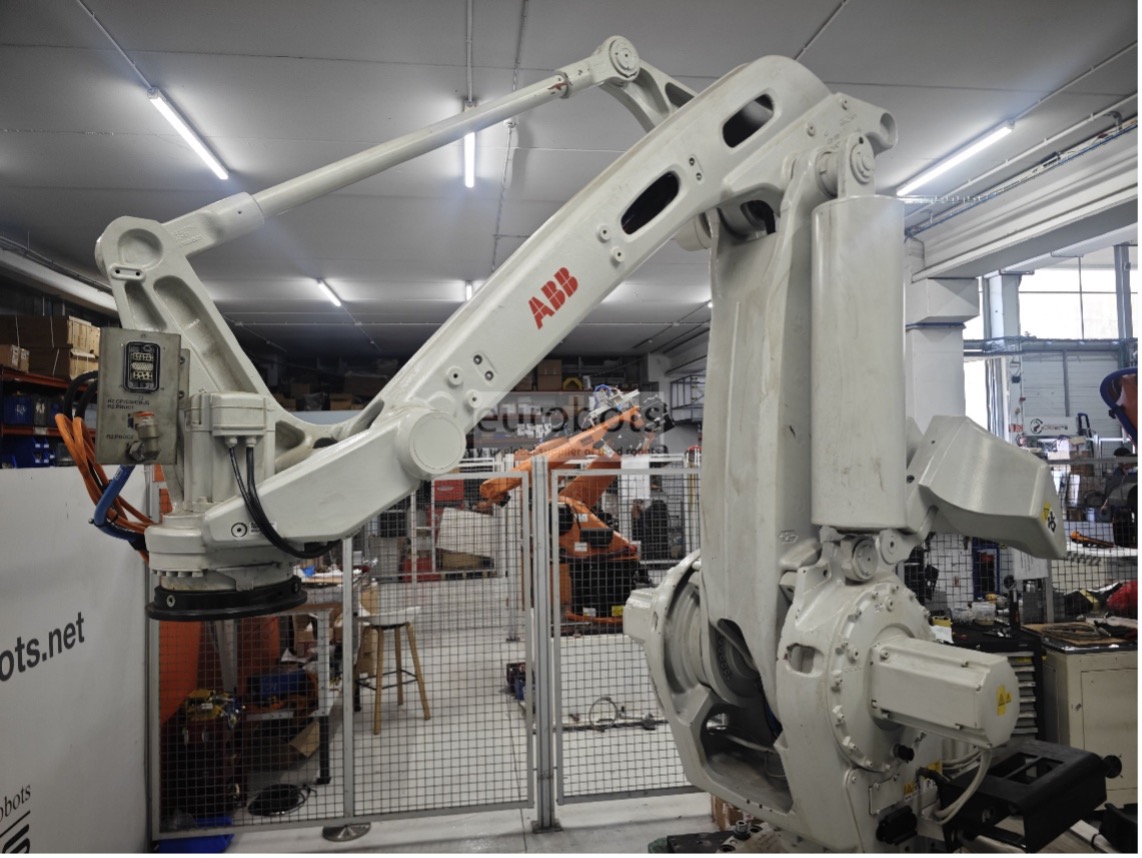
The ABB IRB 760 is ABB’s primary platform for heavy-duty industrial palletizing. It is a 4-axis robot optimized specifically for end-of-line palletizing — not a general-purpose 6-axis robot adapted for palletizing, but a platform designed from the ground up for the motion profile that layer-building requires.
This article covers the verified technical specifications of the ABB IRB 760, the applications it is best suited for, how it compares to the ABB IRB 460, and the cell design considerations that determine whether it delivers on its throughput potential.
For companies considering end-of-line automation, the IRB 760 sits in a specific segment of the palletizing market — high payload, wide reach, sustained multi-shift operation. Whether that profile matches your application is a factual question with a factual answer. This article provides the information to answer it.
ABB IRB 760 Technical Specifications
The IRB 760 handles a payload of 450 kg at a reach of 3,200 mm. Those two numbers define its position in the palletizing market: it covers the heavy end of end-of-line applications that the IRB 460 (110 kg) cannot reach, and it does so from a fixed floor position without requiring a linear track.
The robot runs on ABB’s OmniCore controller on current production units, and on the IRC5 controller on older refurbished units. Both are capable platforms for standard fixed-pattern palletizing. OmniCore adds native vision integration and advanced motion control for applications that need it. The IRC5 is well-supported in the secondary market and a practical choice for operations that do not need OmniCore’s features.
Other key specifications:
- Axes: 4
- Offline programming: RobotStudio compatible — full cell simulation before installation
- Protection variants: Standard and food-grade
ABB’s full technical datasheet for the IRB 760 is available on the ABB product page.
The 4-axis configuration is a deliberate design choice. For layer-building palletizing, 6-axis flexibility is unnecessary. The additional joints add cost, maintenance complexity, and cycle time without contributing to palletizing performance. The IRB 760’s 4-axis kinematics are optimized for the vertical and horizontal motion that stacking requires. The result is faster, more energy-efficient cycles than a general-purpose 6-axis robot at the same payload.
The 3,200 mm reach is one of the IRB 760’s most practical advantages in cell design. It allows the robot to cover two full pallet positions simultaneously from a fixed base — eliminating the need for a linear track that would add capital cost, maintenance complexity, and cell footprint. For facilities where floor space is a constraint, that reach envelope is a meaningful design benefit.
The OmniCore controller on current production IRB 760 units supports advanced motion control and ABB’s integrated vision interface. For operations that need vision-guided palletizing — identifying product position on the infeed conveyor before picking — OmniCore handles this natively. The IRC5 controller on earlier units is a capable platform for standard fixed-pattern palletizing and is well-supported in the refurbished market.
ABB IRB 760 vs ABB IRB 460: Which Palletizing Platform to Choose
ABB offers two dedicated palletizing robots. The IRB 760 and the ABB IRB 460 serve different throughput and payload profiles.
The IRB 460 is optimized for speed at moderate payloads — up to 110 kg. It is the better choice for light-to-medium product palletizing at maximum throughput. Consumer goods, packaged food, and beverage bottle lines where individual case weight is below 30 kg typically fit within the IRB 460’s capability.
The IRB 760 handles heavier payloads up to 450 kg and its 3,200 mm reach exceeds the IRB 460’s envelope. It is the right choice when the robot handles multiple heavy cases per cycle, covers double pallet stations, or serves lines where product weight pushes above the IRB 460’s practical limit.
For most food and beverage end-of-line applications, the IRB 460 is sufficient. For heavier industrial products, multi-case grippers, or wide cell geometries, the IRB 760 is the appropriate platform.
One additional consideration is future-proofing. If a company currently palletizes moderate-weight products but anticipates heavier formats as its product range evolves, specifying the IRB 760 now avoids a robot replacement in three years. The cost difference between the two platforms is smaller than the cost of replacing a correctly functioning cell ahead of its economic life.
Applications Where the ABB IRB 760 Performs Best
Food and Beverage End-of-Line
Lines handling cases of bottled beverages, canned goods, or bulk packaged products frequently involve heavy multi-case gripper loads. The IRB 760 handles these with payload headroom. The food-grade variant — with sealed joints and hygienic design — meets the environmental requirements of facilities operating under strict contamination protocols.
Ergonomic risk is a consistent driver of palletizing automation investment in this sector. End-of-line palletizing of beverage cases and canned goods involves repetitive heavy lifting that produces predictable musculoskeletal injury rates. The IRB 760 eliminates that exposure entirely. According to the International Federation of Robotics, palletizing automation in food and beverage manufacturing has grown consistently year-over-year, driven specifically by ergonomic compliance requirements alongside throughput improvement.
Logistics and Distribution
Distribution centers running mixed SKU palletizing benefit from the IRB 760’s payload capacity and reach. ABB’s PalletPack software generates pallet patterns automatically based on box dimensions. This reduces the programming burden for high-mix logistics environments and allows format changes without full reprogramming.
Industrial Products and Heavy Manufacturing
For manufacturing environments palletizing heavy industrial components, metal parts, or automotive sub-assemblies, the 450 kg payload is the relevant specification. Standard palletizing robots in the 110 to 150 kg class are undersized for these applications. The IRB 760 handles them directly.
ABB IRB 760 Cell Design: What Determines Real Throughput
The IRB 760’s specifications support high throughput. The cell design determines whether that throughput is actually achieved.
Conveyor layout and infeed speed. The robot palletizes as fast as product arrives at the infeed. Cell design must match conveyor throughput to the robot’s cycle capacity. If the infeed is undersized, the robot idles. If it exceeds capacity, product accumulates and causes stoppages.
Gripper design. Common configurations include vacuum cup arrays for uniform-surface cases, clamp grippers for bags and irregular packages, and mechanical layer grippers that handle multiple cases per cycle. Multi-case grippers increase throughput by reducing pick cycles per pallet layer. Verify that EOAT weight plus product weight stays within the 450 kg payload limit.
Pallet exchange system. For continuous multi-shift operation, an automatic pallet dispenser and conveyor eliminates manual pallet swap interruptions and keeps the robot running through shift changes.
RobotStudio simulation before installation. ABB’s offline programming tool confirms reach envelope coverage, validates cycle time against the throughput target, and generates programs that load directly to the controller at commissioning. For projects where installation downtime is expensive, pre-commissioning simulation is standard practice.
For a comparison of robotic palletizing against conventional mechanical systems and the full ROI framework, see our article on industrial robots versus traditional palletizing systems. For the end-of-line automation decision framework, see our article on end-of-line automation: when to automate and when not to.
New vs. Refurbished ABB IRB 760
The IRB 760 is well-represented in the refurbished market. A properly rebuilt unit performs identically to a new one for standard palletizing. The operating environment is controlled, the motion profile is repetitive, and the robot is not exposed to the harsh conditions that accelerate wear in foundry or machining applications.
The IRC5 controller on older IRB 760 units is well-documented and widely supported. Spare parts availability is strong through both ABB’s service network and third-party providers. For buyers where OmniCore’s advanced features are not required — which is most standard palletizing applications — a refurbished IRC5-equipped IRB 760 is a sound investment.
For the complete decision framework on new versus refurbished, see our article on new vs refurbished robots: when each option is appropriate.
FAQ
What is the payload and reach of the ABB IRB 760?
The ABB IRB 760 has a payload of 450 kg and a reach of 3,200 mm, verified from ABB’s official product documentation. Some older sources cite 3,200 mm — the correct current figure is 3,200 mm. The payload budget must account for end-of-arm tool weight in addition to product weight.
What is the difference between the ABB IRB 760 and the IRB 460?
The IRB 460 is optimized for speed at moderate payloads up to 110 kg. The IRB 760 handles heavier loads up to 450 kg with greater reach at 3,200 mm. The IRB 760 is correct for heavy products, multi-case grippers, or cells covering double pallet stations. For lighter consumer goods lines, the IRB 460 delivers faster cycle times at lower cost.
Is the ABB IRB 760 suitable for food industry palletizing?
Yes. The food-grade variant has sealed joints and hygienic design for food and beverage manufacturing environments. Confirm with ABB or your integrator that the specific protection variant meets your facility’s contamination control requirements before specifying.
How many pallets per hour can the ABB IRB 760 produce?
Throughput depends on case weight, pallet pattern, layer count, gripper configuration, and infeed speed. ABB does not publish a single pallets-per-hour figure because it varies by application. Accurate figures come from a RobotStudio simulation with the specific cell parameters. Any throughput claim without a simulation basis is an estimate.
Can the ABB IRB 760 handle multiple packaging formats?
Yes, with appropriate gripper design and recipe-based programming. Format changes are managed through the HMI by selecting a stored program. If the format change requires a different gripper, a quick-change EOAT system allows the transition with minimal downtime. For high-format-variety operations, the gripper platform design matters more than robot selection.
Talk to URT About ABB IRB 760 Equipment
At URT, we supply ABB palletizing robots — including the IRB 760 — new and refurbished, for end-of-line applications in food, beverage, logistics, and industrial manufacturing.
If you are evaluating the ABB IRB 760 for a palletizing project, contact URT. We will give you a direct, technical answer based on your actual production requirements.