
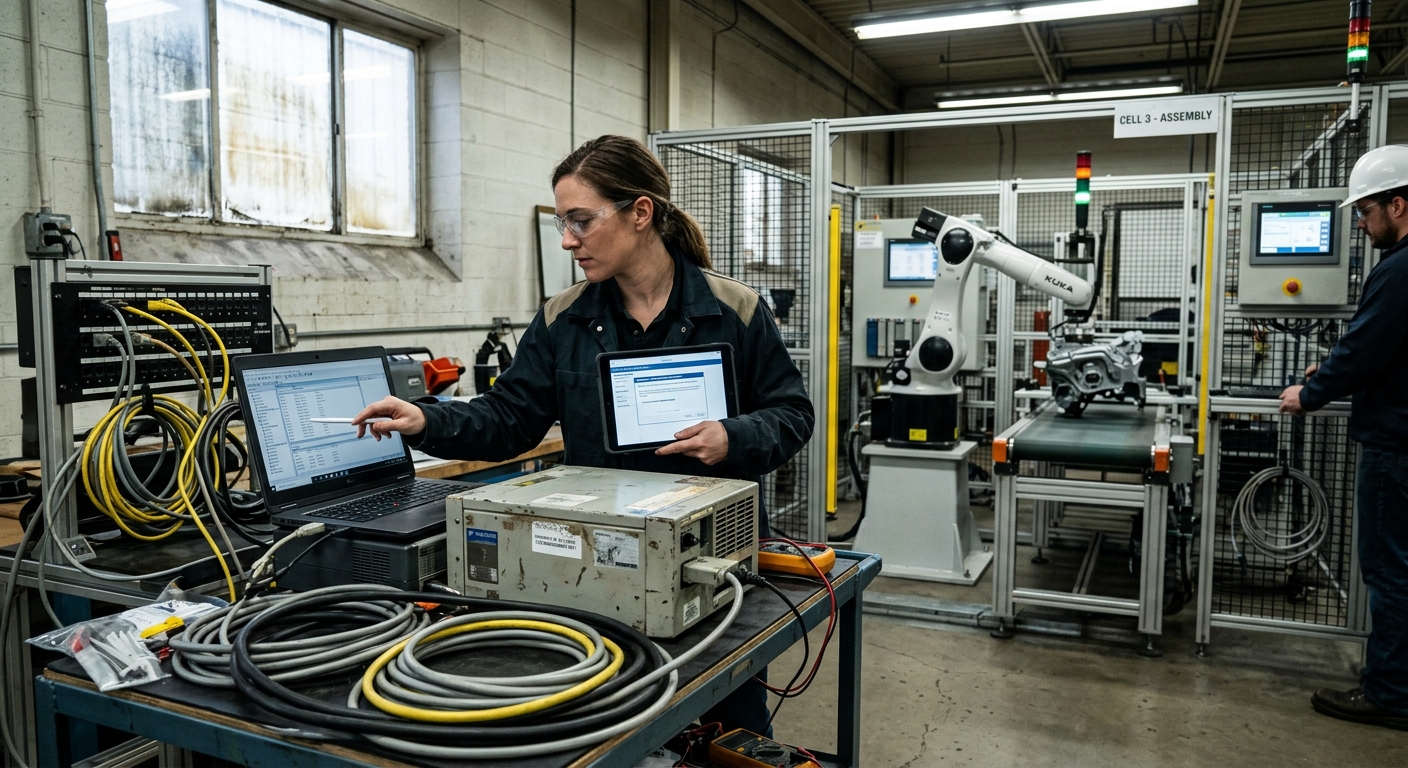
A Compatible Robot Arm Is Not Enough
A used robot can meet the mechanical requirements of an application and still become an expensive integration problem if used robot controller compatibility is checked too late. The controller determines how the robot is programmed, how it communicates with other equipment, which software functions are available, how backups are managed, and how the plant will support the system after commissioning.
This changes the buying decision. A robot with an attractive purchase price may require additional communication hardware, software options, engineering time, training, or replacement components before it can operate inside the intended cell. Those costs do not necessarily make the robot a bad purchase, but they need to be understood before procurement rather than discovered during commissioning.
The correct question is therefore not simply whether the robot can perform the required motion. The buyer needs to establish whether the robot, controller generation, installed options, existing automation architecture, and available support form a system that can be integrated and maintained with acceptable risk.
Controller Generation Must Be Identified Before Compatibility Is Assumed
Two robots from the same manufacturer should not automatically be treated as equivalent from an integration perspective. Controller generations can differ in programming environment, communications, software options, safety architecture, backup procedures, interfaces, and available replacement parts.
This matters particularly when a plant already operates robots from the same brand. Brand standardization can reduce some integration and maintenance complexity, but the benefit depends on the actual controller generation and configuration. A maintenance team familiar with one generation should not assume that every older or newer controller will fit its existing procedures without additional work.
The controller identity should therefore be documented as part of the purchasing specification. The buyer should establish the exact controller platform and configuration associated with the robot rather than relying only on the robot model or manufacturer name.
This is part of the wider process of evaluating refurbished robot compatibility with existing systems. Mechanical suitability and controller suitability need to be evaluated together because a mismatch in either can change the economics of the project.
Communication With the Existing Cell Has to Be Verified
A robot controller rarely operates in isolation. Depending on the application, it may need to exchange information with a PLC, machine tool, conveyor, vision system, welding equipment, process equipment, safety devices, sensors, operator interface, or other controllers.
For that reason, knowing that a controller has “network connectivity” is not a sufficient compatibility check. The relevant question is whether the specific controller configuration supports the communication method and functions required by the intended cell.
PLC and Production Communication
The buyer should document what information must move between the robot and the rest of production. Typical integration logic may include cycle requests, machine-ready conditions, robot status, part confirmation, tool states, faults, completion signals, and recovery conditions.
The controller must provide a practical method of exchanging the required information with the existing architecture. Different controller generations, firmware versions, communication options, and licensed software functions can affect what integration methods are available.
This is why communication compatibility should be confirmed before procurement. Finding a mismatch after the robot arrives can turn what appeared to be a straightforward installation into additional controls engineering and hardware work.
Signal Logic Matters as Much as the Connection
Even when two controllers can communicate, the cell still needs clearly defined production logic. Each device needs to interpret operating states consistently, and responsibility for each production function should be clear.
A robot that communicates successfully with the PLC can still cause commissioning problems if fault states, restart conditions, sequence ownership, or recovery logic have not been defined. Compatibility establishes whether the systems can exchange information; good integration determines whether that information creates predictable production behavior.
The same principle affects programming work. When estimating implementation effort, consider not only robot paths but also the controls and commissioning work around them. URT’s guidance on reducing robot programming time in industrial automation provides additional context for evaluating that project effort.
Software and Licences Can Change What the Controller Can Actually Do
A controller platform may be technically capable of a function without the purchased unit being configured to provide it. Used equipment therefore needs to be evaluated according to the software and options actually present on that controller, not according to what the controller family could support when originally ordered.
This distinction becomes important when the intended application requires particular communications, process functions, coordinated equipment, or other optional capabilities. Assuming that a function is available because similar controllers support it creates procurement risk.
The buyer should determine which installed software and licensed functions are necessary for the planned application and then verify their presence. If something is missing, the next question is whether it can realistically be added to that controller generation and what additional engineering or commercial implications follow.
Program and configuration backups also belong in this review. The plant needs a practical way to preserve the controller configuration and restore the system after a failure or maintenance event. A controller that enters production without an understood backup strategy creates unnecessary recovery risk.
Safety Compatibility Has to Be Evaluated at Cell Level
Controller compatibility is not limited to production signals. The robot will become part of a complete cell that includes safeguarding, control equipment, tooling, sensors, operator interfaces, and other machinery.
The buyer therefore needs to establish how the used controller will fit into the safety architecture designed for the intended installation. This is not a reason to assume that an older controller is automatically unsuitable. It is a reason to avoid assuming that an existing or previously used safety configuration can simply be transferred to a different cell.
For broader safety context, OSHA’s robotics guidance treats the robotic system as more than the manipulator alone. That system-level perspective is useful during a used robot purchase because controller, end effector, related machinery, sensors, controls, and energy sources all affect the final installation.
Safety requirements should be defined for the actual project and evaluated by appropriately qualified personnel. Purchasing a used robot does not remove the need to assess the integrated cell and its intended operation.
Supportability Can Turn a Compatible Controller Into the Wrong Purchase
A controller can pass the immediate integration check and still be a weak long-term choice. Once the robot enters production, the plant needs to troubleshoot faults, maintain backups, replace failed components, support software, train personnel, and recover the cell when something goes wrong.
This is where controller age and plant capability become operational questions rather than technical details. If replacement components are difficult to source, internal technicians have no experience with the platform, or external support is limited, a failure can create more production exposure than the initial purchase saving justified.
Conversely, an older controller is not automatically a poor choice. If the platform is well understood by the plant, appropriate parts and technical support are available, and the controller provides the functionality required by the cell, its age alone does not establish that replacement is necessary.
Maintenance familiarity also has economic value. A controller platform already used elsewhere in the facility may simplify troubleshooting, training, backup practices, and spare-parts planning. Those factors should be considered alongside purchase price when comparing candidates.
The Lowest Purchase Price Can Create the Higher Project Cost
Used robot procurement becomes misleading when the comparison stops at the quoted equipment price. The relevant figure is the cost of getting the robot into stable production and supporting it afterward.
A controller mismatch can create additional expenditure through interface hardware, software, engineering, programming, commissioning, training, spare parts, or external technical support. More importantly, unresolved compatibility problems can delay commissioning or increase downtime after the cell enters production.
That does not mean a used robot must match every piece of existing plant equipment without modification. Integration work is normal. The purchasing decision should instead distinguish between planned integration work with a known cost and an unidentified compatibility problem whose consequences will only become clear after delivery.
This is also why the broader new versus refurbished robot decision should consider integration and support requirements rather than capital cost alone. The lower equipment price is valuable only when the complete project remains technically and commercially defensible.
When a Newer Robot and Controller May Be the Safer Decision
A used robot is not automatically the right choice even when the manipulator itself is in good mechanical condition. If the required controller functions cannot be confirmed, the plant cannot obtain appropriate support, or integration requires extensive changes to the existing automation architecture, the apparent saving can become difficult to defend.
A newer system may also be easier to justify when controller standardization is strategically important to the plant. Introducing another generation solely because one used robot is inexpensive can add training, spares, software, and troubleshooting requirements that remain long after the procurement saving has been absorbed.
The decision should be based on the full production environment. A used controller that is proven compatible, maintainable, and supportable can be a sensible choice. One that requires a series of unverified assumptions should be treated as an integration risk until those assumptions are resolved.
What to Verify Before Buying a Used Robot Controller
Use this checklist before issuing the purchase order, not after the robot reaches the integration floor. The objective is to turn compatibility assumptions into documented requirements that purchasing, engineering, maintenance, and the integrator can review together.
- Identify the exact robot model and controller platform being offered.
- Confirm that the controller belongs to and is correctly configured for the robot being purchased.
- Document the PLC, machines, conveyors, process equipment, sensors, vision systems, and other devices the robot must communicate with.
- Confirm the required communication methods against the actual controller configuration.
- Verify the software and licensed options required by the application.
- Confirm how programs, controller configuration, and relevant system data will be backed up and restored.
- Define how the controller will fit the intended cell safety architecture.
- Identify any additional interface hardware or controls engineering required before production.
- Check the availability of appropriate replacement parts and technical support for the controller generation.
- Confirm that internal maintenance personnel or external support providers can service the platform.
- Estimate programming, commissioning, training, and integration work as part of the project cost.
- Define fault and recovery behavior between the robot, PLC, and connected equipment before commissioning.
The mechanical condition of the robot still matters. Controller compatibility does not replace inspection of the manipulator, application history, service condition, tooling requirements, or other purchasing checks. It is one part of a complete used-equipment evaluation.
FAQ
Does a used robot controller have to be the same generation as the controllers already in my plant?
No. Different generations can potentially operate in the same facility, but compatibility and support should be verified rather than assumed. Communication requirements, software, safety architecture, maintenance capability, spare parts, and training can all affect whether introducing another generation is practical.
If the robot and PLC use industrial networking, does that mean they are compatible?
Not necessarily. The buyer needs to verify the actual communication capabilities and configuration of both systems, along with the signals and production logic required by the application. Establishing a network connection does not by itself resolve sequencing, fault handling, or recovery behavior.
Why do software options matter when buying a used controller?
The controller family may support functions that are not installed or licensed on the individual unit being purchased. The required functions should therefore be checked against the actual controller configuration before the purchase is approved.
Is an older robot controller automatically a bad investment?
No. An older controller can remain a practical choice when it provides the required functionality, can be integrated with the intended equipment, has appropriate support and parts available, and can be maintained by the plant or its service partners. Age becomes a problem when it creates unacceptable integration or uptime risk.
Should controller compatibility be checked before inspecting the robot mechanically?
Both checks are necessary. Mechanical condition determines whether the robot itself is a sensible equipment purchase, while controller compatibility determines whether the system can realistically be integrated and supported in the intended production environment. Passing one check does not compensate for failing the other.
When should a plant choose a newer robot instead of a used one?
A newer system may be the safer choice when required controller functionality cannot be confirmed, support for the existing generation is inadequate, or adapting the used system would create excessive integration, maintenance, or downtime exposure. The decision should compare complete project risk rather than purchase price alone.
Talk to URT About Used Robot Controller Compatibility
If you are evaluating used robot controller compatibility, contact URT. We will give you a direct, technical answer based on your actual production requirements.