
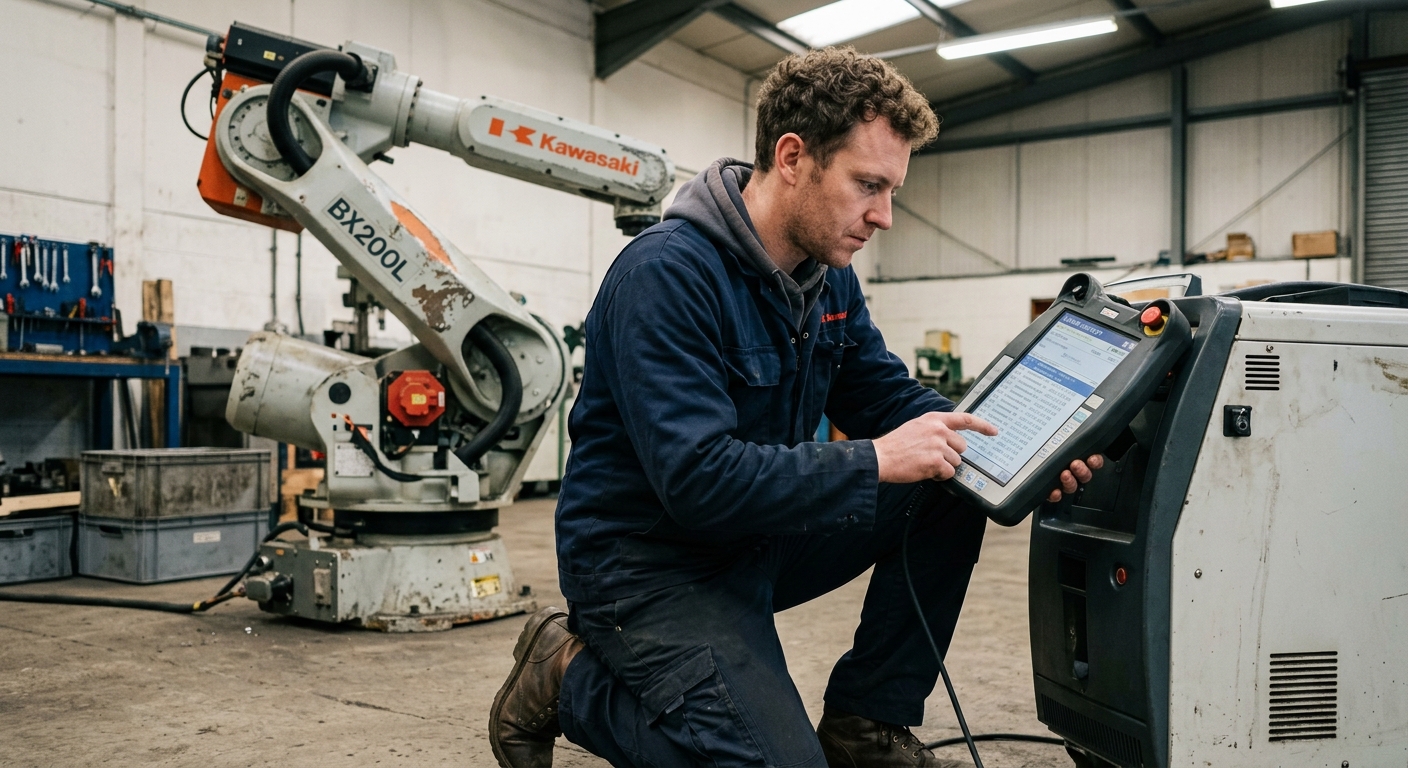
A clean exterior and a successful power-up do not tell you how a used industrial robot behaved during production. The robot alarm history can provide another layer of evidence by showing which faults were recorded, whether similar alarms occurred repeatedly, and which areas deserve closer inspection before a buying decision is made.
Alarm history is not a complete condition report. An alarm can result from the robot itself, tooling, peripheral equipment, communication, programming, operating conditions, or an event elsewhere in the cell. The value is not in counting alarms; it is in understanding the pattern and determining what still needs to be verified.
For a used robot buyer, that distinction matters. A long alarm list does not automatically mean the robot is unreliable, while a short or empty history does not prove that the machine has had an easy operating life.
Why Alarm History Should Be Part of a Used Robot Inspection
A used robot inspection has to answer a practical question: what evidence supports the condition and production risk you are being asked to accept? Visual inspection, mechanical checks, controller condition, available service information, and an operational test all contribute to that answer. Alarm history can add context that a short demonstration cannot reproduce.
Consider a robot that powers up and completes a basic movement test without an obvious problem. That test confirms something useful about its condition at that moment, but it does not show whether a particular fault has appeared intermittently during previous operation.
Historical alarms may direct attention toward recurring communication interruptions, safety events, axis-related faults, peripheral problems, or other conditions recorded by the controller. The exact meaning depends on the manufacturer, controller generation, alarm code, configuration, and circumstances in which the alarm occurred.
This is why alarm history should be treated as diagnostic evidence rather than a pass-or-fail score. Buyers evaluating second-hand equipment should combine it with the broader checks required before buying a refurbished robot, rather than making a condition judgment from the alarm screen alone.
Read Patterns Before You Judge Individual Alarm Codes
The first mistake when reviewing an alarm log is to focus immediately on the most serious-looking message. A single alarm without operating context may tell you very little. A repeated pattern can be much more useful.
The objective is to identify recurrence, concentration, timing, and relationships between events. Those patterns help determine where the inspection should go next.
Look for repeated alarms
If the same alarm or related group of alarms appears repeatedly, it deserves investigation. Repetition does not prove that a component has failed, because the root cause may be external to the robot. It does indicate that the condition was not isolated in the recorded history.
The next question is therefore not simply, “What does this alarm mean?” It is, “Why did this condition keep occurring, and was the underlying cause corrected?”
That distinction prevents a buyer from replacing components based only on an alarm description. It also prevents a recurring historical problem from being dismissed because the robot happens to operate correctly during a short test.
Look for clusters rather than isolated events
Several different alarms appearing around the same operating event can be related. A primary problem elsewhere in the cell can create secondary alarms, and those secondary messages can make the history look more complicated than the underlying failure actually was.
For example, communication, peripheral, safety, and program interruptions may appear together depending on how the cell is configured and what occurred. The correct interpretation requires the relevant controller documentation and an understanding of the original system architecture.
A buyer should therefore avoid reading every entry as an independent robot failure. The sequence matters.
Use timestamps and available context carefully
Where the controller provides useful date, time, or event information, compare that information across recurring alarms. Concentrated events can suggest a particular production episode, commissioning activity, maintenance intervention, cell change, or unresolved operating problem.
However, timestamps are useful only when the controller clock and retained history can be trusted. They should support an investigation, not become proof of operating history by themselves.
Separate Robot Faults From Cell and Process Problems
An industrial robot does not operate in isolation. It interacts with tooling, safety devices, PLCs, sensors, process equipment, conveyors, fixtures, networks, and other machines. An alarm recorded by the robot controller can therefore describe a condition detected by the robot without proving that the robot created it.
This distinction is especially important when a robot has been removed from its original cell. The buyer may have the controller and manipulator but no longer have access to the equipment that generated or contributed to some historical events.
Robot-side conditions
Some alarm patterns may justify closer examination of the manipulator, controller, feedback system, cabling, drives, or other robot-side components. The alarm itself should not be used as a substitute for that inspection.
The appropriate response is to identify the exact code in the manufacturer documentation, understand the conditions that can trigger it, and test the relevant system appropriately. Do not infer a specific failed component from a general alarm category without that verification.
Cell-side conditions
Other alarms may originate from interaction with external equipment. Safety circuits, PLC communication, interlocks, tooling, sensors, process equipment, or network connections can stop robot operation even when the manipulator itself is mechanically healthy.
This matters when estimating refurbishment and integration work. A historical cell-side alarm may have little relevance to a new installation if the original peripheral equipment will not be reused. Conversely, controller or interface limitations revealed during inspection can matter directly when connecting the used robot to the buyer’s new system.
URT’s guidance on refurbished robot compatibility with existing systems is relevant here because condition and compatibility are separate buying questions. A robot can be mechanically serviceable and still be a poor choice for a particular integration architecture.
What a Buyer Should Investigate When an Alarm Keeps Returning
A recurring alarm should change the inspection plan. It does not automatically justify rejecting the robot, but it does justify asking for enough evidence to understand the risk.
The useful investigation moves from the recorded event to the probable system involved, then from that system to physical or functional verification. The alarm log tells you where to look; it does not complete the diagnosis.
Confirm the exact robot and controller configuration
Alarm interpretation must match the actual equipment. Manufacturer, robot model, controller generation, software configuration, installed options, and application history can affect what information is relevant.
Do not apply an alarm explanation from a similar controller or another robot generation simply because the code looks familiar. Manufacturer documentation for the actual controller should be the reference point.
Ask what corrective work was performed
If service records are available, compare recurring alarms with maintenance or repair information. A pattern followed by documented corrective work and subsequent stable operation presents a different risk from the same pattern with no explanation.
When records are unavailable, the uncertainty should remain part of the buying assessment. It should not be replaced by an assumption that the fault was repaired.
Test the relevant functions where practical
A basic power-up is not sufficient evidence for every type of historical fault. The inspection should be designed around the concerns identified in the history and performed by personnel qualified to evaluate that robot and controller.
This does not mean attempting unsafe repairs or bypassing protections to reproduce an alarm. If the history points toward a condition that cannot be responsibly verified during inspection, specialist assessment is preferable to guessing.
An Empty Alarm History Is Not a Clean Bill of Health
Buyers can make the opposite mistake as well: assuming that an empty or unusually limited alarm history proves excellent condition. It does not.
The retained information available to a buyer can be affected by controller history management, previous service work, configuration changes, component replacement, storage conditions, or other actions during the robot’s life. Without supporting evidence, an empty screen cannot establish what happened throughout years of operation.
Condition should therefore be assessed through multiple independent signals. Mechanical inspection, controller condition, operational testing, available maintenance records, application history, compatibility, spare-parts considerations, and alarm information all contribute different pieces of evidence.
This is also why purchase price should not dominate the comparison. The total cost of ownership of a used robot includes the work required to make the equipment dependable and compatible with the intended production system.
When Alarm History Should Trigger Specialist Inspection
Alarm logs become particularly valuable when they reveal a pattern that the buyer cannot confidently interpret. This is the point where specialist support can reduce risk.
Repeated events associated with motion, feedback, controller hardware, safety functions, communication, or other critical systems should not be diagnosed from a screenshot or code description alone. The equipment, configuration, operating state, and manufacturer documentation all matter.
Specialist inspection is also appropriate when the robot cannot be tested under conditions that meaningfully address the historical concern. A robot removed from a complete production cell may not reproduce problems that depended on the original tooling, PLC, network, process equipment, or operating sequence.
The goal is not to eliminate every alarm before buying. Industrial equipment can accumulate operational events for many legitimate reasons. The goal is to distinguish explainable history from unresolved uncertainty that could become downtime after installation.
Use Alarm History as One Part of the Buying Decision
The alarm review becomes most useful when it is incorporated into a broader technical assessment instead of being treated as a separate administrative check. Buyers should use the findings to decide what must be inspected, tested, documented, priced, or resolved before purchase.
Use the following checklist as a decision aid rather than a diagnostic procedure. Any technical investigation should follow the documentation and safe working practices applicable to the specific robot and controller.
- Confirm the exact robot model and controller generation.
- Review the available alarm history before it is dismissed or cleared.
- Identify recurring codes and related groups of events.
- Check available timestamps and event sequences for patterns.
- Verify alarm meanings against documentation for the actual controller.
- Separate probable robot-side events from external cell or process events.
- Compare recurring alarms with available maintenance and service records.
- Ask whether corrective work was performed and what evidence supports it.
- Use the history to define additional mechanical, electrical, controller, or functional inspection requirements.
- Record uncertainties that cannot be verified before purchase.
- Include unresolved condition and compatibility risks in the total project assessment.
The same principle applies to the wider purchase decision. A used robot can represent a sensible investment when its condition, controller, compatibility, support requirements, and intended application are understood. The comparison between new and refurbished robots should therefore be based on production risk and total project requirements, not equipment price alone.
FAQ
Does a long robot alarm history mean I should reject a used robot?
No. The number of alarms alone does not establish robot condition. Their type, recurrence, sequence, operating context, corrective history, and relevance to the intended application matter more than the length of the list.
What matters most when reading industrial robot alarm history?
Recurring patterns are usually more informative than isolated entries. Look for repeated or related events and use them to determine which systems need further investigation. Interpret exact codes using documentation for the actual controller.
Can an alarm recorded by the controller come from equipment outside the robot?
Yes. A robotic cell can include safety devices, PLCs, tooling, sensors, process equipment, networks, and other peripherals. Depending on the system design, events involving those systems can result in alarms or interruptions recorded by the robot controller.
Does an empty alarm history prove that a used robot is in good condition?
No. Alarm history is only one source of evidence and should not be treated as a complete service record. Mechanical condition, controller condition, functional testing, available maintenance history, compatibility, and other inspection findings still need to be evaluated.
Should I clear the alarm history during a pre-purchase inspection?
The existing history can contain useful diagnostic information, so it should be reviewed and documented before any action that could remove relevant evidence. Any controller operation should follow the applicable manufacturer procedures and be performed by qualified personnel.
When should recurring alarms be reviewed by a specialist?
Specialist review is appropriate when the alarm pattern cannot be confidently interpreted, when it points toward systems requiring technical diagnosis, or when the available inspection cannot meaningfully verify the suspected condition. This is preferable to assuming either that the robot is defective or that the alarms are harmless.
Talk to URT About Used Robot Alarm History
If you are evaluating used robot alarm history, contact URT. We will give you a direct, technical answer based on your actual production requirements.