
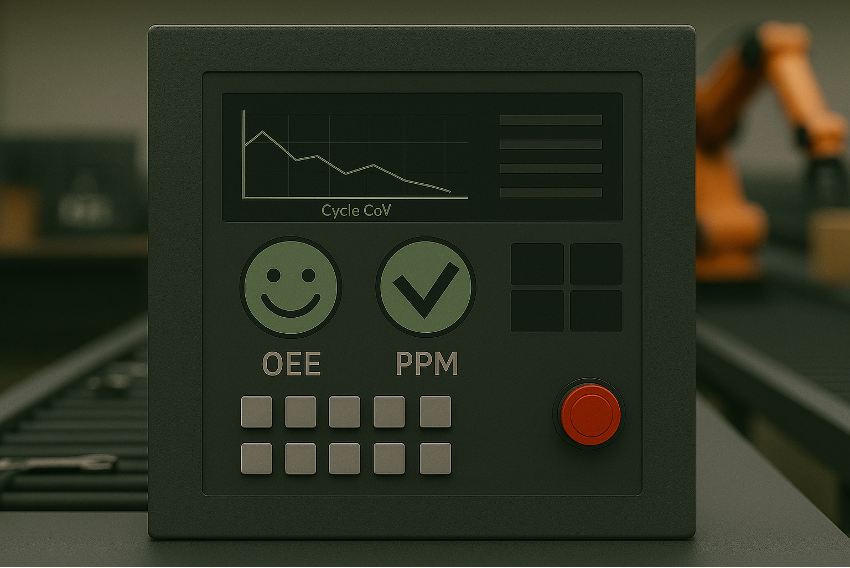
In many industrial companies, robotic automation is no longer justified only by the need to produce more in less time. In mature plants, demand may already be stable and total output may not need to increase. In these cases, the main operational problem is often variability, not capacity.
This creates a practical question for production managers, quality teams, maintenance departments, and financial decision-makers:
How can a company justify investing in a robot if production volume will remain the same?
The answer is that automation does not create value only by increasing throughput. In many industrial processes, its strongest contribution is process stability: reducing variation, improving repeatability, making performance easier to measure, and lowering hidden operational costs that are not always visible in standard productivity calculations.
Why robotic automation can make sense without increasing production volume
When a plant is already producing enough units, a traditional ROI argument based only on higher output may be weak. That does not mean automation has no business case. It means the justification must be built around a different set of operational benefits.
In stable-volume environments, robotic automation is often justified by:
- Lower process variability
- More predictable cycle times
- Reduced scrap and rework
- Better traceability
- Lower dependence on operator availability
- Reduced operational risk
- Improved quality consistency
- More stable maintenance planning
The business case becomes less about producing more and more about producing with greater control.
1. Reducing human variability
Manual processes, even when performed by skilled operators, are influenced by variation. This does not mean operators are the problem. In many cases, human adaptability is exactly what keeps a process running. The issue is that this adaptability also creates inconsistency when the process depends too heavily on individual judgement.
Common sources of variation include:
- Fatigue during long shifts
- Different working styles between operators
- Shift changes
- Experience level
- Environmental conditions such as lighting, temperature, or dust
- Small manual corrections that are not documented
A robot does not replace process knowledge, but it can remove a large part of the inconsistency created by manual repetition. When the process is correctly defined, robotic automation can deliver:
- More stable cycle times
- Fewer deviations between shifts
- Reduced rework
- More consistent part handling
- Improved perceived quality
This is especially relevant in operations where the required output is already sufficient, but the quality, timing, or repeatability of that output still varies too much.
2. Improving medium-term process stability
In many plants, performance problems do not appear continuously. They appear intermittently: one shift performs better than another, one batch is stable while the next creates rework, or output is acceptable most of the time but difficult to predict.
Typical symptoms include:
- “Good days” and “bad days” in the same production cell
- Different results between experienced and less experienced operators
- Irregular cycle times
- Frequent small adjustments
- Unclear root causes for scrap or rework
- Difficulty planning production with confidence
In this context, robotic automation does not need to increase total throughput to create value. It can convert a variable process into a more predictable one. That predictability has a direct operational value because it makes planning, quality control, and maintenance easier to manage.
3. Capturing financial benefits hidden in stability
Some of the strongest financial benefits of robotic automation do not appear immediately in a simple “units per hour” calculation. They are often hidden inside operational instability.
Lower variability can reduce costs related to:
- Unplanned downtime
- Overtime used to recover lost output
- Scrap and material waste
- Rework
- Corrective interventions
- Tool or fixture wear caused by inconsistent handling
- Quality inspections triggered by process instability
- Missed delivery deadlines
When these costs are measured, the ROI can become clearer even without a production volume increase. The question is not only “How many more parts will the robot produce?” A better question is: How much instability is the current process costing the company?
4. Improving process traceability
Robotic automation can also improve traceability by making the process easier to measure. Depending on the system design, a robotic cell can support the collection of:
- Cycle times
- Repetition counts
- Error events
- Stop causes
- Consistency metrics
- Process deviations
- Production history
This information is valuable for internal audits, quality control, certifications, maintenance planning, and continuous improvement. Even when the robot supplier is not the full system integrator, the introduction of automation can create a more objective basis for measuring process performance.
Without traceability, many operational decisions rely on impressions: “the line feels unstable,” “this shift performs better,” or “this product variant causes problems.” With measurable data, the company can identify patterns and make better technical decisions.
5. Creating value for quality and maintenance departments
Automation projects are often presented as production investments. In reality, they may be just as valuable for quality and maintenance teams.
For quality departments, robotic automation can help reduce:
- Process deviations
- Inconsistent handling
- Variable inspection results
- Defects caused by operator-dependent execution
- Rework caused by unstable manual operations
For maintenance departments, a more stable process can reduce:
- Unexpected adjustments
- Tool damage
- Reactive maintenance
- Emergency interventions
- Technical staff overload
- Wear caused by inconsistent manual operation
This is why the justification for a robotic automation project should not be built only with the production department. The strongest business case may come from combining production, quality, maintenance, and financial data.
6. Reducing operational risk
The most common mistake when justifying automation is forcing a volume increase argument that does not exist. If the plant does not need more output, the business case should not pretend otherwise.
The stronger argument is based on:
- Stability
- Predictability
- Repeatability
- Traceability
- Risk reduction
- Lower dependence on manual correction
In this context, a robot becomes a tool for operational risk management, not only a productivity booster. It helps the company reduce exposure to process drift, operator dependency, inconsistent cycle times, and hidden quality costs.
How to evaluate ROI without increasing output
When production volume remains unchanged, the ROI model should include the costs that automation can reduce, not only the units it can add.
A more realistic evaluation should consider:
- Current scrap rate
- Current rework cost
- Downtime caused by unstable manual operations
- Overtime used to recover from production instability
- Quality control costs
- Maintenance interventions linked to process variation
- Operator dependency and training time
- Delivery reliability
Once these costs are quantified, automation can be evaluated as a stabilizing investment. This creates a more accurate business case than relying only on throughput increase.
For companies evaluating the financial side of automation, a robotic ROI calculator can help compare investment cost against savings from downtime reduction, scrap reduction, rework reduction, and improved operational stability.
Business value summary
When robotic automation is justified beyond production volume, the most relevant business benefits are:
- Process stability: fewer variations between shifts, operators, and production batches.
- Predictable cycle times: easier planning and more reliable production scheduling.
- Quality consistency: fewer defects caused by manual variability.
- Lower scrap and rework: reduced hidden costs from unstable execution.
- Improved traceability: better process data for audits, quality control, and continuous improvement.
- Maintenance stability: fewer emergency interventions and less reactive work.
- Operational risk reduction: less dependence on individual operators and informal corrections.
- ROI without increasing output: value generated by reducing waste, downtime, variation, and uncertainty.
Useful resources
FAQ
Can robotic automation be justified even if production volume stays the same?
Yes. Robotic automation can be justified by process stability, quality consistency, traceability, reduced scrap, lower rework, and operational risk reduction, even when total output remains unchanged.
Does automation eliminate human expertise?
No. Automation does not eliminate human expertise. It reduces repetitive variability while still relying on human knowledge for process design, supervision, maintenance, and continuous improvement.
Is the financial ROI still positive without increasing output?
It can be, if the current process has hidden costs related to downtime, scrap, rework, overtime, maintenance interventions, or inconsistent quality. These costs should be included in the ROI calculation.
Which department benefits most from robotic automation in stable-volume processes?
Production benefits from repeatability, but quality and maintenance departments often gain significant value from fewer deviations, more stable execution, reduced emergency interventions, and better process data.
What risks does a robot help mitigate?
A robot can help reduce risks linked to operator dependency, inconsistent cycle times, process drift, undocumented manual corrections, quality variation, and unpredictable production performance.
Internal justification checklist
Use this checklist when presenting a robotic automation project to management without relying on a production volume increase.
Process
- High variability in manual operations
- Frequent rework or scrap
- Inconsistent quality between shifts
- Hard-to-predict cycle times
- Frequent small adjustments by operators
Finance
- Hidden costs from downtime, overtime, and scrap
- Cost of reprocessing defects
- Cost of missed delivery deadlines
- ROI calculated without assuming volume growth
Quality
- Need for higher repeatability
- Need for stable tolerances
- Audit or certification requirements
- Need for better process traceability
Maintenance
- Frequent tool or fixture wear
- Reactive maintenance overload
- Unplanned stops linked to process variability
- Need for more predictable intervention planning
Management
- Operational risk reduction
- Improved traceability
- Predictable performance
- Lower dependence on informal manual correction
Build the business case around stability, not only volume
Robotic automation does not always need to increase production volume to be justified. In many mature industrial processes, the strongest business case comes from reducing variation, improving control, and making performance more predictable.
Contact URT to evaluate whether a robotic automation project can reduce operational instability, improve traceability, and create measurable value without requiring higher output.