
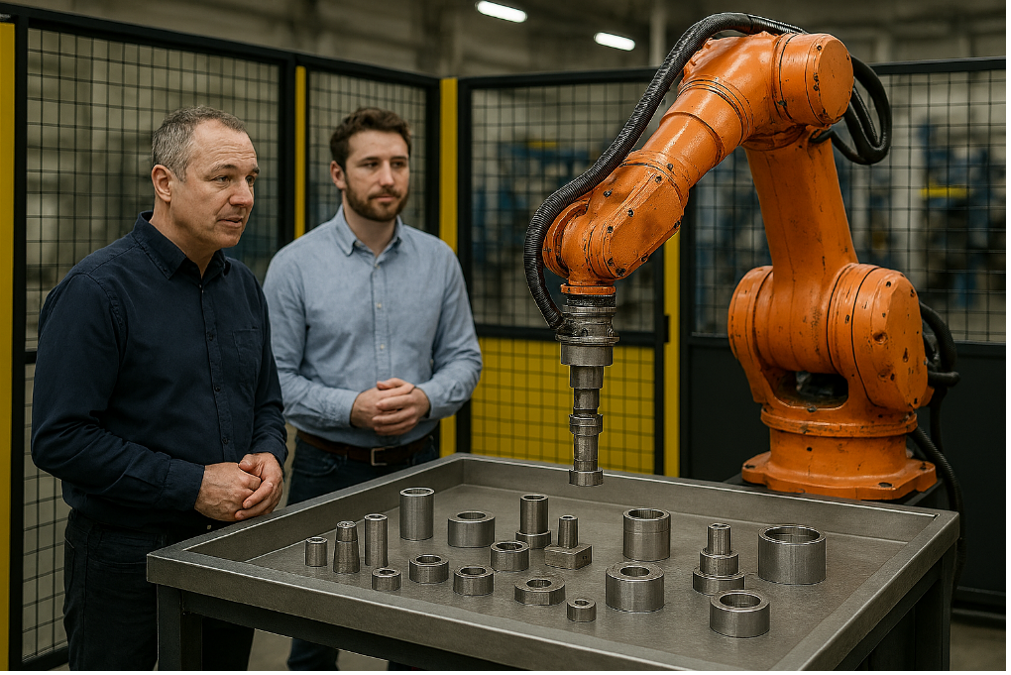
Yes, it is possible to automate a process that involves variable parts, but feasibility depends on what changes from part to part and how much tolerance the operation allows.
If variability stays within defined limits, robotics can absorb it through:
- adaptive tooling
- vision systems
- appropriate programming strategies
When variation is chaotic and input data is not managed correctly, the project quickly becomes unstable and expensive.
The key is turning variability into usable information for the robotic cell.
Not all variability has the same impact
When a company says its parts are variable, this can mean many things:
- dimensions
- geometry
- surface finish
- orientation
- stiffness
- incoming position
- batch‑to‑batch differences
Each type of variability affects automation differently.
- Some variations can be handled with an adjustable gripper
- Others require vision or measurement systems
- Some force a redesign of the production flow itself
The first step is to describe variability precisely, not as a general feeling.
In sectors such as wood, composites, machining, technical food processing, or custom manufacturing, this clarity is critical.
A robotic cell can handle different parts very effectively as long as differences fall within a known framework.
What usually breaks projects is the combination of:
- high variability
- lack of reliable reference data
- expectations of the same speed as a fully standardized process
How to evaluate whether automation is viable
The most useful question is:
What information can the robot use before acting?
That information might be:
- a reference code
- a recipe
- a sensor measurement
- a point cloud
- a simple classification by part family
The clearer the input data, the easier it becomes to adapt:
- trajectories
- gripping
- sequences
—all without losing stability.
If no prior information exists, the cell will need:
- more perception
- more decision logic
This increases cost and complexity.
It is also important to assess process tolerance.
Some operations allow millimeters of deviation; others fail with minimal variation.
Automation feasibility depends not only on the part, but on the acceptable margin of the task: handling, positioning, assembling, cutting, measuring, or milling.
Technologies that typically make variable‑part automation viable
Most successful solutions combine:
- classification by part families
- adjustable tooling
- machine vision
- pre‑measurement
In light machining, cutting, or milling, the ability to recalculate trajectories provides a major advantage.
In handling and assembly, sometimes it is enough to normalize part presentation and allow small corrections.
The right approach is not to add all possible intelligence, but only what is needed to absorb the real variability of the business.
This connects naturally with the URT robotic milling system when variability affects geometry, contours, or surface finish.
Flexibility is not magic — it is built on data, references, and clearly defined variation ranges.
Common mistakes when automating variable processes
The most common mistake is trying to automate chaos without first organizing the input.
Typical issues include:
- mixed parts without family classification
- poor orientation
- lack of reference data
Another frequent error is promising the same throughput as a homogeneous process.
Flexibility has a time cost, and acknowledging it realistically avoids frustration during commissioning.
The good news is that many companies discover they do not need to eliminate all variability — only to manage it better.
Once parts are classified, presentation is improved, and limits are defined, automation often becomes feasible where it once seemed impossible.
link: robotic milling system
❓ FAQ
Does machine vision solve any kind of variability?
No. Vision helps when variation stays within known limits, but it does not replace the need to organize the process and define clear boundaries.
Can the same speed be maintained as with identical parts?
Not always. Flexibility usually requires additional verification or adjustments. The goal is stable, profitable operation, not unrealistic cycle times.
What is the best first step?
Classify parts into families and describe — with data — what actually changes in each one. This analysis alone often simplifies cell design significantly.
If you are dealing with variable parts and wondering whether automation is realistic for your process,
👉 let’s analyze your variability together and identify the right robotic strategy before complexity and costs get out of control.