
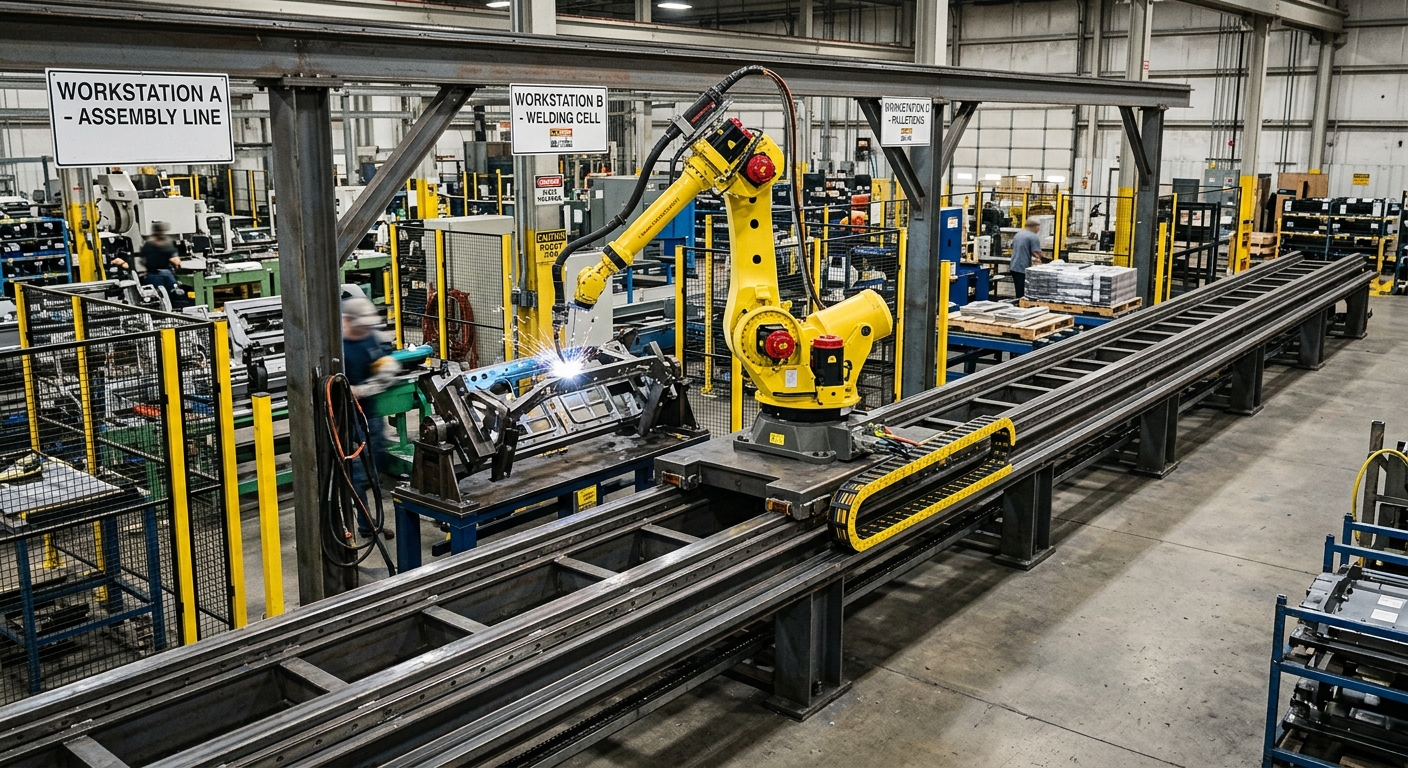
A larger working envelope may seem necessary when a robot cannot reach every process point. However, replacing the arm is not always the best solution. External axes for industrial robots can reposition the robot or workpiece and extend the usable production area. This approach can solve reach problems, but it also adds integration requirements.
The key distinction is simple. An external axis does not increase the mechanical reach of the robot arm itself. Instead, it changes the position of the robot or workpiece within the cell.
A linear track can move the complete robot between work zones. A rotary positioner can present different sides of a workpiece to the robot. Both approaches can expand usable process access without requiring a larger arm.
Why a larger robot is not always the answer
A larger robot may appear to be the simplest answer when process points sit outside the existing working envelope. That choice can create new constraints. A larger arm may require more floor space or create new interference zones. It may also fail to provide the required tool orientation.
An external axis offers another approach. A linear track can move the robot between machines, fixtures, or work zones. A positioner can rotate the workpiece and bring difficult surfaces closer to the robot.
In this way, external axes for industrial robots can change the architecture of the cell. The decision should therefore focus on usable process access rather than maximum geometric reach.
Cycle time must also be considered. A robot may reach several stations but spend too much time moving between them. That travel can reduce the production benefit of the larger working area.
This issue is especially relevant when one robot serves several machines. URT’s guide to robotic machine loading without creating bottlenecks explains why the complete production flow matters. Additional reach has little value if machines spend too much time waiting.
How linear tracks change the usable working area
A fixed robot operates within the working envelope created by its mechanical geometry and mounting position. A linear track changes that relationship. The track moves the robot base and shifts the working envelope along its travel path.
This architecture can support long parts or several production stations. It can also allow one robot to access multiple machines. Equipment no longer has to be concentrated around one fixed robot base.
However, external axes for industrial robots do not make every geometric position useful. The robot still needs an acceptable posture at each process point. Tool orientation, fixtures, cables, guarding, and surrounding equipment can restrict access.
Travel time also becomes part of the production cycle. Long movements between stations may reduce throughput. The cell must therefore be evaluated as a complete production sequence.
Multiple stations require coordinated production logic.
Several stations can create competing demands for the robot. One machine may request unloading while the robot works at another station. The control strategy must decide which operation receives priority.
Buffers can help manage these differences. Recovery logic may also be required when production stops during a transfer. Communication between the robot, machines, PLC, and safety system must support the planned sequence.
Programming effort can increase as the number of possible cell states grows. For projects where this becomes a concern, URT’s guide to reducing robot programming time in industrial automation provides additional planning considerations.
How rotary axes improve process access
Moving the robot is not the only way to expand usable access. In many applications, moving the workpiece can provide a better solution.
A rotary positioner changes the orientation of the part. This can bring difficult process points into a more favorable section of the robot’s envelope. It can also improve the approach angle for the tool.
This distinction matters when the robot can reach a point but cannot approach it correctly. Fixtures, part geometry, or nearby equipment may restrict the wrist. Rotating the workpiece can create a better robot posture.
Welding provides a useful example. A positioner can improve torch access around complex components. However, it cannot correct poor fit-up or unstable fixtures.
Weld quality also depends on process parameters, wire feed, shielding gas, programming, and part consistency. URT examines these broader variables in its guide to the total cost of a robotic welding solution.
Why controller integration matters
A track or positioner adds mechanical movement to the cell. The controller must also manage that movement correctly. Mechanical compatibility alone is not enough.
When external axes for industrial robots are considered, controller compatibility should be checked early. Drives, software options, communication, and safety functions must support the required architecture.
The type of movement matters as well. Some external axes simply reposition the robot between operations. Others move at the same time as the robot during the process.
Coordinated motion creates additional control requirements. Programming and commissioning may become more complex. Process validation must also include the interaction between both motion systems.
These checks become especially important with existing or refurbished equipment. Controller generation and available software should be confirmed. Drive compatibility, communication interfaces, and technical support also need review.
URT’s guide to refurbished robot compatibility with existing systems covers the same compatibility principle in greater depth.
Recovery must be planned before commissioning.
Normal production is only one operating condition. The cell also needs a defined response when production stops unexpectedly.
The robot and external axis may stop in intermediate positions. Operators then need a controlled recovery sequence. The integration plan should address these conditions before production begins.
Testing should include the robot, external motion, tooling, sensors, fixtures, and process equipment. Safety functions must also be included in that validation.
Where external axes create production value
The value of external axes for industrial robots comes from removing a specific production constraint. A larger reachable area alone does not justify the investment.
For example, one robot may serve several machines without reducing their utilization. A track may also allow a long component to be processed without manual repositioning. A positioner may improve tool access around a complex part.
Each case should produce a measurable operational benefit. Cycle time, machine utilization, operator intervention, and process consistency can be compared before and after automation.
Changeover requirements should also be considered. An architecture that works well for one product may become inefficient when fixtures or production sequences change frequently.
The process itself must also be stable. An external axis should not compensate for inconsistent part presentation or uncontrolled process variation.
This principle also applies to broader automation decisions. URT’s framework for choosing which process to robotize first explains why process stability should be established before automation investment.
When an external axis adds too much complexity
An external axis should not be added automatically when a robot lacks reach. Other cell architectures may solve the problem with less complexity.
A fixture could be relocated. Part presentation could be changed. Another robot configuration could also provide better access. In some cases, two robots may suit the production sequence better than one robot on a long track.
With external axes for industrial robots, additional components enter the system. Those components require commissioning, maintenance, programming, and safety considerations.
The frequency of use matters. A costly track may be difficult to justify if the robot needs the additional area only occasionally. The production requirement should therefore be measured before the architecture is selected.
Cycle time can create another limitation. A track may allow one robot to cover several stations while increasing travel time. A positioner may improve access while adding indexing time.
Neither effect automatically makes the concept unsuitable. Both must be included in the production calculation.
External motion changes the safety envelope
A moving robot base changes the area in which hazardous motion can occur. A rotating workpiece can also create new interference and access zones.
The safety concept must cover the complete cell. Guarding, access points, interlocks, maintenance positions, and recovery procedures all require evaluation.
OSHA’s robotics guidance provides broader safety context for robotic systems. It treats associated equipment and controls as part of the robotic installation rather than focusing only on the arm.
Specific safety requirements depend on the installation and jurisdiction. An external axis should therefore be treated as part of the complete cell safety assessment.
What to check before selecting an external axis
The evaluation should start with the production problem rather than the equipment. First identify why the existing robot cannot complete the required process. Then determine which type of motion could remove that constraint.
The following checklist can be used during the initial technical evaluation:
- Identify the process points that cannot currently be reached.
- Determine whether the robot or the workpiece should move.
- Check the required tool orientation at critical process points.
- Review interference with fixtures, tooling, guarding, and surrounding equipment.
- Verify controller, drive, software, communication, and safety compatibility.
- Determine whether coordinated motion is required.
- Include travel and indexing time in the cycle calculation.
- Check cable routing across the complete motion range.
- Provide access for inspection and maintenance.
- Define safe intervention and recovery conditions.
- Plan recovery after interrupted cycles.
- Compare the concept with alternative cell layouts.
The checklist should not be used to select equipment by itself. Instead, it should expose the technical conditions that affect the decision.
A suitable architecture should solve a measurable process constraint. It should also remain practical to program, operate, maintain, and recover.
FAQ
What is an external axis on an industrial robot?
An external axis adds controlled motion to the robotic system. A linear track can move the robot itself. A positioner can rotate or reposition the workpiece.
Does an external axis increase robot reach?
It does not change the mechanical reach of the arm. Instead, it changes the robot’s position relative to the process. This can create a larger usable working area.
Can one robot serve several machines on a track?
Yes, when the production sequence and cell architecture support it. Machine cycles, tooling, travel time, control logic, and safety must all be considered.
Are external axes only used for welding?
No. They can support machine tending, material handling, assembly, and other industrial processes. The application determines whether moving the robot or workpiece creates useful production access.
Can an external axis be added to an existing robot?
It may be possible. Controller compatibility must be confirmed first. Drives, software, communication, safety functions, and the required motion strategy also need verification.
Do external axes always improve productivity?
No. Extra travel or indexing can increase cycle time. Programming and maintenance requirements can also increase. Productivity improves only when the added motion removes a larger production constraint.
How should an external axis be evaluated before investment?
The complete production sequence should be analyzed. Required process points, tool orientation, travel, safety zones, and recovery conditions should all be included. External axes for industrial robots should ultimately be evaluated through usable process access rather than geometric reach alone.
Talk to URT about external-axis integration
If you are evaluating external-axis integration for an industrial robot, contact URT. We will give you a direct, technical answer based on your actual production requirements.