Tag Archives: Artificial Intelligence (AI)

INDUSTRIAL ROBOTS VS. TRADITIONAL PALLETIZING SYSTEMS

Palletizing is one of the most critical stages at the end of the production line. Although it is often perceived as a simple process, in practice it involves occupational risks, production bottlenecks, and hidden operational costs. For many years this process has been handled using traditional systems: manual palletizing, semi‑automatic solutions, or low‑flexibility dedicated machines.

Read More

HOW DOES ROBOTIC AUTOMATION AFFECT INDUSTRIAL CYBERSECURITY WHEN ROBOTS ARE CONNECTED TO CORPORATE NETWORKS OR THE CLOUD?

For a long time, industrial robots operated in isolated environments, disconnected from the rest of a company’s systems. Today, that reality has changed. The need for remote monitoring, production data collection, predictive maintenance and traceability has led to connecting robots to corporate networks and even cloud platforms. As a result, a relatively new concern has

Read More

IS YOUR PROCESS TRULY READY FOR AUTOMATION WITH A REFURBISHED ROBOT?

The truth is that not every industrial task benefits from robotic automation—and even fewer are genuinely compatible with a refurbished robot. The key lies in understanding whether your process meets the fundamental technical conditions that professionals use to evaluate automation projects: aspects such as geometry, repeatability, production volume, accessibility, safety, and the overall stability of

Read More

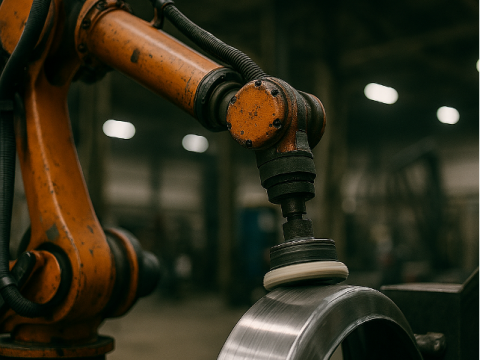
POLISHING, AND FINISHING PROCESSES: WHAT YOU NEED TO KNOW BEFORE INTEGRATION

In the industrial sector, sanding, polishing, and surface finishing might seem like straightforward tasks, but they actually involve a significant level of technical complexity. Each piece requires consistent pressure, precise motions, a uniform rhythm, and an attentive approach to detail—qualities that are difficult to maintain manually over many hours of work. This is where an

Read More

THE 5 SIGNS THAT YOUR MIG/MAG WELDING IS READY FOR AUTOMATION

MIG/MAG welding is one of the most widely used manufacturing processes, but when performed manually it often leads to significant variation. Deciding to automate is not just about bringing new technology into the factory – it’s about determining whether your process is technically and operationally ready for a robot to deliver real, tangible improvements. There

Read More

WHAT SPECIFIC IMPROVEMENTS WOULD WE SEE IN EFFICIENCY, QUALITY, OR COSTS WITH THE INTEGRATION OF A ROBOTIC SOLUTION?

The integration of a robotic welding solution does not simply replace manual labor, but transforms the entire production process. The benefits are mainly reflected in three key areas, which are constantly monitored by the industry: production efficiency, weld quality, and operating costs per part. These improvements are recognized worldwide and proven by the actual performance

Read More

MOTOMAN MH24-10 “HIGH SPEED”: AN EFFICIENT ALTERNATIVE FOR AUTOMATED WELDING

In the robotics industry, the Motoman MH24 is a six-axis articulated robot designed for high-speed tasks such as material handling, general operations, and other precision applications. While it is not a welding-specific robot like some models in Yaskawa’s AR series, its combination of speed, rigidity, and path accuracy makes it a viable option for welding

Read More

PREDICTIVE MAINTENANCE IN INDUSTRIAL ROBOTS: SENSORS, DATA AND MINIMISING DOWNTIME

At the heart of many automated factories, a group of robots works tirelessly for hundreds of hours on end. But what happens if one of these machines fails unexpectedly? An unplanned stoppage can cost thousands of euros per hour, result in lost orders and delayed deliveries. This is where predictive maintenance steps in: instead of

Read More

PREDICTIVE VS CORRECTIVE MAINTENANCE IN INDUSTRIAL ROBOTS

Industrial robots, like any machinery, require regular maintenance. But the key question is: do we act before a failure occurs or after it? Predictive maintenance redefines efficiency by anticipating breakdowns and optimising resources. Corrective: The Traditional Model Corrective maintenance takes place after a failure: when a servomotor stops, an axis loses calibration or a controller

Read More

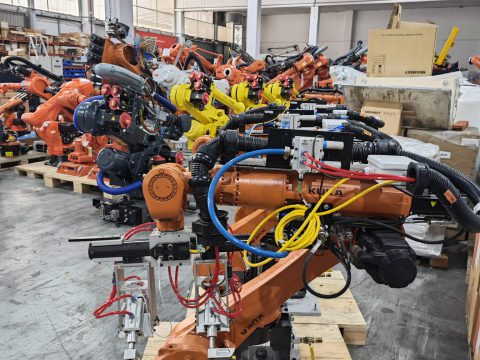
KUKA KR30-3 ON RAIL WITH TWO ROTARY POSITIONERS: INDUSTRIAL CHALLENGES AND ADVANTAGES FOR PRODUCTION LINES

A recent video showcases a robotic cell featuring a KUKA KR30-3 mounted on a linear rail (track) and paired with two rotary positioners as part of an advanced handling or welding solution. This configuration is gaining ground as a flexible alternative for production lines, though it is not without challenges. Eurobots, as a provider of

Read More