
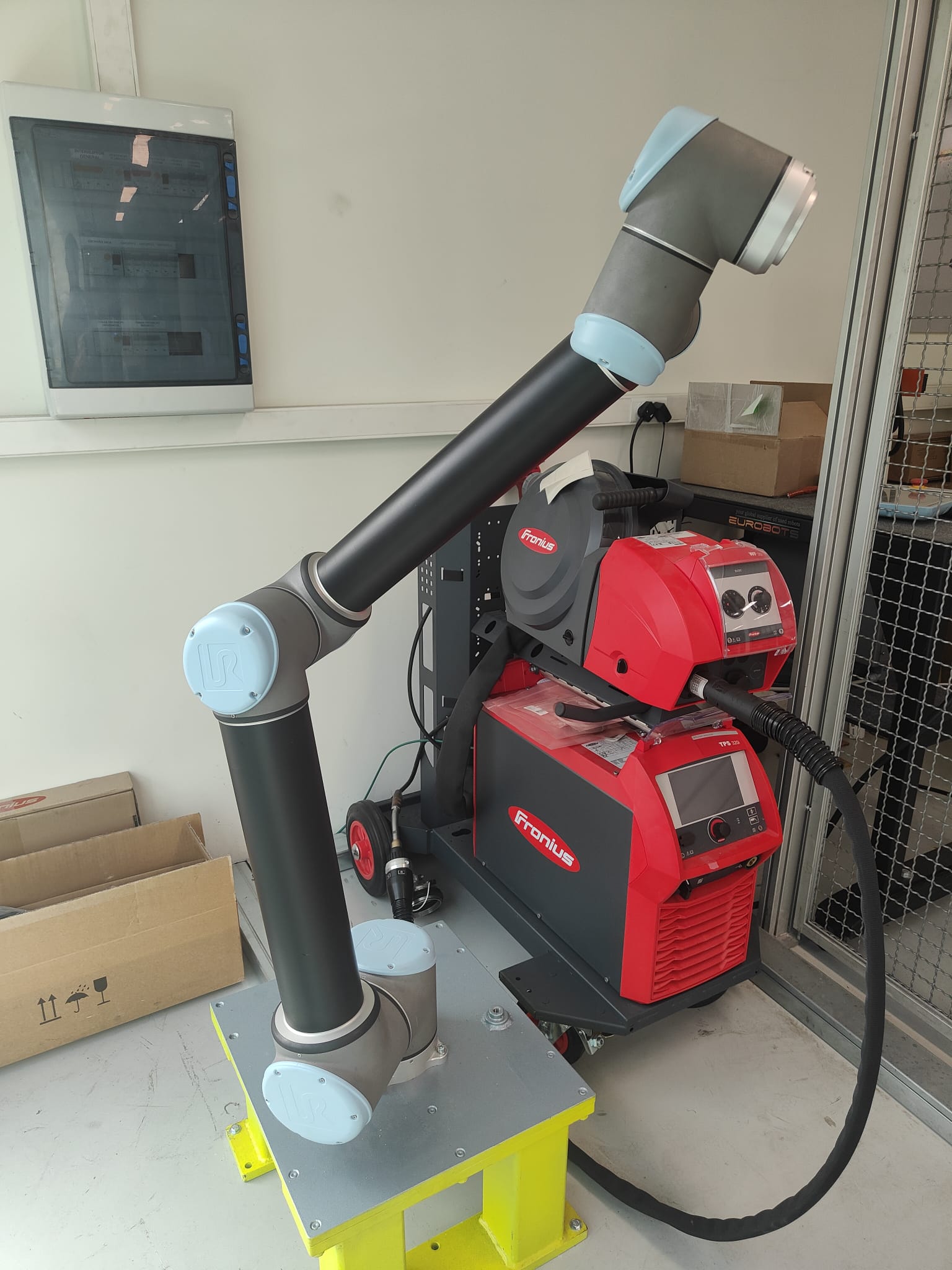
UR10 cobot painting is changing how industrial finishing operations manage quality and consistency — but it has taken until recently for the approach to be practically deployable at scale. The process requires consistent tool path and speed, sensitivity to material flow and surface geometry, and — in powder coating and spray environments — the ability to operate safely near hazardous atmospheres. For decades, these requirements made painting a process that remained largely manual even as other production steps were automated.
This article covers how UR10 cobot painting works in practice, what the verified technical specifications are, and what the documented results from industrial deployment look like. Not by replacing the painter’s expertise, but by capturing it.
UR10 Technical Specifications
The UR10 is Universal Robots’ longest-reach model in the original CB3 series. Its extended reach makes it particularly suited to finishing applications where the robot needs to cover large surface areas without repositioning the workpiece.
Verified specifications for the UR10 (CB3 series):
- Payload: 10 kg — sufficient for most spray guns and powder application tools
- Reach: 1,300 mm — covers wide surface areas without requiring rail or repositioning
- Repeatability: ±0.10 mm
- IP rating: IP54 standard
- Weight: 28.9 kg — lightweight enough for flexible installation
The UR10e (e-Series successor) improves on several of these figures: payload increases to 12.5 kg, repeatability improves to ±0.05 mm, and a built-in 6-axis force/torque sensor is added at the tool flange. For painting applications that require force-sensitive contact — polishing, sanding, or spray distance regulation — the UR10e’s integrated force sensing is a meaningful functional improvement over the base UR10.
Both variants share Universal Robots’ collaborative safety architecture, which allows them to operate alongside workers without fixed safety fencing under correctly assessed conditions. This is the property that makes them particularly suited for painting cells where a human operator needs to perform touch-ups, load parts, or adjust the application alongside the robot.
UR10 Cobot Painting in Practice: The Brandt A/S Case
The clearest documented example of UR10 cobot painting at industrial scale is Brandt A/S, a Danish manufacturer with over 60 years of experience in automotive coatings and industrial finishing. The International Federation of Robotics highlighted this application in its 2024 research into cobot deployment in finishing operations.
Brandt’s challenge was consistent with what most finishing operations face. Manual painting produces variable results. Operator technique changes with fatigue. Quality depends on who is working and how long they have been working. The finish on the last part of a shift is rarely identical to the finish on the first. For a business where surface quality is the core value proposition, that variability is a direct business risk.
The solution Brandt implemented combines three components. The first is the UR10 arm itself. The second is the Mimic module from Nordbo Robotics — a body-tracking system that records a painter’s movements with millimeter-level accuracy as they perform the task naturally. The third is a Gema powder box by G.A. Hansen, the powder application component.
The teaching process is simple. A skilled painter performs the coating task exactly as they would manually, while the Mimic system records the motion. The UR10 then replicates that recorded motion autonomously on subsequent parts. The programmer does not write robot code. The robot learns directly from the painter’s demonstrated technique.
The operational results documented at Brandt include elimination of inter-operator variability, sustained throughput across full production shifts without fatigue-related decline, and the ability to run the coating operation during night shifts and weekend periods without operator attendance. Operators who previously performed repetitive coating tasks are redirected to complex touch-up work and quality inspection — tasks that genuinely benefit from human judgment.
ATEX Zone 22 Compliance in Powder Coating Environments
Powder coating environments present a specific safety challenge. Airborne powder particles create explosive atmospheres that require equipment rated for use in classified hazardous zones. The Brandt installation operates with ATEX Zone 22 certification — the designation for areas where explosive dust atmospheres may occasionally be present under abnormal conditions.
This certification requirement is not trivial. It affects the robot, the end-of-arm tooling, the control cabinet, and all electrical components within the classified zone. Universal Robots, in combination with appropriate peripheral equipment rated for Zone 22, supports deployment in these environments. However, the full ATEX compliance of a cell must be assessed and certified for the complete installation — not assumed based on any single component’s rating.
For manufacturers evaluating robotic automation in painting, coating, or finishing environments with flammable or explosive atmospheres, ATEX or IECEx compliance must be a first-pass requirement in the cell specification, not an afterthought.
Why Cobots Work Better Than Conventional Robots for Painting
Most industrial finishing environments are not optimized for conventional robot integration. Safety fencing requires space that many finishing booths do not have. Part handling is often semi-manual, with operators loading and positioning workpieces between coating passes. Conventional robot integration requires the human to be physically separated from the robot during operation — which breaks the workflow of a mixed manual and automated finishing cell.
Cobots address this differently. Their force-limiting safety architecture allows them to operate in direct proximity to workers under correctly risk-assessed conditions. An operator can load the next part while the cobot is coating the current one, without stopping the cell. Touch-up and quality review can happen in the same space as the automated coating step.
This is particularly relevant for small and medium-sized manufacturers, where the volume may not justify a fully automated robotic painting cell but the quality and consistency benefits of automation are still real. The UR10’s deployment model does not require high production volumes to deliver a positive return. The learning-by-demonstration approach via the Mimic system eliminates the programming barrier that typically requires a specialized integrator for conventional robot painting setups.
For a broader look at what collaborative technology brings to machine and process tending applications, see our article on collaborative technology for machine tending. For context on whether a cobot is the right entry point for your automation project, see our article on cobots as an entry point for SMEs into automation.
Teleoperation: The UR10 in Remote Painting Applications
A parallel development extends the UR10’s relevance beyond standard painting cells. Integration of the UR10 with haptic teleoperation systems — notably the Inverse3 haptic controller developed by Haply Robotics — enables precise remote operation where the operator controls the robot in real time from a safe distance.
This configuration has been tested in aerospace finishing applications, including work at the Aerospace Technology Centre in Quebec. The operator applies force feedback from the controller to perform detailed coating or surface treatment tasks remotely, reducing direct exposure to chemical or hazardous environments while maintaining the tactile sensitivity that precision finishing requires.
For industries where chemical exposure, confined spaces, or hazardous atmospheres make direct operator presence problematic, teleoperated cobot finishing is a development worth tracking.
Considerations Before Implementing UR10 Cobot Painting
The Brandt case and similar deployments demonstrate that UR10 cobot painting works. However, several practical considerations need to be addressed before implementation.
Process stability is a prerequisite. The Mimic system records and replicates a painter’s technique. If the incoming parts have significant dimensional variation — different surface profiles, irregular placement on fixtures — the recorded path may not transfer cleanly to each part. Consistent part presentation is important for the repeatability of the taught path.
The coating material determines the application complexity. Powder coating with a fixed spray distance and pattern is more consistent than wet spray applications where viscosity, atomization pressure, and spray distance interact. Verify that the application characteristics of your specific process are compatible with a fixed robotic path before investing in the cell.
ATEX compliance must be addressed at cell level. A UR10 rated for Zone 22 conditions combined with non-compliant peripheral equipment does not produce a compliant cell. Work with a qualified integrator to ensure the complete installation meets the applicable hazardous area certification.
Programming approach affects adoption speed. The Mimic learning-by-demonstration approach removes the programming barrier for standard painting paths. For complex multi-surface parts or applications requiring path optimization beyond what demonstration capture provides, offline programming or path import from CAD data may be required.
For a framework on evaluating which finishing or coating process to automate first, see our article on what to know about polishing and finishing processes before integration.
FAQ
What is the payload of the UR10 cobot?
The UR10 (CB3 series) has a payload of 10 kg and a reach of 1,300 mm. The updated UR10e (e-Series) increases the payload to 12.5 kg and improves repeatability to ±0.05 mm, with the addition of a built-in force/torque sensor at the tool flange. For most industrial painting applications using standard spray guns or powder application tools, the UR10’s 10 kg payload is sufficient.
Can the UR10 cobot be used in powder coating environments?
Yes, with the appropriate ATEX-rated peripheral equipment and correct cell certification. The Brandt A/S deployment operates with ATEX Zone 22 certification. However, ATEX compliance must be assessed and certified for the complete installation — robot, controller, end-of-arm tool, and all electrical components within the classified zone — not just for the robot itself.
Does the UR10 require specialist programming for painting applications?
Not with the Mimic learning-by-demonstration approach used at Brandt A/S. A skilled painter performs the task as they would manually, and the system records the motion for robotic replication. This eliminates the need for specialist robot programmers for standard painting paths. For complex multi-surface applications or applications requiring path optimization from CAD data, specialist integration support is still required.
Is the UR10 suitable for painting applications in small and medium-sized enterprises?
Yes. Universal Robots’ design philosophy specifically targets the SME market. The UR10 does not require high production volumes to deliver a positive return. The combination of collaborative safety architecture — no mandatory safety fencing in correctly assessed conditions — and learning-by-demonstration programming makes it deployable without the infrastructure investment that conventional robot painting cells require.
What is the difference between the UR10 and the UR10e for painting applications?
The UR10e adds three meaningful improvements for finishing applications: higher payload (12.5 kg vs 10 kg), better repeatability (±0.05 mm vs ±0.10 mm), and an integrated force/torque sensor at the tool flange. The force/torque sensor is particularly relevant for applications involving surface contact — sanding, polishing, or pressure-sensitive coating — where maintaining consistent contact force matters for quality. For pure spray or powder coating applications with no surface contact, the UR10 is sufficient.
Talk to URT About Cobot Finishing Applications
At URT, we work with manufacturers evaluating collaborative robot applications in painting, finishing, coating, and related processes. We supply industrial robots and cobots — new and refurbished — and advise on which platform fits the specific application, environment, and budget.
If you are evaluating a UR10 or cobot painting application for your operation, contact URT. We will give you a direct, technical answer based on your actual production requirements.