Tag Archives: refurbished robots

What level of accuracy and repeatability can you expect from an industrial robot?

Spec sheets vs shop-floor reality On paper everything looks precise. In production you face tolerances, scrap risk, manual tweaks, and material variability. The honest question is: “Will the robot actually be more accurate than what we do today?” Accuracy vs repeatability Repeatability The robot’s ability to return to the same point over and over. Typical
Read More

WHAT LEVEL OF INTERNAL TRAINING DOES A COMPANY NEED TO AVOID FULL DEPENDENCE ON THE SUPPLIER AFTER AUTOMATING WITH INDUSTRIAL ROBOTS?

In many companies, the decision to automate is not held back by the cost of the robot or by floor space, but by a less visible—yet decisive—concern: technical dependency. The question is not always stated openly, but it quickly emerges in any investment committee: What happens when the supplier leaves? Robotic automation introduces powerful technology,

Read More

INDUSTRIAL ROBOTS VS. TRADITIONAL PALLETIZING SYSTEMS

Palletizing is one of the most critical stages at the end of the production line. Although it is often perceived as a simple process, in practice it involves occupational risks, production bottlenecks, and hidden operational costs. For many years this process has been handled using traditional systems: manual palletizing, semi‑automatic solutions, or low‑flexibility dedicated machines.

Read More

IS YOUR PROCESS TRULY READY FOR AUTOMATION WITH A REFURBISHED ROBOT?

The truth is that not every industrial task benefits from robotic automation—and even fewer are genuinely compatible with a refurbished robot. The key lies in understanding whether your process meets the fundamental technical conditions that professionals use to evaluate automation projects: aspects such as geometry, repeatability, production volume, accessibility, safety, and the overall stability of

Read More

REFURBISHED ROBOTS VS. NEW ROBOTS: WHEN TO CHOOSE EACH ONE?

In today’s industrial market, both new and refurbished robots have a legitimate and distinct role within automation strategies. Neither option is universally better; instead, each suits particular technical, operational, and financial requirements. The right decision shouldn’t be based on personal preference, but should come from a careful, comparative analysis that takes into account measurable criteria

Read More

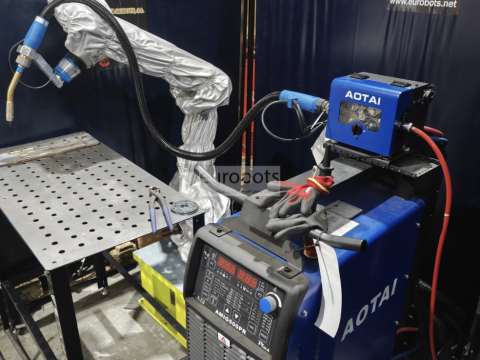
WHAT IS THE TOTAL COST OF INVESTING IN A ROBOTIC WELDING SOLUTION, INCLUDING THE ROBOT, INTEGRATION, SOFTWARE, AND TRAINING?

The total investment goes far beyond the price of the robot itself. A robotic welding cell involves a complete package that covers the industrial robot, mechanical and electrical integration, welding equipment and peripherals, software and programming, staff training, and ongoing maintenance and spare parts. The industry takes this comprehensive approach because it best reflects the

Read More

How Does URT Measure the Success of an Arc Welding Robotic Integration Project?

The effectiveness of a robotic welding integration project is determined by tangible outcomes in several crucial aspects. First and foremost, the quality of the weld bead is of utmost importance, as it directly impacts the strength, safety, and compliance with regulations. High-quality robotic welding results in fewer defects such as porosity, lack of fusion, undercut,

Read More

KUKA KR30-3 ON RAIL WITH TWO ROTARY POSITIONERS: INDUSTRIAL CHALLENGES AND ADVANTAGES FOR PRODUCTION LINES

A recent video showcases a robotic cell featuring a KUKA KR30-3 mounted on a linear rail (track) and paired with two rotary positioners as part of an advanced handling or welding solution. This configuration is gaining ground as a flexible alternative for production lines, though it is not without challenges. Eurobots, as a provider of

Read More

FANUC M-710iC/50: A Medium Payload Robot Serving Industrial Flexibility

In the world of industrial automation, medium-payload robots represent an ideal balance between strength and agility. Among them, the FANUC M-710iC/50 has established itself as a reliable solution for processes that demand precision, speed, and adaptability. Supported by URT, this model remains a competitive alternative for companies seeking to optimize their operations with a cost-effective

Read More

NEW VS REFURBISHED ROBOTS: WHEN IS EACH OPTION APPROPRIATE?

In an increasingly competitive industrial landscape, the choice between purchasing a brand-new industrial robot or opting for a refurbished one has become a crucial consideration for many manufacturing plants. This decision not only impacts the initial investment, but also factors such as ongoing maintenance, technological integration, installation speed and the overall sustainability of the project.

Read More