
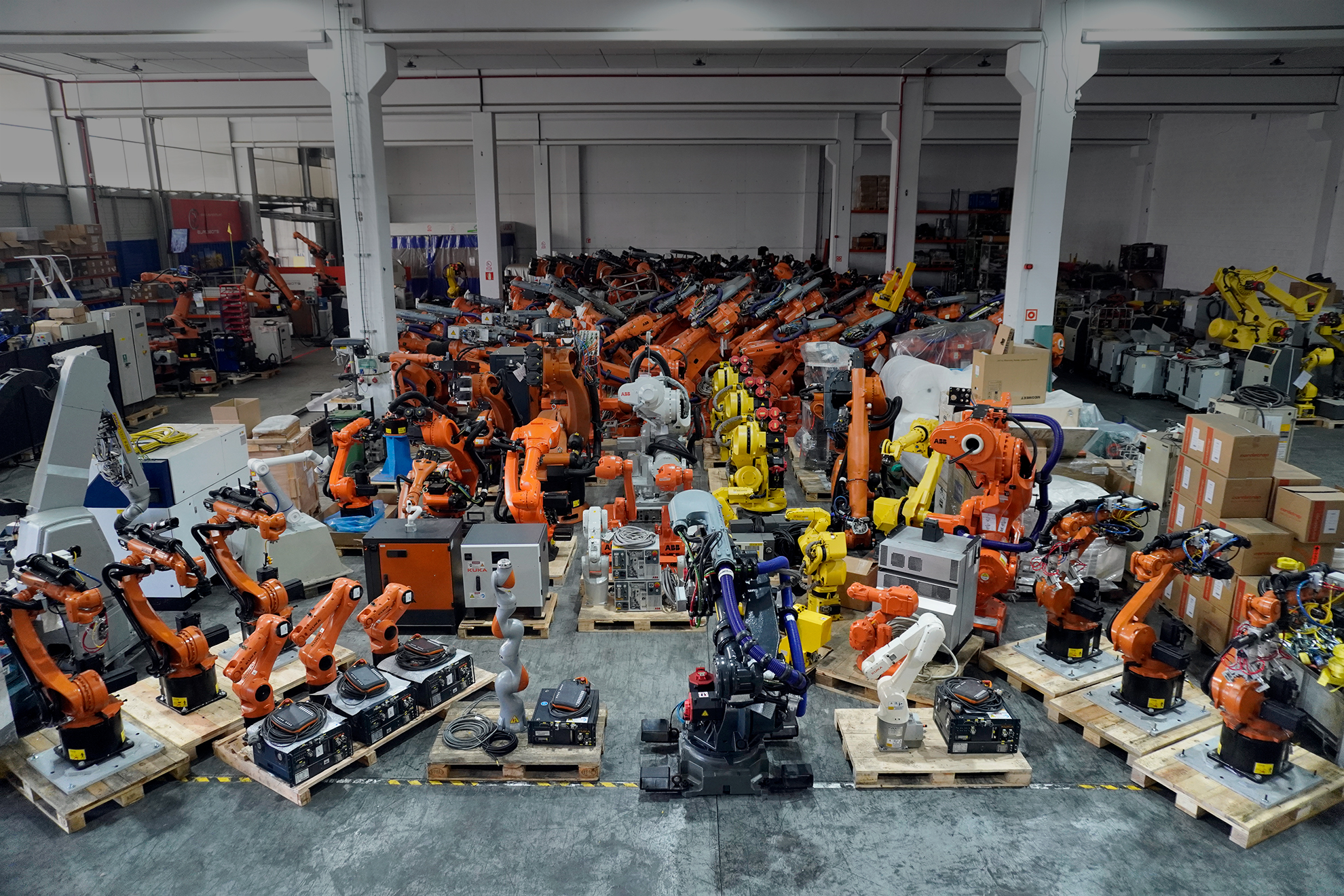
Industrial robots, like any machinery, require regular maintenance. But the key question is: do we act before a failure occurs or after it?
Predictive maintenance redefines efficiency by anticipating breakdowns and optimising resources.
Corrective: The Traditional Model
Corrective maintenance takes place after a failure: when a servomotor stops, an axis loses calibration or a controller displays an error.
Although it is straightforward, it interrupts production and increases costs due to unplanned downtime.
Predictive: The New Paradigm
Predictive maintenance combines sensors, algorithms and data analysis to detect wear before a failure occurs.
In robotics, the following are monitored:
- Vibrations in axes and gearboxes.
- Temperature in servomotors.
- Abnormal current consumption.
- Signs of deviation in accuracy or repeatability.
Tangible Advantages
- Reduction of unexpected downtime by up to 40%.
- Extension of component lifespan.
- Efficient planning of spare parts and maintenance.
- Greater operational availability of robotic cells.
Key Technologies
Modern controllers (ABB IRC5, KUKA KRC4) allow real-time data logging and transmission to predictive maintenance platforms.
Combined with remote diagnostic software, they enable technicians to detect faults without interrupting operation.
Hybrid Strategy
Many companies opt for a mixed model: scheduled preventive maintenance plus predictive monitoring for critical axes.
This reduces costs without compromising operational safety.
Switching from corrective to predictive maintenance is a leap towards Industry 4.0.
URT supports its clients in this transition, offering refurbished robots compatible with intelligent monitoring technologies.
At URT, we recognise the value this robot brings to highly demanding sectors such as electronics, and we offer solutions that enable our customers to integrate ABB technology into their production lines to achieve new levels of efficiency and competitiveness.