
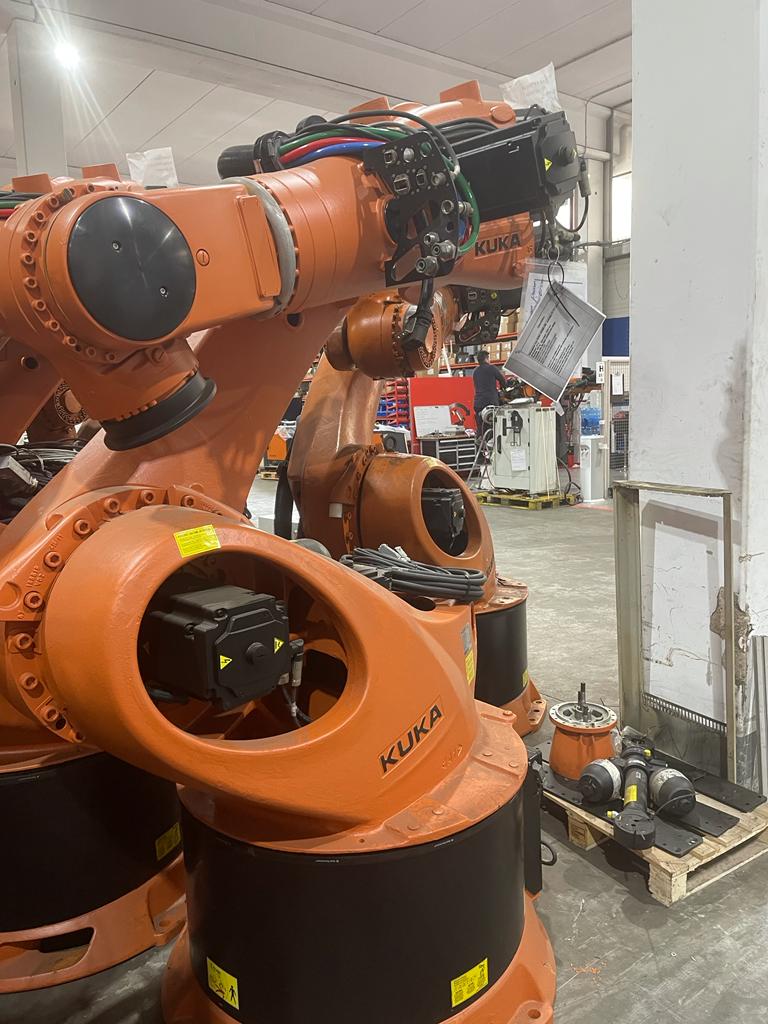
The KUKA KR 510 R3080, part of KUKA’s QUANTEC/FORTEC family, is one of the most powerful high-payload industrial robots available on the market. Designed to handle extremely large and heavy parts—with a nominal payload of around 510 kg and a reach exceeding 3 meters—it offers a combination of strength, reach, and repeatability that makes it ideal for industries with large-scale handling needs.
The capabilities of the KR 510 make it a natural choice for sectors where heavy parts are handled, or where ergonomics and human safety benefit from automation:
- Automotive and heavy bodywork: Handling car bodies, assembling large structures, and loading/unloading large presses or welding lines.
- Aerospace and aerostructures: Handling and positioning large panels, ribs, or subassemblies.
- Foundry and forging: Moving hot or heavy parts between processing stations; versions with specific protection (IP65 or Foundry variants) allow operation in harsh environments.
- Machine tool/machining: Loading and unloading parts in large machining centers, robot-assisted machining, and auxiliary operations that take advantage of its extensive reach.
- Material handling and heavy logistics: Palletizing bulky loads or transferring elements in heavy assembly plants.
Benefits of Integrating the KR 510 R3080
Incorporating a robot like the KR 510 provides clear advantages when properly adapted to an existing line:
- Increased productivity and availability — QUANTEC/FORTEC series robots are designed for high MTBF and low maintenance, which reduces downtime and improves line availability. Additionally, their digital motion modes allow performance optimization across different subprocesses.
- Load capacity and reach — By being able to handle up to ~510 kg and reach over 3 m, the need for intermediate stations, carts, or auxiliary equipment is reduced, simplifying layouts and shortening cycle times.
- Improved ergonomics and safety — Dangerous or physically demanding tasks can be delegated to the robot, reducing occupational risks and claims due to human error. Their modern controllers (KRC4 / KR C4) allow for secure integration with PLCs and vision systems.
- Process flexibility — With software and plug-ins that adjust motion modes (Performance Mode, Path Mode, etc.), the same cell can be optimized for precision tasks or high-force movements without needing different hardware.
- Return on investment (TCO) — Although the initial investment is significant, the robustness, energy efficiency, and lower maintenance costs of the QUANTEC/FORTEC range usually result in a competitive TCO in intensive applications.
KUKA documents cases where QUANTEC family robots have been used to load/unload machine tools and perform complementary machining operations, achieving significant productivity increases by utilizing machine downtime and reducing manual work in hazardous stages. One example cited by KUKA describes the implementation of a KR 500 (a related model) for loading a machining center, with notable improvements in productivity and simplified programming thanks to KUKA.CNC.
Recommendations Before Purchase (by URT)
As an authorized seller offering the guaranteed solution, Eurobots recommends that buyers:
- Conduct a process cycle study with actual time requirements and part geometry to properly size the robot and end effector.
- Evaluate variants (Foundry, Machine-Tooling) according to the working environment (temperature, dust, proximity to cutting machinery).
- Plan the electrical and communication interface with the KRC4/KR C4 controller, as it facilitates expansion with external axes, CNC, and vision solutions.
The KUKA KR 510 R3080 is a powerful solution for companies needing to move, position, or machine large and heavy parts with industrial precision. For factories looking to reduce risks, increase performance, and modernize heavy-duty processes, purchasing the KR 510—offered by URT with product warranty—represents a strategic investment. However, successful implementation requires technical planning and coordination with local integrators to adapt the production cell to the specific demands of each industry.