
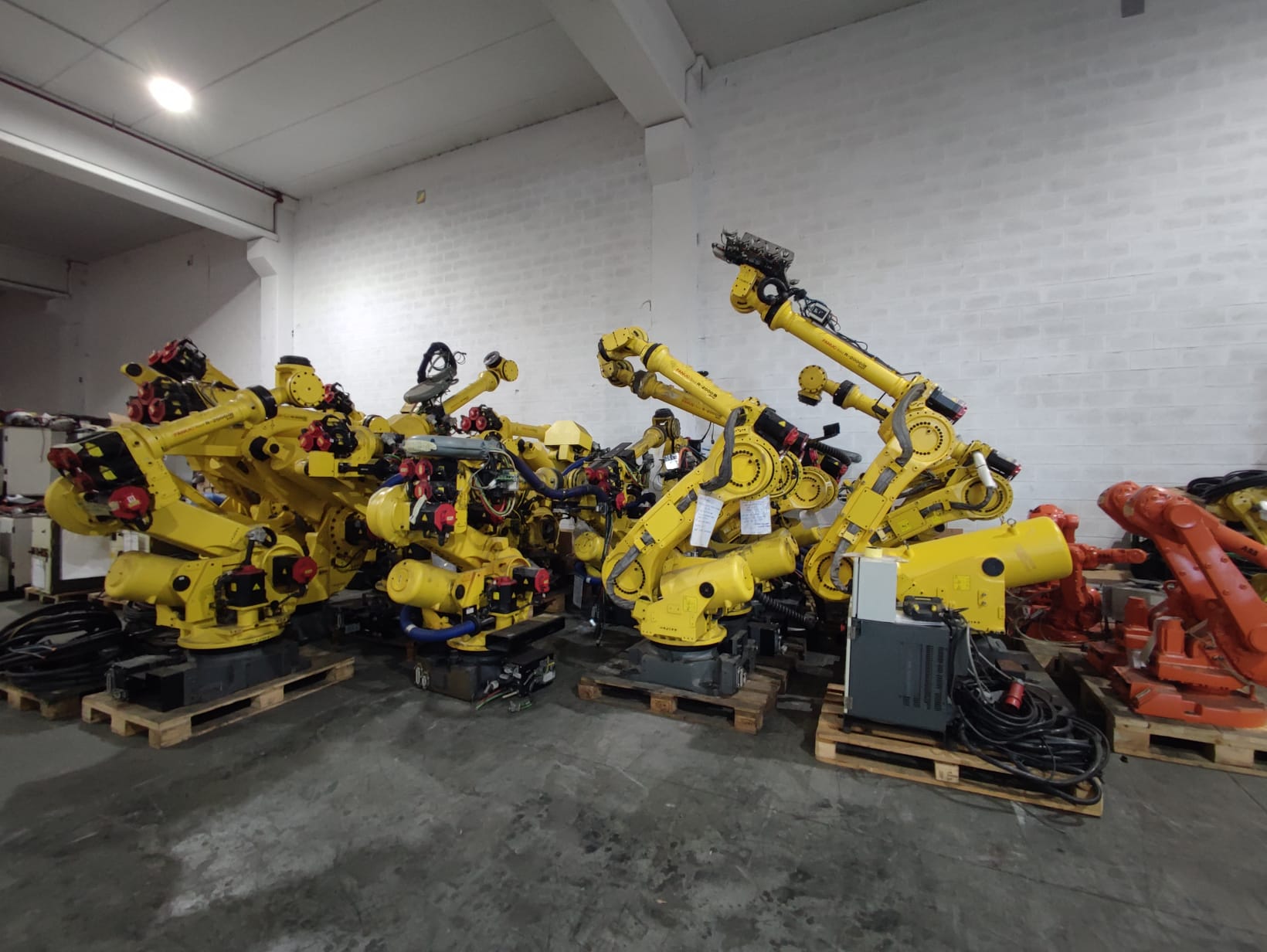
Purchasing a robot is not simply a technical decision. In reality, it is a financial one. Many companies believe that the most expensive robot is the best, or that buying new is the safest way to “avoid risks”. However, when looked at from a business perspective, with numbers and strategy in mind, the reality is quite different: what truly matters is not the purchase price, but the total cost of ownership (TCO). From this point of view, a reconditioned industrial robot is not only competitive—it is, in many cases, the smartest decision.
The TCO is the real cost of owning a robot throughout its useful life. It includes not only the purchase price, but also installation, spare parts, maintenance, energy consumption, unexpected downtime, training, integration, and residual useful life. Many companies are surprised to discover that a reconditioned robot can have a TCO up to 50% lower than a new one, while offering the same productive performance.
Why does this happen? First, a new robot comes with an initial premium due to branding, marketing and technological amortisation. A new ABB IRB 4600 or a KUKA KR 60, for example, can cost two or even three times as much as their certified reconditioned versions, even though the practical operational difference is minimal for typical industrial tasks such as welding, palletising, machining, handling or inspection.
Furthermore, a certified reconditioned robot has already overcome its initial failure curve. In other words, it has already “proven” its mechanical and electrical stability in production. During reconditioning, gearboxes are adjusted, cables and seals are replaced, lubrication is refreshed, motors are tested, and axes are calibrated with precision. The result? With appropriate preventive maintenance, it can continue working reliably for between 8 and 12 years.
Then there is the cost of time. Many factories lose money due to automation delays. A new robot can take months to deliver, especially during periods of high global demand. In contrast, reconditioned robots are available immediately. Being able to start an automation project four months earlier has a tangible financial impact, as it accelerates return on investment and reduces reliance on scarce labour.
There’s also a factor that few companies consider: reconditioned robots enable progressive scalability. Instead of buying five new robots and restructuring the entire line, a smart plant can start with a single reconditioned FANUC M-20iA or Yaskawa GP12, automate a critical operation, quickly recover the investment and reinvest. This approach reduces financial risk and allows the project to be fine-tuned step by step, without blind bets or unnecessary debt.
The TCO also depends on the ecosystem. A new robot typically requires new spare parts, mandatory support contracts and sometimes more expensive proprietary software. On the other hand, reconditioned industrial robots have access to a global spare parts market, are compatible with standard accessories (grippers, rotary tables, sensors), and many allow integration with Siemens, Rockwell, or Beckhoff PLCs without barriers.
In summary, when a plant manager, financial director or entrepreneur truly assesses the investment, the question is no longer: “New or used?”, but rather: “Which option gives me more productivity per euro invested?”. According to this metric, the certified reconditioned robot wins.
Because it’s not about spending more, it’s about investing smarter.
At URT, we help companies of all sizes reduce their TCO through intelligent automation with reconditioned ABB, KUKA, FANUC, and Yaskawa robots. Each robot is delivered tested, certified, and ready for production. We speak the language of factories: productivity, reliability, and return on investment.
If you want to compare the TCO for your next automation project, contact us at www.usedrobotstrade.com — we’ll help you invest with strategy.