
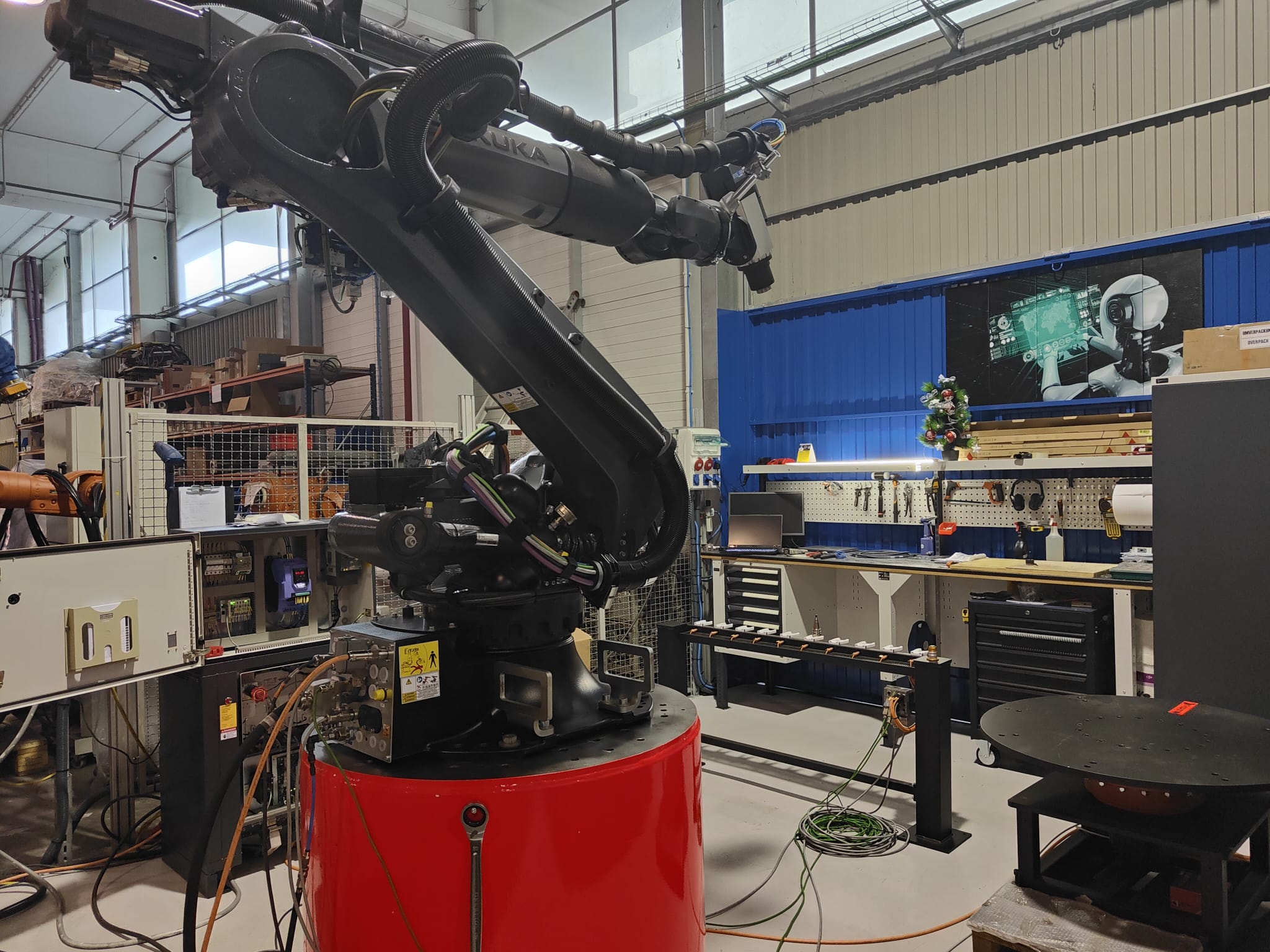
Choosing the right spindle for a robotic milling cell is not about buying “the most powerful one” and calling it a day. Several factors are involved: the application (material, tool, MRR), the rpm/torque window, the tool interface, cooling/duty‑cycle, and in robotics the weight and moments that the robot arm must withstand. If these factors are properly anticipated, the spindle will perform well and your robot will not work “at the limit.”
1) Power, Torque and Speed Range: the Basic Triangle
Power is useless without the right rpm and sufficient torque at cutting speed. The relationship is well known:
P = 2π · N · T
(P in kW, N in rps, T in N·m)
With the same power, higher rpm means lower torque; this is why for aluminium (small tool diameters, high‑speed cuts) spindles in the 24–36k rpm range are preferred, while for foams/wood medium‑high rpm work comfortably; for steels (less common in robotics due to rigidity), the limiting factor is usually torque at low rpm. This relationship and its implications are widely documented in technical machining power/torque literature.
For actual reference values, an HSD ES368 spindle offers 7–11 kW versions with 20–24k rpm and S1 torque of 5.6–8.7 N·m (up to ~10 N·m in S6 40%), suitable for composites, engineered wood and light aluminium with small cutters.
If your application requires more muscle, the HSD ES951 family reaches 25 kW, with 18–24k rpm options and higher S1/S6 torque values (e.g., 19/22.8 N·m), covering more aggressive material removal and larger diameters.
2) Tool Interface: Why HSK‑F63 Dominates Robotic Milling Cells
In robotic milling, HSK‑F63 is common: its double contact surface (cone + face) increases rigidity and improves tool‑change repeatability compared to BT/ISO steep‑taper holders, offering change accuracies around ~3 μm and suitability for high rpm. It is also compatible with ER32 collet chucks, covering a wide range of tool shank diameters.
3) Cooling and Duty Cycle: S1 vs S6
- Liquid cooling keeps temperatures stable for continuous high‑load use (S1); many HSD series (e.g., ES368) specify this in their datasheets.
- Forced air cooling is adequate for intermittent or medium‑duty cycles.
- The difference between S1 (continuous) and S6 (intermittent 40%) is critical: S6 torque/power applies only in duty cycles with thermal rest periods. Always check the model’s performance table.
4) Criteria by Material and Tooling
- Foams (PU/EPS): Medium‑high rpm and high feed with dedicated foam cutters; tooling manufacturers often suggest ~8,000 rpm for large foam bits in EPS, prioritizing large chips and low friction.
- Wood/Composites: 18–24k rpm with 6–12 mm end mills works well; limitations will come from chip evacuation and robot structural vibration (robomilling literature emphasizes vibration/stability management).
- Aluminium: Requires a balance of rpm/torque and proper tool cooling; preferable to use 24k rpm spindles with sufficient torque in the working range (refer to S1/S6 values in technical datasheets).
Practical guideline: Start from the tool (diameter and manufacturer recommendations), calculate target vc and fz, estimate MRR and required power (using P = 2πNT as a check), and verify that the spindle can deliver that torque at those rpm continuously.
5) Weight, Leverage and Robot Limits: the Most Overlooked Factor
In robotics, “motor power” alone is not enough: the mass of the spindle, toolholder, tool, and support all contribute load and generate wrist moments. A liquid‑cooled HSD ES368 weighs around ~20 kg (without holder/plate), plus the HSK‑F63 + ER32 + tool. Always check that the robot’s wrist load and moment limits (axis 6) are respected with margin.
HSD manuals also specify limits for the tool‑holder assembly mass and its center of gravity (e.g., ES7xx series specify maximum weight and the “X” distance of the CG from the nose). This data is essential to avoid vibration and protect bearings.
6) Bearing Quality, Lubrication and Runout
For fine surface finish and tool life, look for hybrid ceramic bearings (common in high‑performance series), long‑life grease lubrication and low dynamic runout. Manufacturers’ catalogues describe these options and their suitability for high rpm.
7) Lessons from Literature and Case Studies
Research in robomilling shows that the robot’s dynamics (far less rigid than a CNC) require careful attention to stability lobes and damping; selecting a spindle with stable torque delivery and a rigid tool interface helps prevent chatter. Recent studies discuss active damping and methods to suppress vibration in robotic milling.
Quick Checklist Before Buying
- Target material and tool (diameter, vc, fz) → define rpm/torque requirements.
- Verify S1/S6 curves and cooling based on your real‑world cycle.
- Choose HSK‑F63 + ER32 if you need high rigidity and quick tool changes.
- Keep total weight and CG (holder + tool) within the limits of both the robot and spindle.
- Check runout and bearing quality for your finish/tool‑life requirements.
- For foams, use dedicated parameters/tools (e.g., EPS ~8,000 rpm as a starting point, then refine).
- For demanding aluminium/composites, consider the ES951 range (higher torque).
If you need further guidance or would like to discuss the best spindle configuration for your robotic application, please feel free to contact us. We will be happy to support you and help you choose the most suitable solution for your needs.