How To Reduce Robot Programming Time In Industrial Automation

Industrial robot programming setup for reducing commissioning time

In many automation projects, the real bottleneck is not hardware selection or mechanical integration. It is robot programming. Fine adjustments, repeated trials, last-minute changes, and dependencies with PLCs, vision systems, fixtures, and operators often extend commissioning far beyond the original plan. For engineering and production managers, the practical question is not simply how to program … Read more

Industrial robots vs. traditional palletizing systems

Industrial palletizing robot stacking boxes at the end of a production line

The comparison between industrial robots and traditional palletizing systems is not a new debate — but it has become more consequential as product variability increases, labor costs rise, and safety requirements tighten. A mechanical stacker or a manual palletizing line that worked well ten years ago may be creating measurable operational costs today that are … Read more

WHAT LEVEL OF PRECISION AND REPEATABILITY CAN I EXPECT FROM AN INDUSTRIAL ROBOT?

The difference between what the technical datasheets say and what actually happens on the shop floor “On paper it’s precise… but in real production?” One of the most frequent — and most honest — questions production teams ask is this: “Will the robot really be more precise than what we do today?” It’s not a … Read more

HOW FAR CAN I SCALE PRODUCTION WITHOUT REBUILDING THE ENTIRE CELL?

It’s a question that rarely appears at the beginning of a project. It usually comes after the first success: The cell works. Cycle times are stable. Quality is consistent. And for the first time, the team trusts the system. Then someone asks: “What if we double production?” It’s not an innocent question — it’s a … Read more

IS YOUR PROCESS TRULY READY FOR AUTOMATION WITH A REFURBISHED ROBOT?

The truth is that not every industrial task benefits from robotic automation—and even fewer are genuinely compatible with a refurbished robot. The key lies in understanding whether your process meets the fundamental technical conditions that professionals use to evaluate automation projects: aspects such as geometry, repeatability, production volume, accessibility, safety, and the overall stability of … Read more

Does Automation Improve Quality Or Just Make The Same Mistake Faster?

There’s an awkward moment in some automation projects when no one really wants to look too closely at the first batches. The parts come out quickly. The robot never stops. Productivity indicators look great. And yet… something feels off. The defect that used to appear sporadically now shows up with impeccable regularity. There’s no debate: … Read more

WHAT SPECIFIC IMPROVEMENTS WOULD WE SEE IN EFFICIENCY, QUALITY, OR COSTS WITH THE INTEGRATION OF A ROBOTIC SOLUTION?

The integration of a robotic welding solution does not simply replace manual labor, but transforms the entire production process. The benefits are mainly reflected in three key areas, which are constantly monitored by the industry: production efficiency, weld quality, and operating costs per part. These improvements are recognized worldwide and proven by the actual performance … Read more

PREDICTIVE MAINTENANCE IN INDUSTRIAL ROBOTS: SENSORS, DATA AND MINIMISING DOWNTIME

At the heart of many automated factories, a group of robots works tirelessly for hundreds of hours on end. But what happens if one of these machines fails unexpectedly? An unplanned stoppage can cost thousands of euros per hour, result in lost orders and delayed deliveries. This is where predictive maintenance steps in: instead of … Read more

KUKA KR30-3 ON RAIL WITH TWO ROTARY POSITIONERS: INDUSTRIAL CHALLENGES AND ADVANTAGES FOR PRODUCTION LINES

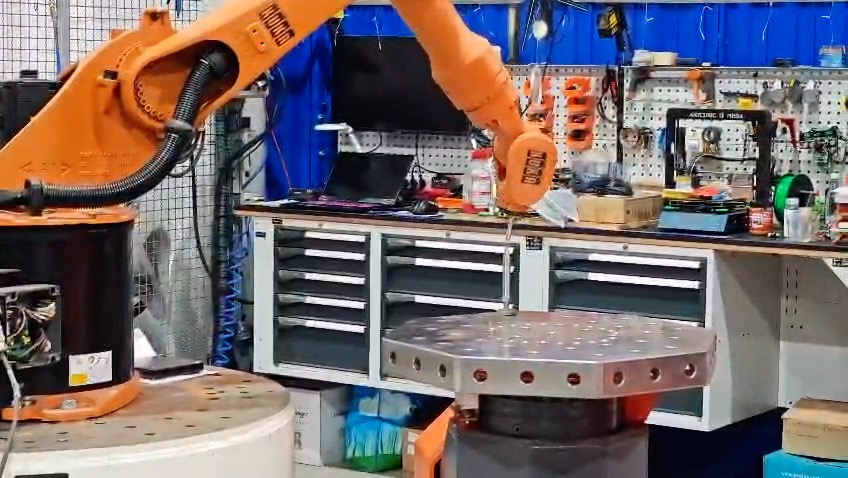
A recent video showcases a robotic cell featuring a KUKA KR30-3 mounted on a linear rail (track) and paired with two rotary positioners as part of an advanced handling or welding solution. This configuration is gaining ground as a flexible alternative for production lines, though it is not without challenges. Eurobots, as a provider of … Read more

ABB IRB 1300: precision and speed in electronic assembly

ABB IRB 1300 robot performing precision assembly in an electronics manufacturing cell

The ABB IRB 1300 is one of ABB’s most capable compact 6-axis robots for high-speed, precision applications. It is designed specifically for environments where floor space is at a premium, cycle time matters, and the application requires both speed and path accuracy — electronics assembly, machine tending, polishing, inspection, and testing. This article covers the … Read more