
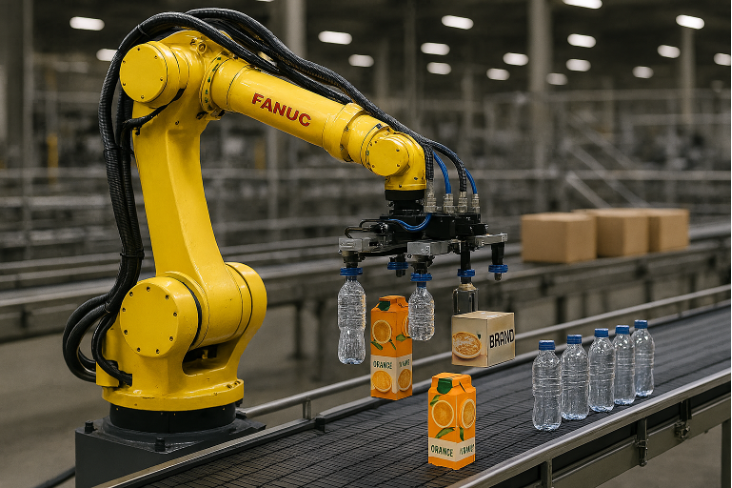
Packaging lines that handle a single format are relatively straightforward to automate. The geometry is fixed, the gripper is optimized for one product, and the cell can be tuned to run at maximum efficiency. But in food, beverage, cosmetics, and consumer goods manufacturing, single-format lines are the exception, not the rule.
Most production environments deal with bottles, trays, cartons, shrink packs, and cases — sometimes within the same shift. The question is not whether you can automate a multi-format line. You can. The question is how to structure the project so the robot actually delivers consistent performance across every format, without turning every changeover into a productivity loss.
This guide walks through the practical criteria that determine which robot type works best when format variety is a permanent feature of your operation — not an occasional exception.
The Real Problem Is Not the Number of Formats — It Is How They Change
A common mistake in multi-format automation projects is framing the challenge as a payload or reach problem. In most cases, it is neither. Standard industrial robots from ABB, FANUC, KUKA, and Yaskawa cover the payload and reach requirements of virtually every secondary packaging application. The constraint is almost always the changeover.
If your robot requires manual tool changes, reprogramming, or physical adjustments every time the packaging format changes, the line loses effective throughput during exactly those windows when flexibility was supposed to be an advantage. A robot that handles eight formats but takes forty minutes to switch between them is not a flexible asset — it is a bottleneck with a marketing label.
Before comparing robot brands or models, the analysis needs to start with four questions:
- How many format changes occur per shift, and how long does each changeover currently take?
- How do products arrive at the robot — in what orientation, from what direction, with what consistency?
- What is the handling sensitivity required for each format — rigid cases, flexible packs, fragile glass, premium-finish packaging?
- What is the realistic commercial roadmap — will marketing introduce new SKU sizes in the next two to three years?
The answers to these questions define the cell architecture before a single robot model is even evaluated.
Robot Types and What Each Does Well in Multi-Format Lines
Delta Robots
Delta robots operate at very high speeds for lightweight picking applications — typically up to 5 kg payload, with cycle times that can exceed 150 picks per minute. They excel in primary packaging pick-and-place where products arrive on a conveyor in a defined orientation and need to be transferred into trays or cartons at high throughput.
Their limitation in multi-format applications is mechanical: the workspace is fixed and relatively shallow, and switching between product geometries typically requires changing the end-effector. For lines where format changeovers are infrequent and the product is consistently lightweight, a delta robot is an efficient choice. For lines with frequent changeovers or significant weight variation across formats, it is usually not the right primary solution.
SCARA Robots
SCARA robots offer a good combination of speed and precision for medium-weight products in confined horizontal workspaces. They are well-suited for cartoning, tray loading, and secondary packaging applications where the product moves in a defined plane and the cycle time requirements are moderate.
Like delta robots, they perform best when the format range is bounded and the changeover complexity is managed through tooling design rather than reprogramming.
4-Axis Articulated Robots
For end-of-line palletizing, 4-axis articulated robots remain one of the most cost-effective configurations available. The fixed wrist eliminates the complexity of full 6-axis motion for stacking applications, reduces cycle time, and simplifies programming. Models like the FANUC M-410 series and the ABB IRB 760 are designed specifically for palletizing payloads in the 100–450 kg range and are widely used in food, beverage, and consumer goods end-of-line applications.
Their limitation is flexibility at the product level: they are optimized for layer-building patterns and are less suited for the kind of mixed-format handling that happens earlier in the packaging line.
6-Axis Articulated Robots
For multi-format lines with significant variation in product geometry, weight, and handling requirements, 6-axis articulated robots offer the most flexibility. The full range of motion allows the robot to approach products from multiple angles, adapt trajectories to different container profiles, and handle the combination of picking, orienting, and placing that multi-format lines typically require.
The trade-off is cost and programming complexity. A 6-axis cell for multi-format packaging will typically cost more upfront than a dedicated single-format solution, but when format variety is a permanent operational requirement rather than an exception, the economics usually justify it — particularly when the alternative is a manual changeover process that costs labor hours every shift.
According to the International Federation of Robotics 2024 World Robotics Report, the food and beverage industry accounted for one of the fastest-growing segments of new industrial robot installations globally, driven specifically by the need to handle increasing SKU variety without proportional increases in labor.
Why the Gripper Usually Matters More Than the Robot
In a multi-format packaging application, the end-effector — the gripper or tool mounted at the end of the robot arm — determines more of the system’s practical capability than the robot itself. A well-specified 6-axis robot with a poorly designed gripper will underperform a correctly specified 4-axis robot with an intelligent end-of-arm tool.
The main gripper categories for multi-format applications are:
- Adjustable mechanical grippers — fingers or jaws that can be repositioned or reconfigured to accommodate different product widths and depths. Suitable when format dimensions vary within a defined range and changeovers can be semi-automated.
- Vacuum systems — suction cup arrays that adapt to flat or gently curved surfaces. Effective for cartons, trays, and rigid cases, but limited on flexible packaging where surface contact is inconsistent.
- Hybrid gripping systems — combinations of mechanical contact and vacuum that allow the robot to handle both rigid and flexible formats without a full tool change. These systems add complexity and cost but significantly reduce changeover time in lines with genuinely mixed product types.
- Quick tool-change systems — standardized mechanical interfaces that allow the robot to swap between pre-configured end-effectors autonomously or with minimal manual intervention. When format variety is extreme and no single gripper can cover the range, this is often the most practical solution.
The selection of the gripper should be driven by the actual product mix and changeover frequency, not by what is standard or most commonly available. Oversizing the gripper for flexibility the line will never actually use adds cost and maintenance complexity. Undersizing it for the sake of simplicity creates exactly the format-transition problems the automation was supposed to solve.
Vision Systems: When They Add Value and When They Do Not
Machine vision is frequently proposed as a solution to multi-format variability, and in some applications it genuinely is. In others, it adds cost and complexity without a proportional benefit.
Vision systems add real value when:
- Products arrive at the robot with inconsistent or random orientation that cannot be controlled upstream
- The line handles a mix of formats where visual identification is required to route products correctly
- Quality inspection needs to be integrated into the pick-and-place cycle
Vision systems are often unnecessary when:
- Product flow is well-controlled and consistently oriented before reaching the robot
- Format changes are managed through recipe selection rather than real-time detection
- The line runs a bounded format set where positions can be pre-programmed
Adding a vision system to a line that does not need one inflates the project budget, creates an additional maintenance dependency, and introduces a potential failure point. The question to ask is not “should we add vision?” but “what specific problem does vision solve that a well-designed mechanical solution cannot?”
Designing for the Commercial Roadmap, Not Just the Current Format Mix
One of the most common sources of post-installation regret in packaging automation is a cell that was designed for the current product portfolio and immediately faced with new SKUs that the system was not built to handle.
Marketing teams introduce new packaging sizes. Retailers request format changes. Seasonal variations require temporary shifts in the product mix. A cell designed around the current state of the line with no consideration for likely evolution will require either costly redesign or manual workarounds within a few years of commissioning.
The practical approach is to design the cell around the company’s realistic commercial roadmap over a three-to-five year horizon. This means:
- Identifying the maximum and minimum product dimensions that are commercially plausible, not just currently active
- Selecting a gripper platform that can accommodate that range with tooling changes rather than full replacement
- Programming the cell with a recipe-based HMI that allows operators to call up new format configurations without engineering intervention
- Specifying a robot with payload and reach headroom above current requirements to absorb product changes without hitting mechanical limits
This is not over-engineering — it is the difference between a system that remains a productive asset for eight to ten years and one that requires significant investment again within three.
How to Avoid Over-Engineering and Protect Project ROI
Over-engineering is as common a problem in packaging automation as under-specification. It typically takes the form of:
- A robot selected for maximum theoretical payload when actual products are well within a lighter, faster, less expensive model’s capability
- Vision systems added speculatively rather than in response to a defined operational problem
- Grippers designed for extreme format flexibility that the line will rarely if ever actually require
- Safety fencing and guarding specified beyond what the risk assessment actually requires
Each of these adds to capital cost, increases commissioning time, and creates ongoing maintenance complexity. The result is a cell that is technically capable but economically suboptimal — and that operations teams often find difficult to manage without specialist support.
The discipline of right-sizing a packaging automation project comes from working backward from the operational requirement rather than forward from the technical specification. Define the throughput target, the format range, the acceptable changeover time, and the maintenance capability of the site. Then select the minimum configuration that reliably meets those requirements.
A practical tool for this process is a simple matrix that maps each active format against the key parameters: line speed, required gripper configuration, acceptable reject rate, and changeover method. When this matrix is built before equipment selection begins, it almost always reveals that the real format complexity is narrower than it first appeared — and that a simpler cell design is viable.
Where ROI Actually Comes From in Multi-Format Lines
The return on investment in multi-format packaging automation is rarely driven by labor reduction alone — particularly in lower-labor-cost environments. The primary value drivers are typically:
- Reduced format-change downtime. If a manual changeover currently takes 45 minutes and a robotic cell with a well-designed gripper and recipe-based HMI reduces that to 8 minutes, the recovered production time across three shifts and multiple changes per week represents significant additional output.
- Reduced product damage. Consistent robotic handling eliminates the variability introduced by operator fatigue, shift changes, and the inherent differences between individual workers. In premium or fragile packaging categories, this alone can justify the investment.
- Downstream consistency. A robot that builds pallets or fills cases to a consistent pattern reduces rejection rates at retail and distribution center receiving, which are often invisible costs that never appear in the production KPIs but consistently erode margin.
- Scalability without proportional labor increase. Once the cell is commissioned and proven, adding a shift or increasing throughput does not require a proportional increase in headcount. The fixed cost of the automation is spread across additional output.
For a broader framework on evaluating which packaging or production process to automate first, see our guide on which process delivers the fastest ROI when robotized.
New vs. Refurbished Robots for Packaging Applications
Multi-format packaging cells are one of the better use cases for refurbished industrial robots. The robot itself — a FANUC M-20, an ABB IRB 2600, a KUKA KR 60 — is a mature, well-understood platform. The gripper and cell design are where the project-specific engineering happens. Using a refurbished robot body and controller while investing in a properly designed end-effector and HMI is a legitimate cost optimization that many integrators and end users use to reduce project capital requirements.
The critical caveat is refurbishment quality. A robot that has been mechanically rebuilt, had its harnesses replaced, had its controller diagnostics completed, and has been calibrated and cycle-tested is a reliable foundation. A robot that has simply been cleaned and had its memory wiped is not. The price difference between the two is often less than 15% — but the operational difference over five years of production is significant.
URT sources, inspects, and supplies refurbished industrial robots specifically for applications like this. For more on evaluating refurbished equipment before committing, see our guide on how to assess refurbished robot compatibility with existing systems.
FAQ
Can the same robot handle both rigid and flexible packaging formats?
Yes, but the gripper design is the determining factor, not the robot. A 6-axis articulated robot equipped with a hybrid gripper — combining mechanical contact and vacuum — can handle both rigid cases and flexible packs. The practical question is how often the line needs to switch between them and whether the changeover can be automated through a quick tool-change system or managed manually at acceptable cost.
Is it better to use one robot for the entire line or multiple robots for different stations?
It depends on throughput requirements and the physical layout of the line. A single robot handling multiple stations introduces sequencing constraints that limit overall line speed. Multiple robots, each optimized for a specific station, allow each process step to run at its own optimal speed. The additional capital cost is often recovered through higher overall equipment effectiveness (OEE) within the first two to three years.
How many format changes per shift is a robot realistically able to handle?
With a recipe-based HMI and a well-designed gripper platform, a modern packaging robot can complete a format change in under ten minutes. In practice, this means that even lines with four or five format changes per shift can maintain acceptable OEE. The key is engineering the changeover process — gripper adjustment, pattern reprogramming, conveyor settings — into a single operator-initiated sequence rather than a series of independent manual steps.
What payload range covers most secondary packaging applications?
For pick-and-place and case-packing applications, a robot in the 10–50 kg payload range covers the majority of secondary packaging use cases. For end-of-line palletizing, payloads of 100–450 kg are typical depending on the pallet pattern and case weight. It is worth specifying with a 20–30% headroom above the maximum calculated product weight to account for gripper weight, acceleration forces, and future product changes.
Do I need a system integrator or can I buy and commission the robot directly?
For simple, single-format applications with well-defined parameters, direct purchase and commissioning with manufacturer support is feasible. For multi-format applications with custom gripper requirements, vision integration, or complex HMI programming, working with an experienced system integrator typically reduces project risk and commissioning time significantly. The integrator’s fee is usually recovered through faster time-to-production and fewer post-commissioning modifications.
Talk to URT About Your Packaging Automation Project
At URT, we work with manufacturers across food, beverage, cosmetics, and consumer goods to source and supply industrial robots for packaging and end-of-line automation — both new and refurbished, depending on the project requirements.
If your line handles multiple formats and you are evaluating whether automation makes sense, which configuration fits your production reality, or which robot models are available within your budget, contact URT. We will give you a direct, technical answer based on your actual requirements.