Can Your Process Become Collaborative Without Losing Productivity

Collaborative robotics has positioned itself as an attractive solution for many industries: promises of safety, flexibility, fast deployment, and the ability to work side by side with operators. However, on the shop floor a critical and completely legitimate question arises: How do I know if my process can truly become collaborative without sacrificing safety, production … Read more

WHAT TRAINING DOES MY STAFF REALLY NEED TO OPERATE AND MAINTAIN AN INDUSTRIAL ROBOT?

From the fear of depending on the integrator to true autonomy on the shop floor: “What if only they know how to make it work?” When an automation project is nearing its end, a silent concern often appears: “After the integrators leave, who keeps the knowledge?” It’s not a technical question. It’s a human question, … Read more

HOW TO CHOOSE THE RIGHT MILLING SPINDLE FOR ROBOTICS: DIMENSIONS, POWER AND MATERIALS

Choosing the right spindle for a robotic milling cell is not about buying “the most powerful one” and calling it a day. Several factors are involved: the application (material, tool, MRR), the rpm/torque window, the tool interface, cooling/duty‑cycle, and in robotics the weight and moments that the robot arm must withstand. If these factors are … Read more

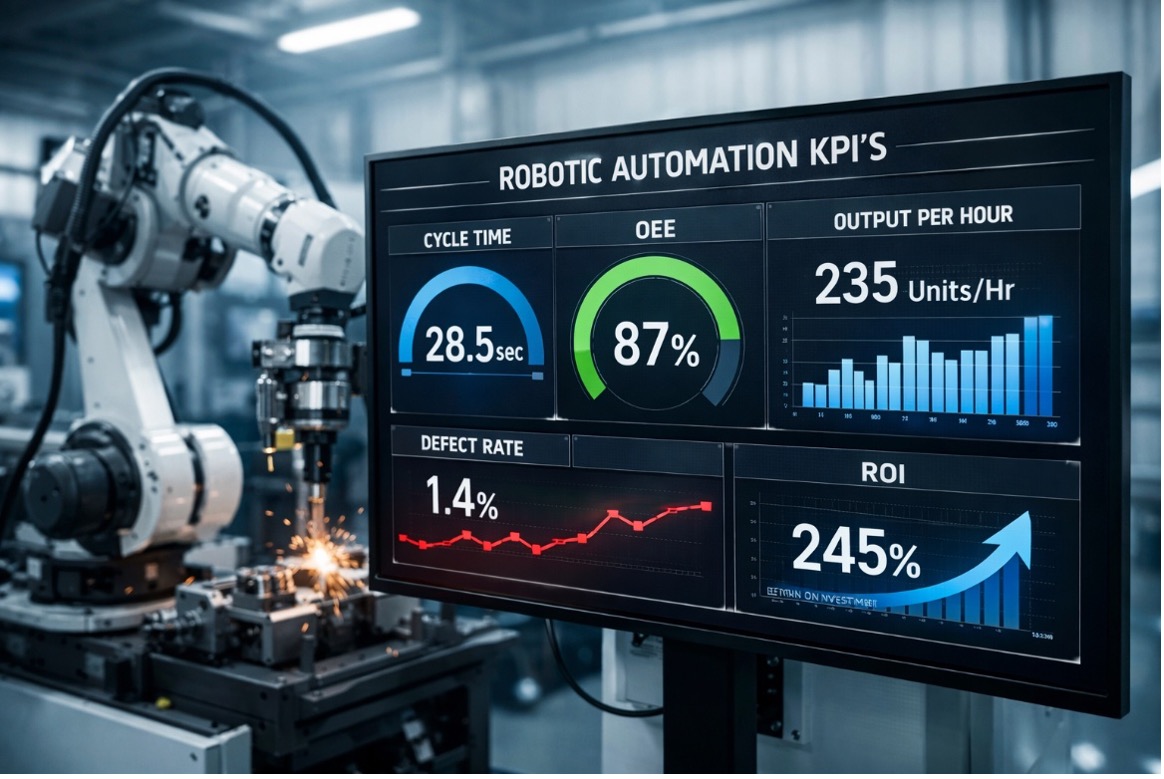
How to Calculate the Real ROI When Replacing a CNC Machine with a Robot + Spindle

Robotic milling cell with industrial robot and high-speed spindle machining a part

Replacing a CNC machine with a robotic milling cell is not a simple upgrade decision. It is a strategic one. The financial case depends heavily on which specific costs and benefits are included in the calculation — and many standard ROI comparisons leave out the variables that most often determine whether the investment makes sense. … Read more

AI IN ROBOTIC ARMS FOR DETECTING PRODUCTION FAILURES

Failure detection in production has historically relied on a combination of human inspection, statistical controls, and traditional sensors. However, the increasing complexity of processes, the pressure to reduce scrap, and the need for real-time traceability have highlighted clear limits in these approaches. In this context, a frequently asked question on the shop floor is: How … Read more

What level of accuracy and repeatability can you expect from an industrial robot?

Spec sheets vs shop-floor reality On paper everything looks precise. In production you face tolerances, scrap risk, manual tweaks, and material variability. The honest question is: “Will the robot actually be more accurate than what we do today?” Accuracy vs repeatability Repeatability The robot’s ability to return to the same point over and over. Typical … Read more

How Dependent Does My Process Become on Software Instead of Hardware?

This question rarely appears when a robot first arrives on the production floor. It emerges months later. When everything works. When the cell is producing. When nobody questions the arm, the gearbox, or the repeatability anymore. The doubt appears in front of a screen: A pending update. A license about to expire. A file that … Read more

What level of internal training does a company need to avoid full dependence on the supplier after automating with industrial robots?

In many companies, the decision to automate is not held back by the cost of the robot or by floor space, but by a less visible—yet decisive—concern: technical dependency. The question is not always stated openly, but it quickly emerges in any investment committee: What happens when the supplier leaves? Robotic automation introduces powerful technology, … Read more

Industrial robots vs. traditional palletizing systems

Industrial palletizing robot stacking boxes at the end of a production line

The comparison between industrial robots and traditional palletizing systems is not a new debate — but it has become more consequential as product variability increases, labor costs rise, and safety requirements tighten. A mechanical stacker or a manual palletizing line that worked well ten years ago may be creating measurable operational costs today that are … Read more

REFURBISHED MOBILE ROBOTS: THE NEW ERA OF FLEXIBLE AUTOMATION

Modern industry demands flexible, reconfigurable, and fast automation. Factories can no longer rely solely on fixed production lines; they need solutions that adapt in hours, not months. This need has given rise to a powerful combination: refurbished mobile robots integrated with used industrial robotic arms. This approach delivers the agility required by Industry 4.0—without the … Read more